
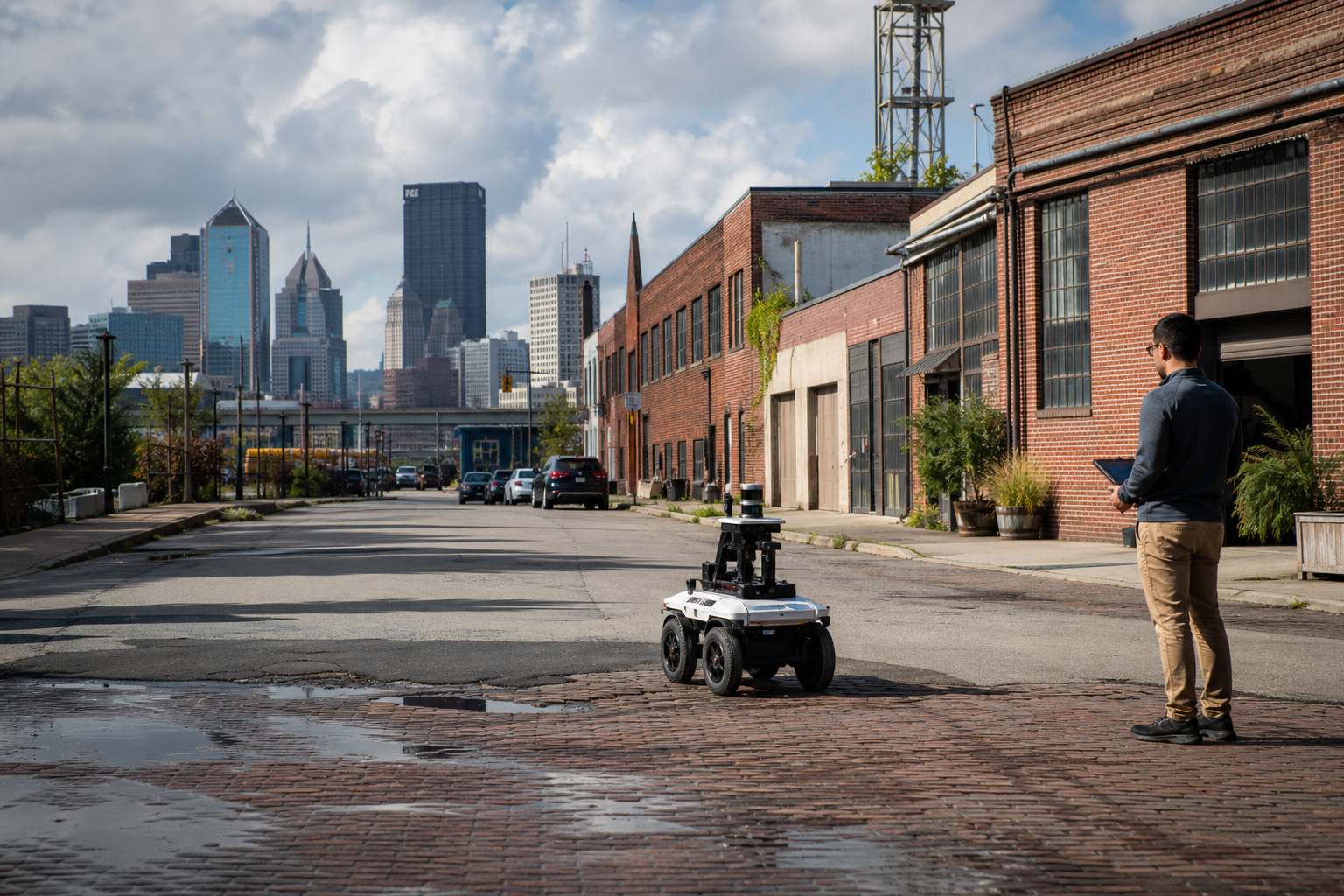
On 40th Street in Lawrenceville, the future of Pittsburgh arrived in a place that still looked like its industrial past. The National Robotics Engineering Center, or NREC, opened in 1996 inside a former steel foundry, turning a manufacturing shell into a laboratory for machines built to work in fields, mines, roads, disaster zones and other places where ordinary office technology does not belong.
That address helps explain why Pittsburgh became one of America’s most important robotics cities. The story is not simply that Carnegie Mellon University invented impressive machines, or that technology companies later rented old warehouses. Pittsburgh built a connected ecosystem: university research, industrial partners, government funding, startup companies, skilled workers, test sites and buildings large enough for robots to move through the real world.
The name Robotics Row now describes the corridor stretching through parts of Lawrenceville and the Strip District. It is a useful nickname, but the deeper story is geographic. Pittsburgh’s robotics identity grew along streets shaped by steel, freight, river commerce and heavy manufacturing—and then adapted those same spaces for autonomy and artificial intelligence.
The decision that set the course
Carnegie Mellon’s robotics story begins in 1979, when the university created the Robotics Institute with support from Westinghouse and the Office of Naval Research. The institution was unusual from the start. It treated robotics not as a narrow mechanical specialty, but as a meeting point for computer science, engineering, perception, planning and artificial intelligence.
That interdisciplinary approach mattered because a useful robot has to do more than move. It has to understand a changing environment, make decisions under uncertainty and operate safely around people, machinery or terrain. CMU’s researchers worked on intelligent manufacturing, computer vision, space exploration, medical robotics and autonomous vehicles—areas that helped define the field while keeping the work tied to practical problems.
Raj Reddy became a central figure in that early development, while roboticist Red Whittaker pushed the technology into dangerous environments. After the 1979 Three Mile Island nuclear accident, Whittaker and his colleagues developed a remote reconnaissance vehicle to help inspect hazardous areas. The lesson was distinctly Pittsburgh: robotics would not be proven in a showroom. It would be proven where conditions were difficult, dirty or dangerous.
For a city coming out of the steel collapse, that distinction carried enormous weight. Pittsburgh was losing mills, but it still possessed engineering knowledge, fabrication skills, research institutions and a culture of solving physical problems. Robotics gave those strengths a new vocabulary.
From Oakland research to Lawrenceville hardware
CMU’s campus in Oakland supplied the research base, but NREC supplied something just as important: a place where ideas could become working systems. The center was created through a partnership involving CMU, NASA, the Commonwealth of Pennsylvania, the City of Pittsburgh, regional development organizations and foundations. Its mission was to move robotics from academic research toward commercial and industrial use.
The location was strategic. NREC’s 40th Street facility offered the kind of high-bay industrial space that robotics research needs. A robot designed for agriculture, construction or mining cannot be fully evaluated on a lab table. It needs room, irregular surfaces, heavy equipment and access to people who understand how machines behave outside the university.
NREC also helped create a pipeline from research to companies. Carnegie Robotics traces its roots to that Lawrenceville environment, beginning with John Bares and a company launched in a trailer at NREC before moving into a rehabilitated steel mill. The trajectory—from trailer, to industrial building, to independent robotics business—became a local pattern.
Other companies found similar advantages in the corridor. Seegrid developed autonomous mobile robots for warehouses and manufacturing. RedZone Robotics worked on systems for inspecting underground infrastructure. Carnegie Robotics built sensing and autonomy products. Companies associated with autonomous vehicles, including Uber’s former Advanced Technologies Group, Aurora and Motional, brought large-scale attention to Pittsburgh’s ability to test and develop self-driving systems.
Why the Strip District became part of the story
Robotics Row is not one campus with a gate around it. It is a network spread across neighborhoods. Lawrenceville provided industrial buildings and the NREC anchor. The Strip District offered warehouses, riverfront access, transportation connections and a growing concentration of technology firms. The same district known for produce terminals, wholesale markets and the smell of the old industrial waterfront became a place where autonomy companies could build, recruit and test.
That overlap between old infrastructure and new technology is central to Pittsburgh’s appeal. Robotics companies need more than venture capital. They need floor space, machine shops, engineers, computer scientists, technicians and a city where the built environment still makes room for experiments. Pittsburgh’s industrial leftovers were not merely picturesque backdrops; they were usable assets.
The region also developed institutions to support applied work. The Advanced Robotics for Manufacturing Institute, based in Pittsburgh, connects robotics research with factories and workforce needs. The University of Pittsburgh contributes medical and biological expertise. CMU’s Robotics Institute continues to train researchers, and its first robotics Ph.D. program, created in 1989, helped establish a global alumni network that carries Pittsburgh methods into universities, companies and public agencies around the world.
For readers interested in the longer arc of Pittsburgh’s cultural and industrial changes, RadioPGH’s Pittsburgh listening guide offers a useful companion idea: the city’s identity is often best understood through the places where work, migration, invention and sound overlap.
The robot city keeps moving
Pittsburgh’s robotics reputation was built through field tests and long partnerships, but it is not frozen in the 1990s. On February 27, 2026, Carnegie Mellon opened its 150,000-square-foot Robotics Innovation Center in Hazelwood. The center expands the geography of the city’s robotics future beyond the traditional Robotics Row corridor, with spaces designed for land, air and water-based systems.
Hazelwood is an especially meaningful next chapter. The Robotics Innovation Center sits on land shaped by steel and industrial production, linking the region’s earlier manufacturing economy to research in robotics, artificial intelligence and advanced automation. The point is not that robots replace the steel mills one-for-one. They do not. The point is that Pittsburgh continues to reuse industrial knowledge and industrial space in ways that can support a different kind of making.
There are real tensions in that transition. A robotics boom can raise property values, reshape neighborhoods and produce highly paid jobs without automatically reaching every worker or resident. The city’s challenge is to make the ecosystem durable and broadly useful—not just a collection of laboratories and corporate offices, but a source of education, manufacturing work, public benefit and local ownership.
Still, the Pittsburgh case is unusually strong because the pieces arrived over decades. CMU supplied the research culture. Westinghouse and federal agencies supplied early confidence. NREC translated ideas into field-ready systems. Lawrenceville and the Strip District supplied adaptable industrial space. Startups and larger companies supplied commercial pressure. Pittsburgh’s engineers, fabricators and universities kept the work connected to physical reality.
That is why Robotics Row matters beyond its nickname. It is a record of how Pittsburgh learned to carry its industrial character forward without pretending the old economy could simply return. The city’s robotics identity was assembled in laboratories, former mills, warehouse corridors, university classrooms and test sites—one practical machine at a time.
RadioPGH is interested in that kind of Pittsburgh listening: the hum of a changed neighborhood, the rhythm of old work meeting new tools, and the stories hidden in places that keep reinventing themselves. For the station’s current programming, visit the RadioPGH Schedule, or Listen Live as Pittsburgh’s next chapter keeps moving through the airwaves.
The Revolution Is Live
You found the story. Now hear the station — independent Pittsburgh radio, live 24/7.
Meet RadioPGH.
Stay Tuned to Pittsburgh
New local music, RadioPGH stories, station updates, shows and events—straight to your inbox.