
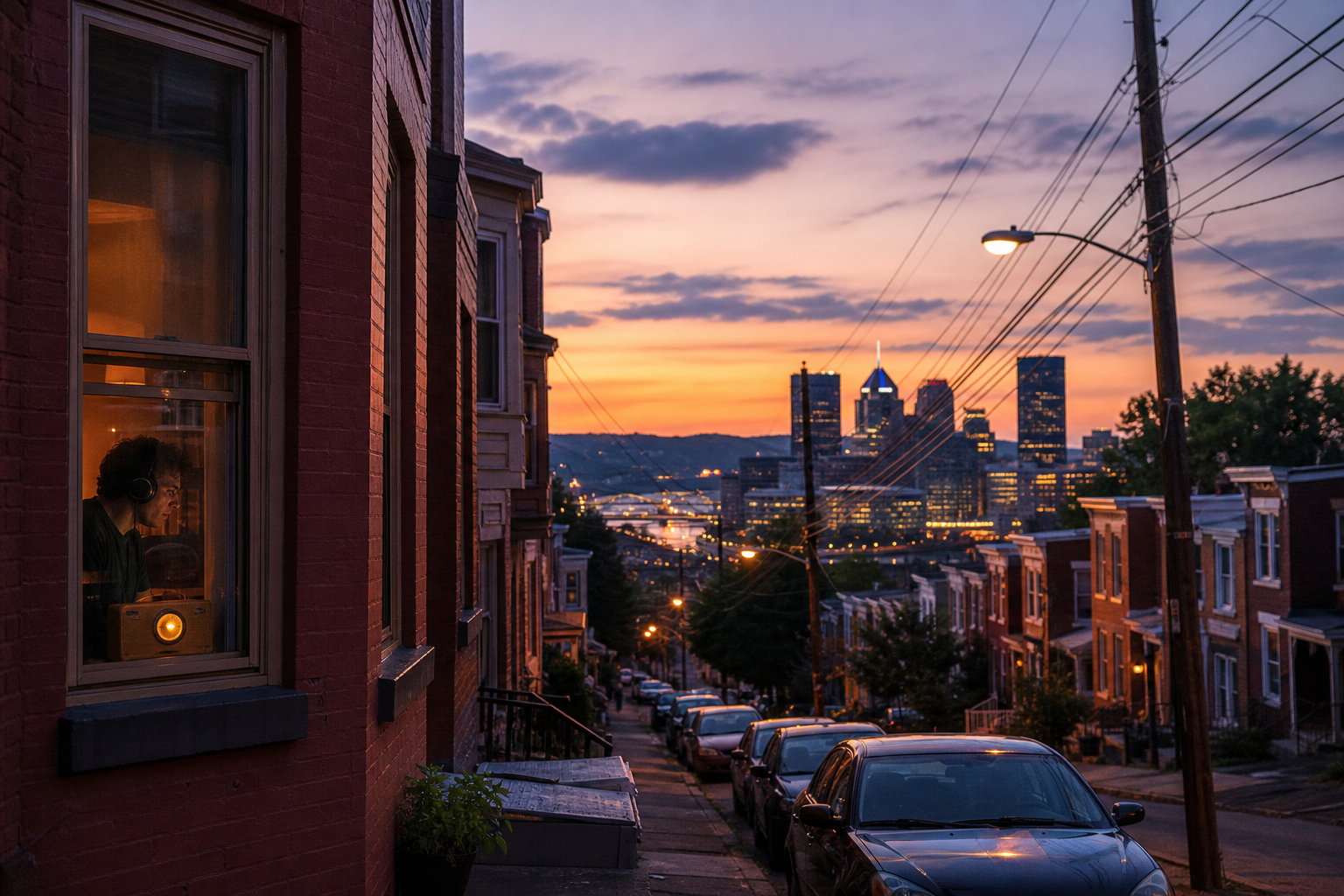
In February 2026, Pittsburgh got a very Pittsburgh kind of reminder that it still cares how Pittsburgh sounds. The television drama The Pitt put local emergency medicine on a national screen, and viewers around here immediately noticed what was missing: not enough yinz, not enough dahntahn, not enough of the vowel that turns “house” into something closer to “hahse.” The argument was not really about acting technique. It was about recognition. If a show set in Pittsburgh does not sound especially Pittsburgh, does that mean the accent is fading?
The short answer is yes, in some mouths and some settings. But “disappearing” is too simple. Pittsburghese in 2026 is less a single uniform accent than a changing collection of sounds, grammar, vocabulary, performance, and memory. The broadest version may be harder to hear among younger, mobile, college-educated, or professionally public-facing speakers. The local way of talking still survives in smaller signals: a word choice, a vowel, a sentence construction, or the instant recognition that somebody said “needs washed” without realizing it was regional.
The accent was never one volume setting
One reason the disappearance question gets slippery is that Pittsburghese has always been used unevenly. Linguists Barbara Johnstone and Scott Kiesling have treated local speech not simply as a list of funny spellings, but as part of how people construct Pittsburgh identity. Their work distinguishes between the actual speech patterns heard across Western Pennsylvania and the stylized version of Pittsburghese that appears on T-shirts, radio comedy, souvenirs, and television.
That distinction matters on a street in Brookline, at a Steelers tailgate, in an Oakland classroom, or behind a microphone. A speaker may not use the strongest local vowel all day, but still say yinz to a group of friends, call a rubber band a gumband, describe someone as nebby, or say the car needs washed. Another speaker may understand every one of those expressions but avoid them in a job interview. The accent and the dialect are related, but they are not identical, and neither is fixed.
Even the word “Pittsburghese” carries a little theater with it. It can describe a real regional variety of English, but it can also mean an exaggerated character: the cartoon Yinzer who says “Stillers,” “dahntahn,” and “n’at” in every sentence. Pittsburghers know the difference. That is why the absence of a heavy accent in The Pitt could feel both realistic and disappointing. Most actual Pittsburghers do not speak in a permanent sketch-comedy voice. They also do not speak like anonymous broadcast Americans all the time.
What is changing?
The pressures on regional accents are familiar, but Pittsburgh gives them a particular shape. People move more often, work across regional boundaries, consume the same national media, and spend more of their lives in settings where a standardized professional voice is rewarded. Pittsburgh’s universities, hospitals, technology companies, and growing service economy bring in people from outside the region while sending local residents elsewhere for school and work.
Children also learn speech primarily through interaction with peers, not by copying a parent word for word. That means a local feature can weaken even when a family remains rooted in the same neighborhood. A kid in the South Hills might hear redd up at home, national English online, and a dozen different accents at school. The result is often not a clean replacement. It is a blended local voice, with some features retained and others dropped.
Pronunciation can shift quickly. The well-known Pittsburgh vowel in words such as “down” and “house” is more geographically specific than many of the vocabulary items associated with Pittsburghese. Other features, including certain vowel mergers, occur in broader parts of the country and are changing nationally. That makes it difficult to identify a single Pittsburgh accent that is either fully alive or fully gone.
There is also a social question. Regional speech has often been associated with working-class Pittsburgh, and speakers have sometimes softened it to avoid being judged as less educated, less professional, or less mobile. A person may flatten an accent in an office and bring it right back at a family picnic in Dormont. That is not linguistic death. It is code-switching, sometimes deliberate and sometimes unconscious.
Why “yinz” may outlast the vowel
Some pieces of Pittsburghese have become more durable because they work as identity markers. Yinz is the obvious example. Its older history reaches into the speech of settlers from northern Ireland, Scotland, and northern England, but its modern Pittsburgh life is much bigger than its grammar. It has become a badge, a joke, a business name, a tourism symbol, and a way to signal belonging even for people who do not use it in every conversation.
The same is true of expressions such as redd up, nebby, slippy, and jagoff. They are not all exclusive to Pittsburgh, and some have roots across Appalachian and Midland speech. But in Pittsburgh they accumulate local meaning. The Heinz History Center’s guide to regional speech treats these words as more than punch lines: they are traces of migration, neighborhood life, work, family, and the way immigrant communities learned English from one another.
That history is important because Pittsburghese was never created by one ethnic group or one part of town. Scots-Irish and northern English influences form an early layer. German, Eastern European, African American, Appalachian, and broader Midland speech traditions all belong in the story. The sound heard around the Strip District, East Liberty, the Hill District, or the Monongahela Valley is part of a larger regional history, not a mascot detached from the people who speak it.
The microphone changes the question
Radio has always been one of the places where Pittsburghers hear themselves being represented. WESA’s explainers, KDKA’s local features, old WDVE comedy, neighborhood call-in shows, and the everyday voices moving through Pittsburgh news have helped make local speech audible as culture. A station such as RadioPGH operates in that same space, where listening is not only about the song but also about the voice introducing it, the phrase used between records, and the sound of a person who knows the difference between Squirrel Hill and S’liberty.
That does not mean every host should perform an accent. Forced Pittsburghese is easy to spot, and locals are right to be suspicious of it. The better question is whether local radio leaves room for natural regional speech: the quick “jeet yet,” the softened vowel, the neighborhood pronunciation, the words that arrive without quotation marks. On the RadioPGH Schedule, the value of a local voice is not that it imitates a stereotype. It is that it gives Pittsburgh listeners another place to hear the region speaking in its own register.
For listeners who want the broader story of how Pittsburgh hears itself, RadioPGH’s Pittsburgh Listening Guide connects the city’s musical history to its radio culture. Language belongs in that same conversation. The voice between songs is part of the soundscape, even when nobody is making a point of sounding local.
So, is Pittsburghese disappearing?
The honest answer is that the strongest traditional accent may be receding in some generations and social settings, but there is no good reason to announce its extinction. The available scholarship emphasizes variation and change, not a simple vanishing line. The public reaction to The Pitt in 2026 showed that Pittsburghers can still recognize the local sound, debate its absence, and care about what it communicates.
More likely, Pittsburghese is becoming more selective. Fewer people may carry every feature in every situation. More people may use one or two words consciously, especially when signaling humor, affection, irritation, or hometown loyalty. Some features will fade. Others will be revived, exaggerated, or given new meanings by people who grew up hearing them secondhand.
That is how accents usually survive: not as museum pieces, but as living choices. A vowel changes on Brownsville Road. A grandmother says “redd up” in a kitchen near McKeesport. A college student uses “yinz” ironically until it stops being ironic. A caller on local radio says “n’at” and nobody needs a translation. Pittsburghese is not disappearing so much as moving around—between generations, neighborhoods, workplaces, screens, and speakers.
Keep listening for those small turns of phrase. They are part of what RadioPGH is here to preserve: not a fake Pittsburgh voice, but the real, changing sound of people making music, making conversation, and making a place feel like home. Listen Live and hear what Pittsburgh sounds like right now.
Sports Porch Black & Gold
You found the story. Now hear the station — independent Pittsburgh radio, live 24/7.
More from the Republic.



Meet RadioPGH.
Stay Tuned to Pittsburgh
New local music, RadioPGH stories, station updates, shows and events—straight to your inbox.