

How Domestic Policy Shapes Urban Development: The Hidden Connection That Transforms Cities
When you walk through your city’s streets, have you ever wondered why certain neighborhoods thrive while others struggle? Why some areas boast gleaming skyscrapers and well-maintained parks while others face crumbling infrastructure and limited services? The answer often lies in something that might seem abstract but is profoundly concrete in its effects: domestic policy.
Domestic policy serves as the invisible architect of our urban landscapes, shaping everything from housing availability to transportation networks, economic opportunities to environmental quality. Understanding this relationship isn’t just academic curiosity—it’s essential for anyone who wants to comprehend why cities develop the way they do and how they might evolve in the future.
Understanding the Foundation: What Is Domestic Policy in Urban Context?
Domestic policy encompasses the government’s decisions and actions regarding internal affairs, covering areas like housing, transportation, education, healthcare, and economic development. In the urban context, these policies become the building blocks that determine how cities grow, function, and serve their residents.
Think of domestic policy as a city’s DNA. Just as genetic code influences how an organism develops, policy decisions made at federal, state, and local levels influence how urban areas take shape. These policies don’t work in isolation—they interact, sometimes harmoniously and sometimes in conflict, creating complex patterns of urban development that can persist for decades.
The relationship between policy and urban development is particularly fascinating because it’s both intentional and unintentional. While some policies explicitly target urban growth patterns, others create urban consequences as side effects of broader national priorities.
Housing Policy: The Cornerstone of Urban Growth Patterns
Perhaps no domestic policy area has a more direct impact on urban development than housing policy. From the Federal Housing Administration’s loan programs of the 1930s to contemporary affordable housing initiatives, these policies have literally shaped the physical form of American cities.
The suburban boom of the post-World War II era wasn’t just a cultural phenomenon—it was largely driven by federal housing policies that made suburban homeownership more accessible than urban living. The GI Bill, FHA loans, and highway construction programs worked together to encourage outward urban expansion, creating the sprawling metropolitan areas we know today.
More recently, inclusionary zoning policies have attempted to address housing affordability by requiring developers to include affordable units in new projects. These policies directly influence where different income groups can live within cities, affecting everything from school demographics to local business patterns.
Rent control policies present another fascinating example of how housing policy shapes urban development. While intended to maintain affordability, these policies often create complex market dynamics that influence building maintenance, new construction patterns, and neighborhood gentrification processes.
Transportation Infrastructure: The Arteries of Urban Life
Transportation policy might be even more transformative than housing policy in its urban development impacts. The Interstate Highway System, launched in the 1950s, didn’t just connect cities—it fundamentally restructured them. Highways enabled suburban development while sometimes dividing existing urban neighborhoods, creating patterns of development and disinvestment that persist today.
Public transportation policies have equally profound effects. Cities that invest heavily in rail systems, like Washington D.C. or San Francisco, see concentrated development around transit stations. This transit-oriented development creates denser, more walkable neighborhoods that contrast sharply with car-dependent suburban areas.
The recent trend toward complete streets policies—which design roads for pedestrians, cyclists, and public transit users, not just cars—is already beginning to reshape urban neighborhoods. These policies encourage mixed-use development and can transform commercial corridors from auto-oriented strips into vibrant community centers.
Even parking policies have surprising urban development impacts. Cities that require abundant parking create different development patterns than those that limit parking or charge market rates for street parking. These seemingly minor policy decisions influence building design, land use intensity, and local business viability.
Economic Development Policies: Driving Urban Transformation
Economic development policies often serve as powerful engines of urban change. Tax increment financing districts can concentrate public investment in specific areas, spurring redevelopment that might not otherwise occur. Enterprise zones and opportunity zones use tax incentives to encourage business investment in targeted neighborhoods.
Industrial policy decisions have historically shaped entire urban regions. The decline of manufacturing in the Rust Belt wasn’t just an economic phenomenon—it was partly driven by trade policies and federal priorities that favored other sectors. Similarly, the growth of technology centers in cities like Austin and Seattle reflects both local policies and federal investments in research and development.
Small business policies also influence urban development patterns. Cities that streamline permitting processes and provide business support services often see more diverse, locally-owned commercial districts. These policies can help maintain neighborhood character while supporting economic vitality.
Minimum wage policies present an interesting case study in unintended urban consequences. While primarily designed to improve worker welfare, these policies can influence business location decisions, potentially affecting which neighborhoods attract certain types of employment and commercial activity.
Environmental Regulations: Green Policies, Urban Outcomes
Environmental policies increasingly shape urban development in both obvious and subtle ways. Clean air regulations influence industrial location decisions, potentially pushing polluting facilities away from dense urban areas. Water quality regulations affect development costs and feasibility in different areas.
Green building standards and energy efficiency requirements change construction costs and building design, influencing what gets built where. LEED certification programs and similar initiatives have created markets for sustainable development that didn’t exist a generation ago.
Climate change adaptation policies are beginning to influence development patterns in flood-prone areas, coastal regions, and areas susceptible to extreme weather. These policies may increasingly direct development away from vulnerable areas and toward more resilient locations.
Urban agriculture policies and green space requirements affect neighborhood livability and property values. Cities that mandate parkland dedication or allow urban farming create different development patterns than those focused purely on maximizing building density.
Social Services and Education: The Quality of Life Factor
Social service policies profoundly influence urban development by affecting neighborhood desirability and resident stability. School funding formulas determine educational quality, which in turn influences residential location decisions for families. Areas with well-funded schools often see increased housing demand and development pressure.
Healthcare policy affects urban development through facility location decisions and accessibility requirements. The placement of hospitals, clinics, and specialized care facilities influences surrounding development patterns and can anchor neighborhood revitalization efforts.
Public safety policies and policing strategies affect neighborhood stability and investment patterns. Areas perceived as safe attract more private investment and development, while those with persistent crime problems may struggle to attract capital for improvement projects.
Social housing policies determine where low-income residents can live within cities. Whether these policies concentrate affordable housing in specific areas or distribute it throughout metropolitan regions has profound implications for urban development patterns and social equity.
Technology and Innovation Policies: Shaping Tomorrow’s Cities
Emerging technology policies are beginning to influence urban development in new ways. Smart city initiatives affect infrastructure investment priorities and can influence which neighborhoods receive upgraded services first. Broadband access policies determine which areas can attract knowledge-based businesses and remote workers.
Autonomous vehicle policies will likely reshape urban development patterns in the coming decades. If self-driving cars reduce the need for parking, cities could see dramatic changes in land use patterns. If they make longer commutes more tolerable, they might encourage further suburban sprawl.
E-commerce and delivery policies affect retail development patterns. Cities that accommodate delivery vehicles and package storage needs may see different commercial development patterns than those that don’t adapt to changing retail logistics.
The Ripple Effects: How Policy Decisions Create Long-Term Urban Patterns
One of the most fascinating aspects of domestic policy’s impact on urban development is how decisions made decades ago continue to influence cities today. The redlining practices of the 1930s and 1940s, while officially ended, created investment patterns that still affect neighborhood development today.
Urban renewal policies of the 1950s and 1960s cleared entire neighborhoods, creating vacant land that in some cases remained undeveloped for decades. The highways built through urban areas during this period continue to shape development patterns and neighborhood connectivity.
These historical examples remind us that today’s policy decisions will influence urban development for generations to come. The affordable housing policies we implement now, the transportation investments we make, and the environmental standards we establish will shape cities well into the future.
Understanding these long-term impacts is crucial for policymakers who want to create positive urban development outcomes. It’s also important for residents who want to understand why their cities look and function the way they do.
Looking Forward: Policy Challenges and Opportunities
As cities face new challenges like climate change, technological disruption, and changing demographics, domestic policy will continue to play a crucial role in shaping urban development. The policies we choose today regarding remote work, climate adaptation, and technological infrastructure will determine what our cities look like in the coming decades.
The COVID-19 pandemic has already begun to influence urban development through policies affecting commercial real estate, residential location preferences, and public space usage. These policy responses may have lasting effects on urban form and function.
Future urban development will likely be shaped by policies addressing artificial intelligence, renewable energy, and social equity. Cities that proactively develop policies in these areas may see different development patterns than those that react to changes after they occur.
The key is recognizing that domestic policy and urban development are inextricably linked. Every policy decision, from seemingly mundane zoning changes to major federal initiatives, has the potential to influence how cities grow and change. By understanding these connections, we can make more informed decisions about the policies we support and the urban futures we want to create.
Frequently Asked Questions
How do federal policies affect local urban development?
Federal policies influence local urban development through funding programs, regulations, and incentives. For example, federal transportation funding shapes local infrastructure decisions, while federal housing programs affect local housing markets. Federal environmental regulations also influence local development patterns and costs.
Can local policies override federal urban development impacts?
Local policies can modify but rarely completely override federal impacts. Local zoning, for instance, can direct where federally-subsidized housing gets built, but can’t eliminate federal housing programs entirely. Local policies work best when they align with and leverage federal programs rather than fighting against them.
What are the most impactful domestic policies for urban development?
Housing policy, transportation infrastructure investment, and zoning regulations tend to have the most direct impact on urban development. Tax policies, environmental regulations, and education funding also significantly influence development patterns, though sometimes less visibly.
How long does it take for policy changes to affect urban development?
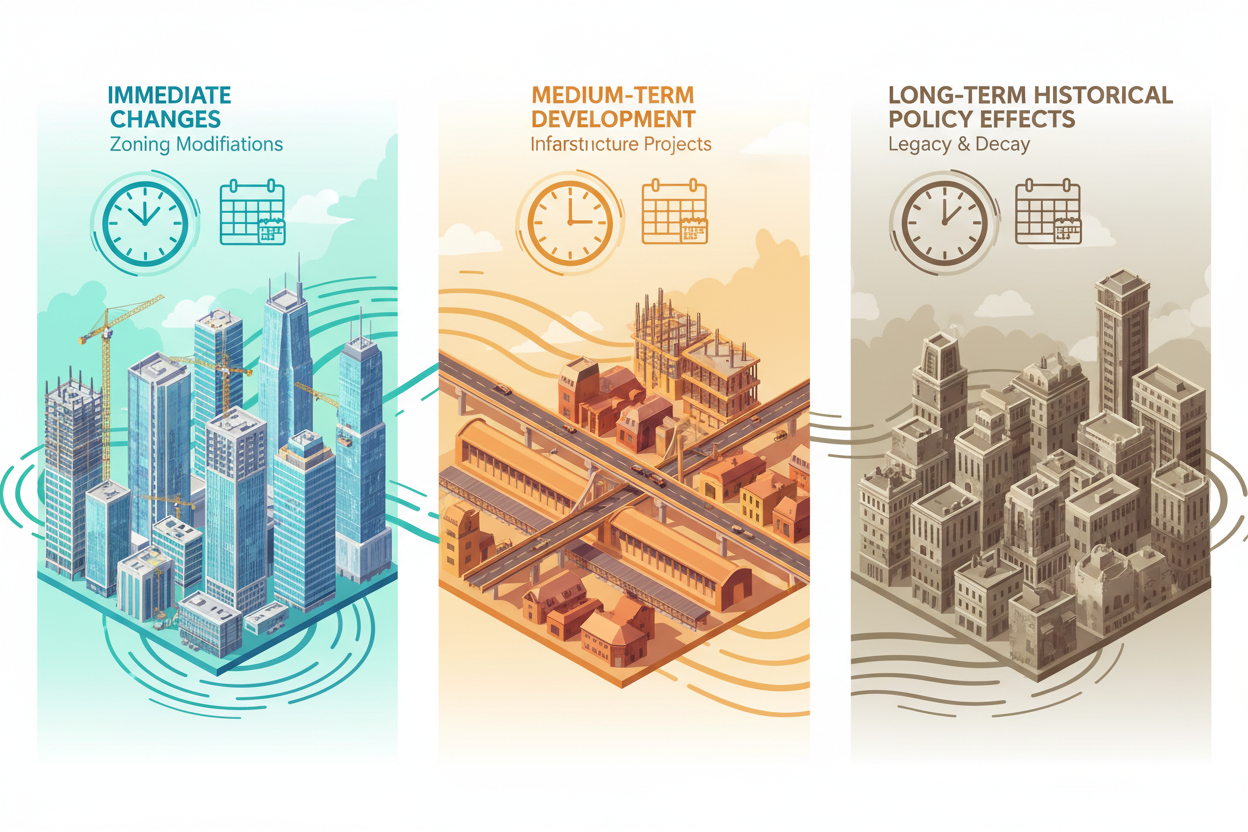
Policy impacts on urban development can occur immediately or take decades to manifest. Zoning changes might affect development within months, while major infrastructure investments may take years to complete and additional years to influence surrounding development patterns. Some policy effects, like those from historical redlining, persist for generations.
Do all cities respond to domestic policies in the same way?
No, cities respond differently to domestic policies based on their existing infrastructure, demographics, geography, and local political culture. A transportation policy that spurs development in one city might have minimal impact in another due to different local conditions and complementary policies.
How can residents influence domestic policies that affect urban development?
Residents can influence these policies through voting, attending city council meetings, participating in public comment periods for development projects, joining neighborhood associations, and contacting elected representatives. Many urban development policies are decided at the local level where individual voices can have significant impact.