
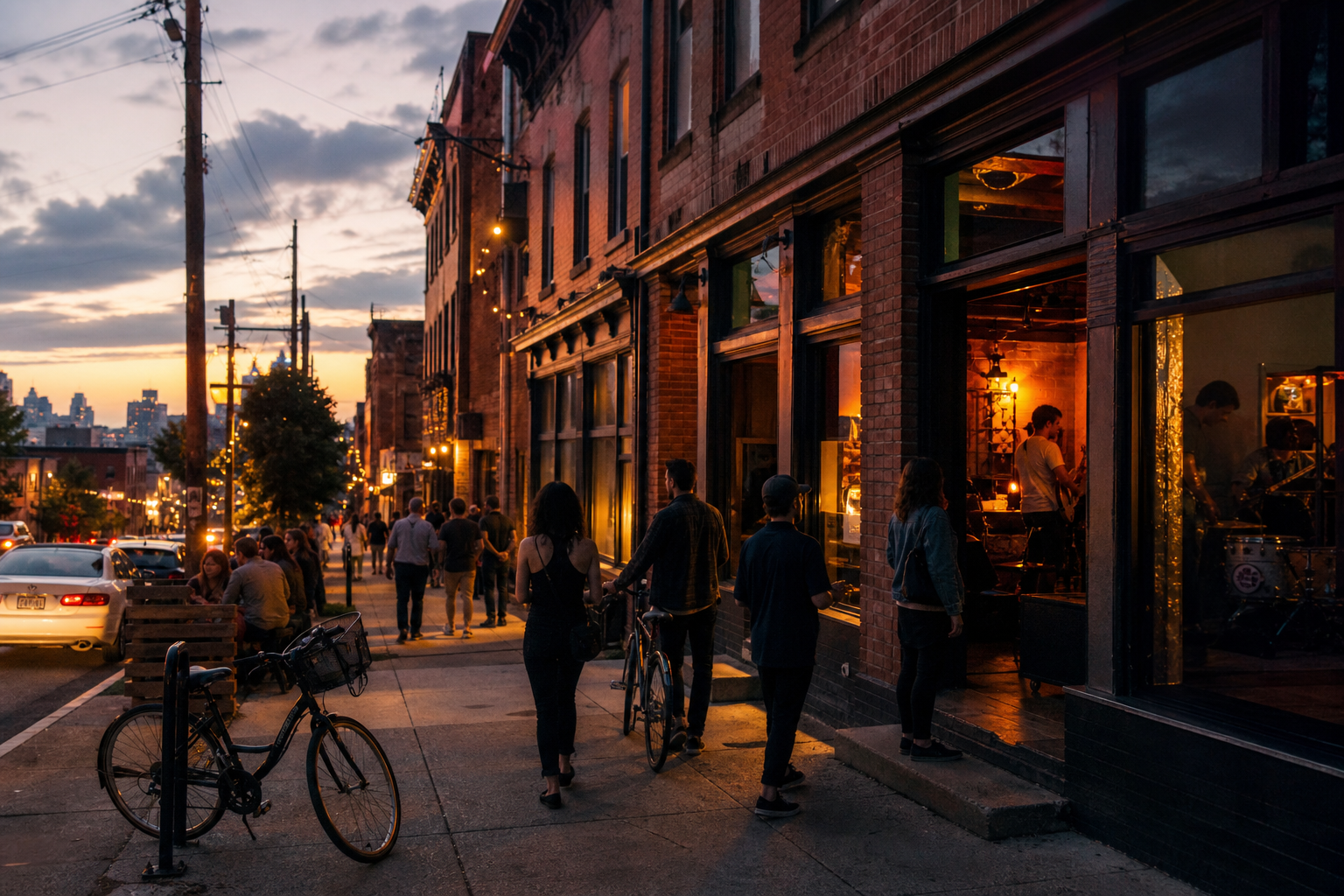
On Saturday, August 29, Lawrenceville is offering two very different versions of a Pittsburgh night before the clock even gets close to midnight. At Thunderbird Music Hall on Butler Street, the South Hills School of Rock is scheduled for an all-ages afternoon show, followed later by Rep Your Flag, an Afro-Caribbean party. A few blocks away, Spirit is spreading its Summer Recess event across both floors, the garden, and the rooftop. At SideQuest on 44th Street, the night belongs to a dance event with a late-running kitchen.
That collision of formats is the clearest way to understand Lawrenceville’s changing live-music and nightlife scene. The neighborhood is no longer organized around one kind of bar, one kind of audience, or even one definition of a concert. It is becoming a layered nighttime district where touring bands, local collectives, DJs, school-of-rock students, dance parties, pinball players, diners, and people simply looking for somewhere open after 10 p.m. overlap.
Butler Street still carries the signal
Lawrenceville’s transformation has been visible for years along Butler Street, the commercial spine that runs past old row houses, former industrial buildings, restaurants, bars, and the entrances to several of the neighborhood’s most recognizable venues. But the current shift is less about a sudden boom than about what kinds of places are able to keep operating and what kinds of nights they can support.
Thunderbird Music Hall remains the neighborhood’s most obvious traditional concert anchor. Its calendar shows the room working across scale and style: all-ages performances, touring indie and roots acts, heavier bills, benefit events, and late-night parties. The venue’s own history reaches back to Michalski’s Café, a neighborhood bar that received a Pittsburgh liquor license in 1933. Under John Pergal’s ownership, the former Thunderbird Café became a dedicated music room, eventually growing into a 520-capacity venue that filled a useful middle space in Pittsburgh’s concert map.
That middle space matters. Pittsburgh has large rooms such as Stage AE and, soon, Citizens Live at The Wylie in the Hill District, but a city’s musical health is also measured by whether emerging acts can play a room that feels substantial without requiring arena-level demand. Thunderbird gives touring artists a stop between the club circuit and the larger theater, while giving local musicians a place where a serious bill can still feel close to the floor.
Spirit made the night bigger than the show
Spirit pushed Lawrenceville’s venue model in another direction. The former Moose Lodge at 242 51st Street became a three-level, 15,000-square-foot combination of music venue, restaurant, event space, rooftop garden bar, and community gathering place. Its significance is not just that it added another stage. Spirit made it possible to build an entire evening around a show without treating dinner, drinks, dancing, and music as separate errands.
Its current calendar makes that strategy plain. One night can bring a DJ party in the Lodge, a talk or community event in the Hall, a rooftop afternoon, or a larger outdoor program that uses multiple parts of the building. Spirit has also been central to Pittsburgh’s party culture beyond guitar music. Slappers N Bangers, the hip-hop and R&B dance party founded in 2015, began there before growing into a major regional event. That history helps explain why Lawrenceville’s nightlife cannot be reduced to the old distinction between “live music” and “club night.” In this neighborhood, a DJ-led party can function as a concert, a social institution, and a launchpad for local artists.
For a broader look at how Pittsburgh’s rooms, radio signals, and neighborhood scenes connect, RadioPGH’s A Pittsburgh Listening Guide puts Lawrenceville’s role in a longer citywide story.
The newer layer: late kitchens, DJs, and flexible rooms
SideQuest gives the neighborhood’s current evolution its most direct example. Located at 146 44th Street, it describes itself as an independent bar, kitchen, and music venue. Its booking model pairs Pittsburgh collectives with touring DJs, while its kitchen stays open late. The distinction is important: SideQuest is not asking customers to choose between a restaurant and a venue. The food is part of the nightlife infrastructure.
That approach reflects how people actually move through Lawrenceville now. A night may begin with food, turn into a ticketed show, continue at a DJ set, and end with coffee rather than another round. In June, Afters Cafe opened a second location at 4316 Butler Street, extending the neighborhood’s after-hours options with a shop open until 10 p.m. It is not a music venue, but it belongs in the nightlife conversation because it changes what “staying out” can mean. Lawrenceville is increasingly supporting the post-show pause: somewhere to sit, talk, regroup, or wait for the bus without treating the night as over the moment the speakers shut off.
The Goldmark represents another part of the change. Since 2015, the DJ-owned and operated bar at 4517 Butler Street has centered Pittsburgh’s DJ community, with format-specific nights during the week and open-format sets on Fridays and Saturdays. That is a different kind of local music institution from Thunderbird, but no less important. The Goldmark treats selectors, dance floors, and recurring nightlife communities as the main event rather than as background programming.
And then there is Remedy, the long-running dive bar at 5121 Butler Street. Its mix of cheap drinks, pinball, karaoke, punk and metal shows, and underground electronic nights keeps a rougher, less polished version of Lawrenceville nightlife in circulation. That matters in a district where new development and higher rents can make every storefront feel more curated. Remedy’s value is partly musical and partly social: it remains a place where a band can be loud, a crowd can be strange, and the room does not need to explain itself.
What has disappeared—and what that pressure reveals
The neighborhood’s current strength should not obscure its losses. Hambones, a longtime Lawrenceville bar and music venue, closed in the years after the pandemic. Cattivo, another Lawrenceville music room, closed in September 2024. Across the region, the Original Pittsburgh Winery announced that it would close in August 2026, citing changing audience habits and the difficult economics facing independent music venues. These closures are reminders that a busy-looking corridor does not automatically produce stable conditions for live music.
Independent venues carry unusual costs: staffing, sound, security, insurance, licensing, ticketing fees, and the challenge of filling a room on a weeknight when audiences are watching their budgets. Pittsburgh’s 5% amusement tax adds pressure to ticketed events. A successful Saturday can keep a room visible, but it does not necessarily make the business durable.
That is why Lawrenceville’s hybrid venues are so consequential. Spirit has food and multiple spaces. SideQuest has a late kitchen. Remedy has pinball and inexpensive drinks. The Goldmark builds around resident DJs and repeat nights. Thunderbird balances a substantial concert calendar with a neighborhood-cafe identity. Each is trying, in its own way, to create more than one reason to come through the door.
The neighborhood is changing around the venues, too
Lawrenceville’s nightlife is also operating inside a fast-changing physical neighborhood. Lawrenceville Corporation currently lists major residential projects under construction or moving through approval, including developments at Butler and McCandless, 39th and Foster, and 51st Street. More residents can support more businesses, but new housing also raises familiar questions about rent, noise, parking, pedestrian safety, and who gets to remain part of the neighborhood’s cultural life.
Those questions are not abstract for music venues. A late-night district depends on neighbors who can tolerate activity, visitors who can arrive without turning every block into a parking dispute, and businesses that can afford to keep their doors open. Lawrenceville United and Lawrenceville Corporation’s community planning work—including Butler Street design guidelines and ongoing development meetings—matters because the nightlife economy is tied directly to land use. A music room is not an isolated entertainment box; it is part of a block, a transit pattern, and a residential community.
For listeners, the practical lesson is simple: do not wait for a major announcement to notice where Pittsburgh’s music culture is moving. Check the RadioPGH Schedule, watch the calendars at Thunderbird, Spirit, SideQuest, The Goldmark, and Remedy, and pay attention to the smaller recurring nights that build audiences over time. The most important Lawrenceville shows may not be the ones with the biggest names. They may be the ones teaching a room what it can become.
Lawrenceville’s nightlife is changing because the neighborhood is learning to hold several scenes at once. The old Butler Street bar crawl has not vanished, but it now shares the block with concert rooms, rooftop gatherings, dance parties, all-ages programming, late coffee, and independent spaces trying to survive on flexibility. That is a more complicated ecosystem—and, for RadioPGH, a more interesting one to listen to.
When the night is still moving and you want the next sound without another drive across town, Listen Live to RadioPGH and let Lawrenceville’s changing frequency meet you where you are.
The Revolution Is Live
You found the story. Now hear the station — independent Pittsburgh radio, live 24/7.
Meet RadioPGH.
Stay Tuned to Pittsburgh
New local music, RadioPGH stories, station updates, shows and events—straight to your inbox.