
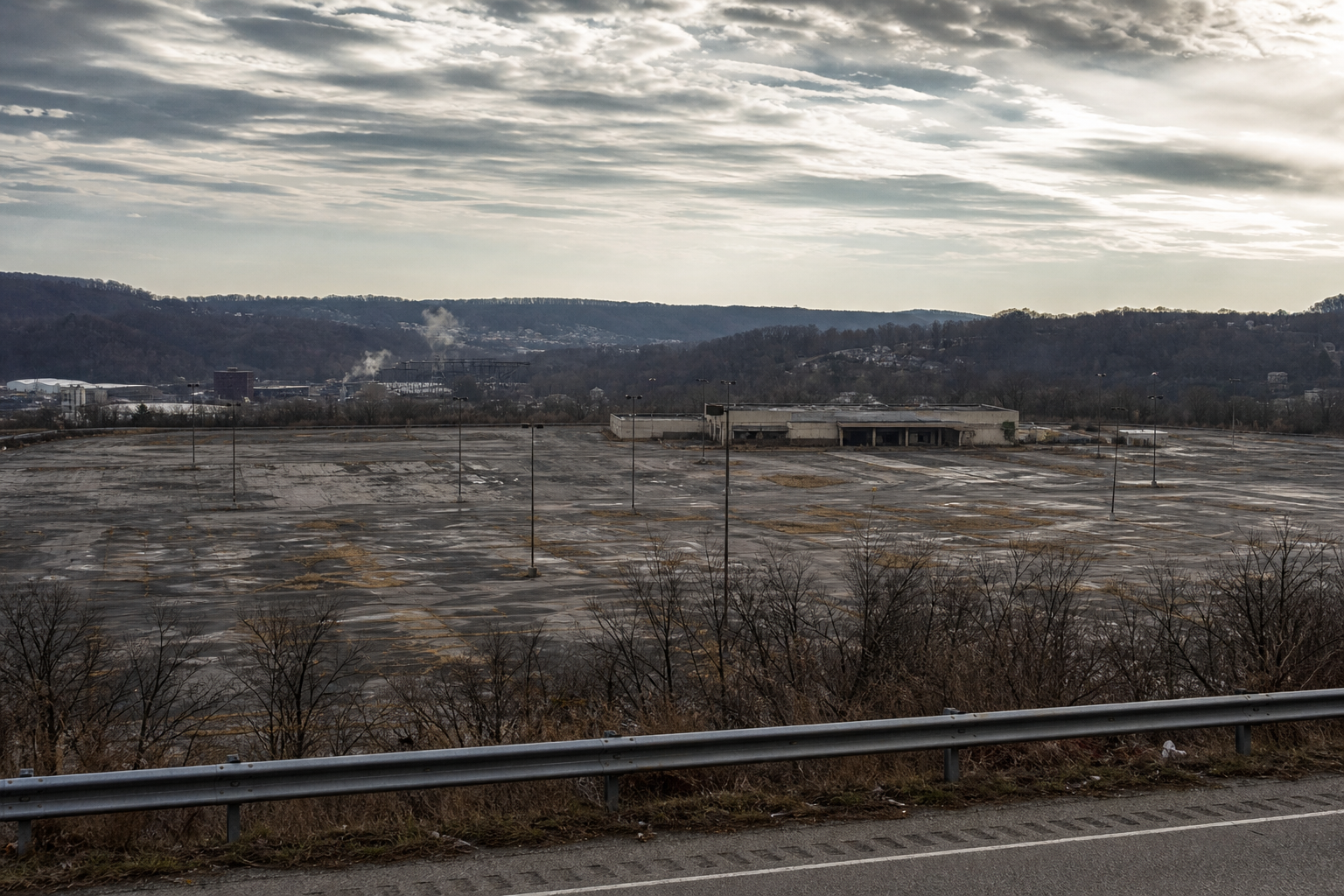
Before it became a fenced-off demolition site, Century III Mall was one of the places Pittsburghers used to measure time. You went to West Mifflin for school clothes, Christmas presents, a movie, a food-court lunch, or simply because somebody in the family had a reason to make the drive down Route 51. For a generation of South Hills families, the mall was not just a retail address. It was where errands became afternoons.
Now, in September 2026, the mall is nearly gone. Demolition has been moving through the former 1.3-million-square-foot complex, leaving behind debris, altered sightlines and a large question mark about what comes next. But the physical disappearance has made the memory of Century III feel sharper. Pittsburghers are not only remembering stores. They are remembering the version of themselves who stood beneath those ceilings.
That is the strange Pittsburgh afterlife of Century III: a place built as a symbol of the future, abandoned as a warning about the future, and preserved in local imagination as folklore.
A retail monument on a slag heap
Century III opened in West Mifflin in 1979, built across a huge former industrial landscape near Clairton Road and Route 51. Its name pointed toward the country’s bicentennial era and the idea that the region was entering a new century of prosperity. The mall’s scale made that ambition visible. It covered roughly 63 acres, offered thousands of parking spaces and was promoted as one of the largest shopping centers in the world.
The setting mattered. This was not a mall dropped into an anonymous suburb. It rose in a borough shaped by steel, coal, rail lines and the Monongahela Valley’s industrial economy. The shopping center’s construction on slag deposits connected two Pittsburgh realities: the old landscape of mills and furnaces, and the new landscape of enclosed retail, escalators and climate-controlled leisure.
Inside, the anchors gave the place its social map. There was a two-story Kaufmann’s, the Pittsburgh department-store institution that turned shopping into a family ritual, along with Sears and JCPenney. People did not always say they were going to Century III Mall. They said they were going to Kaufmann’s, or Penney’s, or Sears, and everybody understood the larger destination.
The mall’s scale also made it a useful meeting point for a wide territory. Families came from West Mifflin, Pleasant Hills, Jefferson Hills, South Park, Clairton and the Mon Valley. A trip from farther out could become an event. The parking lot felt enormous; the corridors seemed designed to make a child believe the building might never end.
The mall as Pittsburgh ritual
Century III’s strongest memories are specific and ordinary. They live in the smell of the food court, the long walk from the car, the search for a particular entrance and the argument over where to eat. They live in holiday displays and department-store windows, in shopping bags carried through winter weather, and in the particular excitement of being allowed to wander a few steps ahead of your parents.
Former Kaufmann’s employees have described the elaborate Christmas displays that transformed parts of the store into miniature seasonal worlds. That detail helps explain why the mall remains emotionally durable. Retail spaces are often dismissed as interchangeable, but the people who decorated them, worked there and returned every December made them personal. A display assembled by hand could become part of somebody’s family calendar.
For teenagers, Century III served a different purpose. The mall was a public interior: warm in winter, cool in summer, and large enough to offer a little independence without requiring a trip downtown. It could be a place to kill time, run into classmates, buy a record or shirt, and practice the social choreography of growing up.
That is why the mall’s story cannot be reduced to retail economics. South Hills Village and The Mall at Robinson offered other shopping choices. Kennywood offered rides. Monroeville Mall carried its own movie history and pop-cultural mythology. But Century III belonged to a particular Route 51 orbit. Its identity was tied to the neighborhoods and river towns that fed into West Mifflin, and to the feeling that the South Hills had built its own downtown under one roof.
From destination to dead mall
The decline did not happen in one dramatic afternoon. It arrived through changing shopping habits, competition from newer centers, store closures, ownership problems and years of deferred maintenance. Moonbeam Capital Investments acquired the property in 2013 with promises of revitalization, but the mall’s condition continued to deteriorate. By the late 2010s, the old confidence had been replaced by empty storefronts, dark corridors and the uneasy feeling that the building was being left behind in real time.
One image captured that reversal better than a financial report: the lonely Easter Bunny photographed in 2018, sitting on a throne in a nearly empty mall. The picture circulated widely because it was funny, sad and instantly legible. Everyone understood the mismatch between the bright costume and the abandoned setting. It looked like a holiday tradition waiting for the people who no longer came.
Century III closed permanently in 2019, although JCPenney remained open longer than much of the complex and finally closed in October 2020. After that, the mall became a different kind of destination. Urban explorers, videographers and dead-mall enthusiasts documented its decay. YouTube tours drew large audiences. Graffiti, broken glass, water damage, mold and fire damage turned the former shopping center into a dangerous ruin, but also into an object of fascination for people who had never experienced its crowded years.
The contrast was especially powerful for younger Pittsburghers. Someone who remembered Christmas at Kaufmann’s saw the building as a lost public room. Someone raised after the closure saw only a forbidden shell with escalators leading nowhere. Both versions were true. Century III had become a place where generations could compare what they remembered with what they inherited.
Why the ruin became folklore
Pittsburgh has always been good at turning vanished places into shared reference points. We keep the names of closed mills, demolished stadiums, former department stores and old clubs alive in conversation. Century III fits that tradition because it combines civic ambition, consumer memory and physical collapse in one enormous object.
The mall also carries the region’s complicated class geography. It was designed as a major commercial center for a broad suburban and industrial population, but its later decline became entangled with judgments about who still shopped there and what kinds of public behavior people associated with the building. Those memories are not always comfortable, and they should not be polished into a simple story about a better past. Nostalgia can preserve warmth while also hiding the inequalities and changing economic realities around it.
Still, the affection is real. People remember the building because it gave them a shared setting. They remember first jobs, first dates, holiday errands, school trips, awkward teenage afternoons and family members who are no longer here. The mall’s architecture was generic by design, but the lives inside it were not.
That is also why preservation conversations around Century III were meaningful even after the building became unsafe. The Young Preservationists Association included the mall on a 2021 list of historic sites, not because every piece of the structure deserved to remain untouched, but because recent history can carry cultural weight. The Senator John Heinz History Center understands this broader archival problem: photographs, advertisements and ordinary objects can document how Western Pennsylvanians lived, worked and gathered.
What comes after the last wall?
West Mifflin officials eventually condemned the mall as a public nuisance, and demolition began in 2024 after years of legal and maintenance disputes. The borough’s current planning documents identify the property as a major redevelopment opportunity, alongside other underused and industrially shaped land. As of September 4, 2026, the site’s next chapter is still taking shape. The mall is almost physically absent, but the questions it represented remain: What should replace a regional gathering place? Who gets to decide what counts as useful? And how can redevelopment acknowledge the community memories attached to a site?
Those questions matter beyond West Mifflin. Across the Pittsburgh region, malls and commercial strips are being asked to become housing, medical space, logistics centers, offices or mixed-use districts. Century III’s story is a reminder that these properties are never only square footage. They are where people learned the geography of their own lives.
For RadioPGH, that is the part worth holding onto. Pittsburgh music and Pittsburgh listening are built from the same kind of memory: the place where a song first found you, the radio playing in the car on Route 51, the local voice that made an ordinary afternoon feel specific. You can explore more of those connections through Pittsburgh Stories & Takes, check the RadioPGH Schedule for what is playing, or Listen Live while you remember the places that made the region sound like itself.
The Revolution Is Live
You found the story. Now hear the station — independent Pittsburgh radio, live 24/7.
More from the Republic.
Meet RadioPGH.
Stay Tuned to Pittsburgh
New local music, RadioPGH stories, station updates, shows and events—straight to your inbox.