

The Future of Tech: Innovations to Watch in the Next Decade
Remember when smartphones seemed like something out of a sci-fi movie? Now we can’t imagine life without them. Technology has this incredible way of sneaking up on us, transforming from impossible dreams into everyday necessities faster than we ever thought possible. As we stand on the brink of another technological revolution, the next decade promises to bring innovations that will fundamentally reshape how we live, work, and interact with the world around us.
The pace of technological advancement isn’t just accelerating—it’s reaching a crescendo that will define the next chapter of human civilization. From artificial intelligence that rivals human cognition to quantum computers that could solve humanity’s greatest challenges, we’re about to witness breakthroughs that seemed purely theoretical just a few years ago. Let’s explore the groundbreaking technologies that will dominate the next ten years and change everything we thought we knew about what’s possible.

Artificial Intelligence and Machine Learning Revolution
The AI revolution isn’t coming—it’s already here, and it’s about to get exponentially more powerful. While we’ve seen impressive demonstrations with chatbots and image generators, the next decade will bring AI systems that can truly think, reason, and create in ways that mirror human intelligence. We’re talking about artificial general intelligence (AGI) that could emerge within the next five to seven years, fundamentally changing every industry on Earth.
Machine learning algorithms are becoming so sophisticated that they’re starting to discover patterns and solutions that human researchers never considered. In healthcare, AI will revolutionize drug discovery, potentially reducing the time to develop new medications from decades to mere years. Imagine AI systems that can analyze millions of molecular combinations simultaneously, predicting which compounds will treat diseases we haven’t even fully understood yet.
The workplace transformation will be equally dramatic. AI won’t just automate repetitive tasks—it will become our collaborative partner, handling complex analysis while humans focus on creativity, strategy, and emotional intelligence. By 2034, we’ll likely see AI assistants that understand context so well they can manage entire projects, coordinate teams, and make decisions that would have required senior management approval just years earlier.
Quantum Computing Breakthroughs
Quantum computing represents perhaps the most mind-bending technological leap we’ll witness in the next decade. While today’s quantum computers are impressive but limited, the 2030s will bring quantum systems powerful enough to solve problems that would take classical computers millions of years to crack. This isn’t just an incremental improvement—it’s a complete paradigm shift in computational capability.
The implications are staggering. Quantum computers will revolutionize cryptography, potentially making current security systems obsolete while enabling new forms of ultra-secure communication. Financial modeling will become incredibly precise, allowing for risk assessments and market predictions that could prevent economic crises before they begin.
Perhaps most exciting is quantum computing’s potential in scientific research. These machines will simulate molecular interactions with perfect accuracy, accelerating breakthroughs in materials science, climate modeling, and pharmaceutical development. We’re talking about designing new materials atom by atom, creating substances with properties that don’t exist in nature but could solve everything from energy storage to space exploration challenges.
Extended Reality: The Metaverse Becomes Reality
Virtual and augmented reality technologies are finally reaching the tipping point where they’ll become as common as smartphones. The next decade will see the emergence of truly immersive extended reality (XR) experiences that blend physical and digital worlds so seamlessly that the boundaries become meaningless.
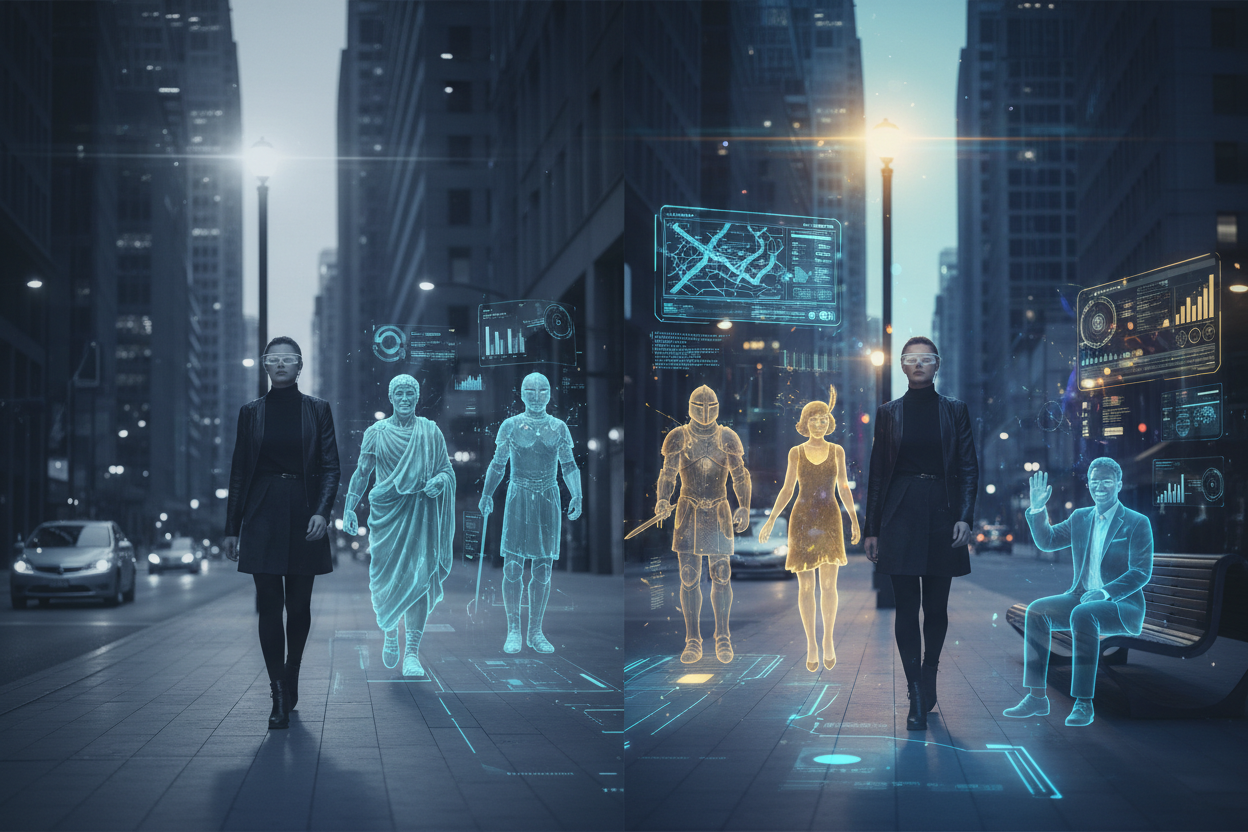
Forget bulky headsets and awkward controllers. By 2034, we’ll have lightweight AR glasses that overlay digital information onto the real world with stunning clarity. Imagine walking through a city where historical events play out in front of you, or having a conversation with a colleague who appears to be sitting across from you but is actually on another continent. The technology will be so natural that we’ll wonder how we ever functioned without it.
The professional applications are equally transformative. Surgeons will operate with AI-guided overlays showing exactly where to make incisions. Engineers will collaborate on 3D designs that they can walk through and manipulate with their hands. Students will explore ancient Rome or the inside of a human cell as if they were actually there. Remote work will become so immersive that physical offices might become obsolete for many industries.
Biotechnology and Genetic Engineering Advances
The next decade will mark the golden age of biotechnology, with genetic engineering tools becoming so precise and accessible that we’ll routinely edit genes to treat diseases, enhance crops, and even extend human lifespan. CRISPR technology, already revolutionary, will be joined by even more sophisticated gene-editing tools that can make changes with surgical precision.
Personalized medicine will become the standard rather than the exception. By analyzing your genetic makeup, lifestyle, and environmental factors, AI-powered systems will create treatment plans tailored specifically to your biology. Cancer treatments will target the exact genetic mutations in your specific tumor, making therapy more effective while reducing harmful side effects.
Perhaps most remarkably, we’re approaching the ability to reverse aging at the cellular level. Research into telomeres, senescent cells, and genetic factors of longevity suggests that the first person to live to 150 years old might already be alive today. The next decade will bring therapies that don’t just treat age-related diseases but actually slow or reverse the aging process itself.
Sustainable Technology and Green Innovations
Climate change has created an urgent need for technological solutions, and the next decade will deliver breakthrough innovations that could fundamentally alter our relationship with energy and the environment. Solar panel efficiency will continue improving while costs plummet, making renewable energy cheaper than fossil fuels in virtually every market.
Energy storage technology will solve the intermittency problem that has limited renewable adoption. Next-generation batteries will store massive amounts of energy for weeks or months, allowing entire cities to run on renewable power even when the sun isn’t shining and the wind isn’t blowing. We’re also seeing promising developments in hydrogen fuel cells and other alternative energy storage methods.
Carbon capture technology will mature from experimental projects to large-scale industrial solutions. Direct air capture systems will pull CO2 from the atmosphere and convert it into useful products like building materials and fuels. Some projections suggest we could actually reverse atmospheric carbon levels within the next two decades using these technologies.
Space Technology and Commercial Space Travel
The next decade will transform space from a government-dominated frontier into a thriving commercial ecosystem. Space tourism will evolve from expensive novelty trips to accessible travel options, with companies developing space hotels, lunar bases, and even Mars missions for civilian passengers.
Asteroid mining will transition from science fiction to business reality. Companies are already developing the technology to extract precious metals and rare earth elements from asteroids, potentially solving resource scarcity issues on Earth while generating enormous wealth. The first commercial asteroid mining operation could launch within the next seven years.
Space-based manufacturing will create products impossible to make on Earth. The zero-gravity environment allows for perfect crystal formation, ultra-pure alloys, and manufacturing processes that could revolutionize electronics, pharmaceuticals, and materials science. We might see the first space factories producing goods for Earth markets by 2032.
Autonomous Systems and Robotics Evolution
Autonomous vehicles will finally achieve widespread adoption in the next decade, but that’s just the beginning. We’ll see autonomous systems managing entire supply chains, from self-driving delivery trucks to robotic warehouses that operate without human intervention. The efficiency gains will be extraordinary, reducing costs and environmental impact while improving safety.
Household robotics will become as common as dishwashers. Advanced AI will enable robots to perform complex tasks like cooking, cleaning, and even providing companionship for elderly family members. These won’t be simple programmed machines but adaptive systems that learn your preferences and routines, becoming truly helpful household members.
Industrial robotics will reach new levels of sophistication, with robots capable of delicate assembly work, creative problem-solving, and collaboration with human workers. Manufacturing will become increasingly automated, but rather than eliminating jobs, this will create new roles focused on robot management, maintenance, and programming.
Frequently Asked Questions
Q: How will these technological advances affect job security in traditional industries?
A: While automation will eliminate some traditional roles, history shows that technological advancement typically creates more jobs than it destroys. The key is adaptation—workers who develop skills in AI collaboration, robotics management, and creative problem-solving will find abundant opportunities in the new economy.
Q: Are there any risks associated with rapid technological advancement?
A: Absolutely. Privacy concerns, cybersecurity threats, and the potential for technological inequality are real challenges. However, awareness of these risks is driving the development of ethical AI frameworks, stronger cybersecurity measures, and policies to ensure technological benefits are widely distributed.
Q: How expensive will these new technologies be for average consumers?
A: Technology costs typically follow a predictable pattern—expensive and exclusive initially, then rapidly becoming affordable as production scales up. Smartphones cost thousands when first introduced but are now accessible to billions of people worldwide. Expect similar trajectories for AR devices, autonomous vehicles, and other emerging technologies.
Q: When can we expect to see these innovations in everyday life?
A: Many of these technologies are already in early deployment phases. AI assistants and electric vehicles are becoming mainstream now. More advanced applications like quantum computing and space tourism will likely become accessible to broader populations between 2030 and 2035.
Q: How can individuals prepare for this technological future?
A: Focus on developing uniquely human skills that complement rather than compete with AI—creativity, emotional intelligence, complex problem-solving, and adaptability. Stay curious about new technologies and consider how they might enhance rather than replace your current skills and interests.
The next decade promises to be the most transformative period in human history since the Industrial Revolution. These technological advances won’t just change how we work or communicate—they’ll fundamentally alter what it means to be human in an interconnected, AI-enhanced world. The future isn’t just coming; it’s racing toward us at unprecedented speed, bringing possibilities that would have seemed like magic just a generation ago. The question isn’t whether these changes will happen, but how quickly we can adapt to embrace the incredible opportunities they’ll create.



Leave a Reply