


Top 10 Engineering Wonders of the World: Architectural Marvels That Defy Imagination
Throughout human history, our species has demonstrated an incredible ability to dream big and build bigger. From ancient civilizations to modern metropolises, engineering marvels have stood as testaments to human ingenuity, determination, and the relentless pursuit of the impossible. These architectural wonders don’t just serve practical purposes – they inspire awe, challenge our understanding of physics, and remind us that with enough creativity and persistence, we can literally move mountains.
Today’s engineering feats combine cutting-edge technology with time-tested principles, creating structures that would have seemed like pure fantasy just decades ago. Whether it’s bridges that span impossible distances, buildings that scrape the clouds, or tunnels that burrow through the earth’s crust, these marvels represent the pinnacle of human achievement in construction and design.
The Great Wall of China: Ancient Engineering That Spans Millennia
When we talk about engineering wonders, it’s impossible not to start with the Great Wall of China. This isn’t just a wall – it’s a 13,000-mile testament to human determination that took over 2,000 years to complete. What makes this ancient marvel so remarkable isn’t just its length, but the sheer variety of terrain it conquers.
The wall snakes through deserts, climbs mountain peaks, and crosses rivers with an engineering sophistication that still impresses modern architects. Built primarily during the Ming Dynasty, the structure required innovative solutions for each geographical challenge. The engineers of ancient China developed techniques for building on steep slopes, created watchtowers with perfect sight lines, and established a communication system that could relay messages across thousands of miles.
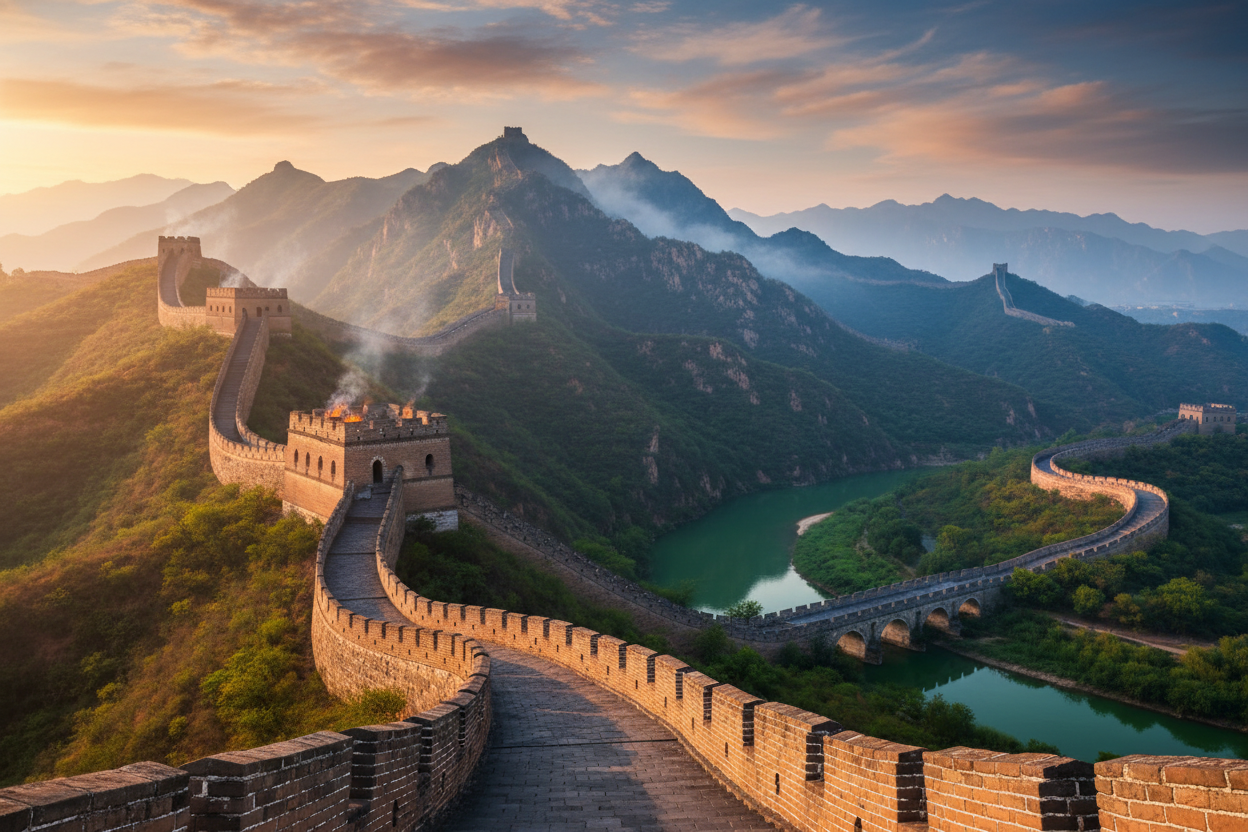
What truly sets the Great Wall apart is how it seamlessly integrates with the natural landscape. Rather than fighting against the terrain, the ancient engineers worked with it, creating a fortification that feels like a natural extension of the mountains themselves.
Burj Khalifa: Touching the Sky in Dubai
Standing at an astounding 2,717 feet tall, the Burj Khalifa in Dubai represents the current pinnacle of vertical engineering achievement. This isn’t just the world’s tallest building – it’s a masterclass in overcoming the physics of extreme height construction.
The tower’s innovative Y-shaped design isn’t just aesthetically pleasing; it’s a brilliant solution to wind resistance at extreme altitudes. The building’s exterior features a curtain wall system that can withstand the intense heat of the Arabian desert while maintaining structural integrity in high winds. The engineering team had to develop new concrete mixtures that could be pumped to unprecedented heights and create elevator systems that could efficiently transport people across 163 floors.
Perhaps most impressively, the Burj Khalifa’s foundation extends 164 feet underground, with a sophisticated cooling system that prevents the concrete from overheating in Dubai’s extreme climate. The building consumes the same amount of electricity as a small city, yet its innovative design makes it surprisingly energy-efficient for its size.
Panama Canal: Connecting Two Oceans
The Panama Canal stands as one of humanity’s most audacious engineering projects – literally cutting through a continent to connect two oceans. This 50-mile waterway revolutionized global shipping and required engineering solutions that pushed the boundaries of early 20th-century technology.
The canal’s lock system is a marvel of hydraulic engineering. Ships are lifted and lowered through a series of chambers using nothing but gravity and water – no pumps required. Each lock chamber holds 26.7 million gallons of water, and the entire operation runs with clockwork precision that has barely changed in over a century.
The recent expansion project, completed in 2016, doubled the canal’s capacity and showcased modern engineering capabilities. The new locks can accommodate ships three times larger than the original design, featuring rolling gates that are marvels of precision engineering. These gates weigh 3,100 tons each but can be moved by motors no more powerful than those in a typical car.
Golden Gate Bridge: Spanning the Impossible
When the Golden Gate Bridge opened in 1937, many considered it impossible to build. The 1.7-mile span across San Francisco Bay had to contend with powerful currents, frequent fog, and seismic activity that would challenge even modern engineers.
The bridge’s Art Deco design isn’t just beautiful – it’s incredibly functional. The distinctive International Orange color wasn’t chosen for aesthetics alone; it enhances visibility in San Francisco’s notorious fog while providing optimal corrosion resistance in the marine environment. The bridge’s suspension design allows it to flex up to 27 feet in high winds while maintaining structural integrity.
What makes the Golden Gate Bridge truly remarkable is its foundation work. The south tower sits on land, but the north tower required building a massive concrete foundation underwater in one of the world’s most challenging marine environments. The engineering team had to develop new techniques for underwater construction that are still used today.
Channel Tunnel: Engineering Beneath the Sea
The Channel Tunnel, affectionately known as the “Chunnel,” represents one of the most ambitious underground engineering projects ever attempted. This 31-mile rail tunnel connects England and France beneath the English Channel, with 23 miles running underwater at depths of up to 250 feet below the seabed.
The engineering challenges were immense. The tunnel had to be perfectly waterproof, maintain structural integrity under enormous water pressure, and provide safe passage for high-speed trains. The solution involved boring through chalk marl, a geological formation that’s stable enough to tunnel through but soft enough to excavate efficiently.
The tunnel actually consists of three separate tubes – two for rail traffic and one for maintenance and emergency access. The precision required was extraordinary; when the British and French teams met in the middle, they were off by less than two inches horizontally and less than two inches vertically after digging for over three years from opposite sides.
Millau Viaduct: The World’s Tallest Bridge
The Millau Viaduct in France redefines what’s possible in bridge engineering. At 1,125 feet tall, it’s taller than the Eiffel Tower and represents a perfect marriage of engineering excellence and aesthetic beauty. This cable-stayed bridge spans the Tarn River valley with a grace that seems to defy physics.
The bridge’s design had to account for extreme weather conditions in the valley, including high winds and temperature variations. The deck is designed to expand and contract by up to four feet with temperature changes, while the cable-stayed design provides the flexibility needed to handle wind loads that can exceed 150 mph.
What’s particularly impressive is the bridge’s environmental consideration. The structure was designed to have minimal visual impact on the landscape, and its construction actually improved traffic flow through the region while reducing pollution from vehicles that previously had to navigate the winding valley roads.
International Space Station: Engineering in Zero Gravity
The International Space Station represents perhaps the most challenging engineering environment humans have ever attempted to work in. This orbiting laboratory isn’t just built in space – it has to function in the vacuum of space while traveling at 17,500 mph and experiencing extreme temperature variations from -250°F to +250°F.
Every component of the ISS had to be designed for zero gravity, from the plumbing systems that work without gravity to the structural connections that can withstand the thermal expansion and contraction of orbiting Earth every 90 minutes. The station’s modular design allows for continuous expansion and maintenance, with new sections added regularly over its operational life.
The engineering challenges extend beyond just building in space. The ISS must be constantly adjusted to maintain its orbit, its systems must be redundant to ensure crew safety, and every component must be designed for easy replacement by astronauts wearing bulky spacesuits.
Hoover Dam: Taming the Colorado River
The Hoover Dam stands as a monument to Depression-era engineering ambition and ingenuity. This massive concrete arch-gravity dam not only controls the Colorado River’s flow but also generates enough electricity to power 1.3 million homes while creating Lake Mead, one of the largest artificial reservoirs in the world.
The dam’s construction required innovations in concrete technology that are still used today. The engineers knew that if they poured the dam as a single mass, the concrete would take 125 years to cool and would crack from the heat of curing. Instead, they poured the dam in interlocking blocks and ran cooling pipes through each section, reducing the curing time to just two years.
The dam’s Art Deco design elements aren’t just decorative – they serve functional purposes while creating one of the most beautiful industrial structures ever built. The intake towers, with their distinctive architectural styling, house sophisticated machinery that controls water flow with precision that still impresses modern engineers.
Petronas Twin Towers: Reaching New Heights in Malaysia
The Petronas Twin Towers in Kuala Lumpur held the title of world’s tallest buildings from 1998 to 2004, but their engineering significance extends far beyond height. These 88-story towers showcase innovative solutions for building in tropical climates while incorporating cultural design elements that make them uniquely Malaysian.
The towers’ foundation system is particularly impressive, built on the world’s deepest concrete foundation at the time. The engineers had to account for the limestone bedrock’s irregular surface, creating a foundation system that ensures both towers remain perfectly level despite the challenging geology beneath them.
The skybridge connecting the towers at the 41st and 42nd floors isn’t just an architectural feature – it’s a sophisticated engineering solution that allows the towers to move independently while maintaining a connection. The bridge is designed to slide in and out of the towers as they sway, preventing structural damage during high winds or seismic activity.
Sydney Opera House: Where Art Meets Engineering Excellence
The Sydney Opera House proves that engineering marvels don’t have to be purely functional – they can be works of art that push the boundaries of what’s architecturally possible. The building’s distinctive shell design created engineering challenges that required completely new approaches to construction.
The roof consists of precast concrete sections arranged in a series of shells, each one a segment of a sphere. This mathematical precision allows the complex curves to be constructed from standardized components, but the engineering required to make it work was revolutionary for its time. The shells had to be both structurally sound and acoustically perfect for the performance spaces below.
The building’s location on Sydney Harbour added another layer of complexity. The structure had to withstand marine conditions while integrating seamlessly with the harbor environment. The result is a building that seems to float on the water, its white shells echoing the sails of the boats that surround it.
The Future of Engineering Marvels
As we look toward the future, engineering continues to push boundaries in ways that would have seemed impossible just decades ago. Projects like the proposed Hyperloop transportation system, floating cities designed to address sea-level rise, and space elevators that could revolutionize space travel represent the next generation of engineering ambition.
What unites all these marvels – past, present, and future – is the human drive to solve seemingly impossible problems through creativity, persistence, and innovative thinking. Each structure tells a story not just of engineering achievement, but of human determination to build something greater than ourselves.
These engineering wonders remind us that the impossible is often just the untried. They stand as permanent testaments to what humans can accomplish when we combine vision with technical expertise, proving that our greatest limitations are often just the boundaries of our imagination.
Frequently Asked Questions
What makes a structure qualify as an engineering wonder?
An engineering wonder typically combines innovative design, technical complexity, scale, and cultural significance. These structures often solve previously impossible engineering challenges or push the boundaries of what was thought achievable with available technology.
How do engineers ensure these massive structures remain safe over time?
Modern engineering marvels incorporate multiple safety systems, regular monitoring, and preventive maintenance. They’re designed with safety factors that allow them to withstand forces far beyond normal operating conditions, and many use real-time monitoring systems to detect any structural changes.
What role does computer modeling play in modern engineering projects?
Computer modeling is essential for modern mega-projects. Engineers use sophisticated software to simulate stress, weather conditions, seismic activity, and other factors before construction begins. This allows them to identify and solve potential problems in the design phase rather than during construction.
How do environmental concerns influence modern engineering projects?
Contemporary engineering increasingly focuses on sustainability and environmental impact. Modern projects often incorporate renewable energy systems, use environmentally friendly materials, and are designed to minimize their ecological footprint while maximizing efficiency.
What’s the most challenging aspect of building these engineering marvels?
The greatest challenges often involve working in extreme environments, whether that’s underwater, at great heights, in space, or in harsh climates. Each environment requires specialized techniques, materials, and safety protocols that push engineering knowledge to its limits.