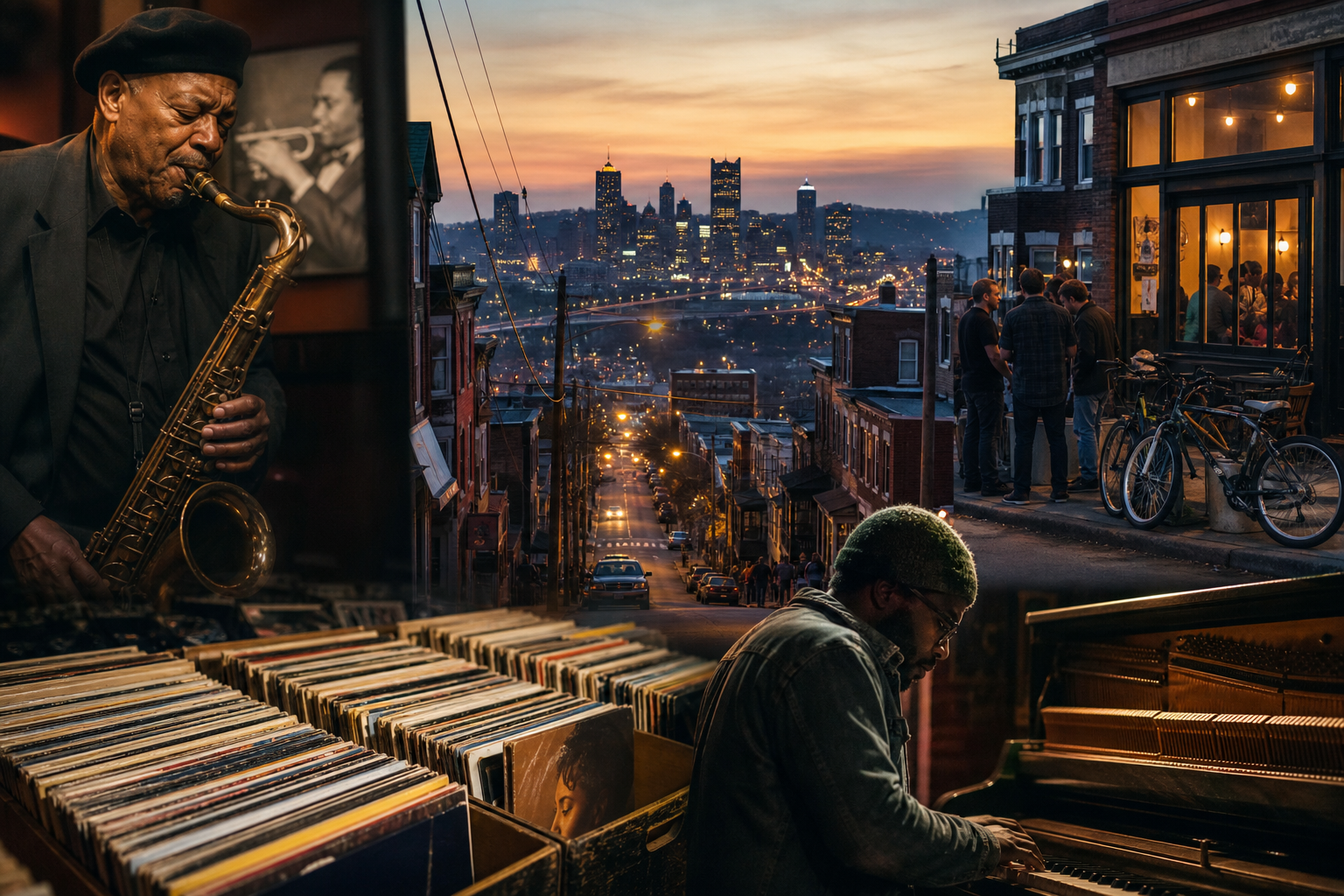
On Wylie Avenue, the story of Pittsburgh music still starts with a room that is no longer open. Crawford Grill No. 2 closed in 2003, but its place in the Hill District remains unmistakable: a Black-owned club where Miles Davis, Ella Fitzgerald, Louis Armstrong, Dizzy Gillespie, and John Coltrane could share the same broad musical map as neighborhood performers, regulars, cooks, bartenders, and people who simply came to hear what was happening that night.
That is the useful way to understand Pittsburgh’s music culture. It is not a single scene, and it has never lived in only one part of town. It is a neighborhood system. Jazz grew in the Hill District. Radio and record collecting built bridges through Oakland, Squirrel Hill, and the East End. Punk, indie rock, dance nights, and experimental music found homes in Lawrenceville, Garfield, the North Side, Millvale, and the South Side. The addresses change, but the pattern stays familiar: music gives a neighborhood another way to remember itself.
The Hill District is the city’s essential musical archive
Before Pittsburgh’s present-day concert circuit took shape, the Hill District was already a national destination for nightlife. From the 1930s through the 1950s, venues including the Crawford Grill, the Hurricane Lounge, the Savoy Ballroom, and the Granada Theater helped make the neighborhood one of the major stops on the Black jazz circuit. Lena Horne, Billy Eckstine, and Earl “Fatha” Hines were part of the larger Hill District story, as were the local musicians who learned by listening, sitting in, and finding work wherever a bandstand existed.
The Hill’s importance was never only about famous names. The clubs were social infrastructure. They connected audiences across racial lines, supported Black entrepreneurship, and gave musicians a place to develop in public. The Crawford Grill’s history also makes clear what was lost when urban renewal, the construction of the Civic Arena, the 1968 unrest, and shifting entertainment economics disrupted the lower Hill. More than 8,000 residents were displaced during the arena’s construction, severing relationships and weakening the commercial world that had supported the music.
That history echoes through the work of August Wilson, whose plays made the Hill District’s streets, arguments, jokes, songs, and silences part of the American theatrical canon. Wilson understood that a neighborhood has a soundtrack long before anyone writes it down. Today, the August Wilson House, August Wilson African American Cultural Center, and the Hill District’s ongoing cultural development keep that connection visible. For anyone trying to understand Pittsburgh music, Wylie Avenue is not a nostalgic side trip. It is one of the city’s central listening points.
Record stores turn neighborhoods into listening rooms
Pittsburgh’s record stores make the neighborhood map tactile. In Squirrel Hill, Jerry’s Records has occupied a former car dealership since 1994 and built its reputation on scale, variety, and the happy possibility that a $1 bin can change the afternoon. Its nearly million-record inventory is not just a shopping statistic. It reflects a local habit of browsing without a destination, following a genre from soul to country to punk, and trusting a staff recommendation or a worn sleeve more than an algorithm.
On the North Side, The Government Center pushes the record store toward a more deliberately communal model. It combines vinyl, espresso, a bar, live performances, listening parties, and DJ nights. That matters because the store is not treating physical media as a museum object. It is using records as an excuse for people to gather, argue about pressing quality, hear something unfamiliar, and make plans for the next show.
Downtown, Eide’s Entertainment connects music to Pittsburgh’s older alternative retail culture. The Penn Avenue institution began adding records in the late 1970s and remains part of a tradition in which comics, magazines, videos, music, and subcultural curiosity all share the same address. In Millvale, The Attic extends that record-store circuit beyond the city line and toward the live-music corridor around Grant Avenue and the Allegheny River.
These places matter even when nobody buys anything. A record store gives a neighborhood a memory bank, a place where local taste is visible and where a visitor can learn what Pittsburghers actually argue about after the show.
Lawrenceville and Garfield made the late night more elastic
Butler Street and Penn Avenue represent two different versions of Pittsburgh’s current cultural energy. Lawrenceville’s old industrial and working-class layers now sit beside restaurants, bars, galleries, studios, and music rooms. Spirit is a particularly Pittsburgh hybrid: a three-level venue, restaurant, rooftop garden bar, and event space where a meal, a loud band, and a late conversation can occupy the same night.
Nearby, Thunderbird Café & Music Hall keeps its own version of the small-room tradition alive. The venue is large enough for touring acts but intimate enough to preserve the crucial exchange between performer and crowd. In Garfield, the monthly Unblurred art crawl shows how nightlife can spill beyond a club: galleries, storefronts, installations, food, and music turn Penn Avenue into a series of connected rooms.
The important point is not that Lawrenceville is “hip.” That shorthand misses the real story. The neighborhood became a practical meeting place for musicians, artists, small businesses, and audiences looking for something less formal than a theater and more focused than a bar with a jukebox. It also shows the pressure built into cultural neighborhoods: rising costs and changing development patterns can make the same spaces harder for working artists and independent operators to hold onto.
South Side, Oakland, and the city’s different kinds of night
South Side has long been one of Pittsburgh’s most visible nightlife districts, especially along East Carson Street. Its concentration of bars and restaurants created a recognizable Saturday-night route, but the neighborhood’s music identity is broader than a bar crawl. Club Café helped establish a smaller, listening-oriented room for touring and local acts, while the South Side’s historic building stock continues to make the area feel like a sequence of compact venues rather than one entertainment complex.
Oakland contributes a different kind of musical pressure. With major universities, student housing, libraries, museums, and a dense population of young listeners, it has always been a place where bands, DJs, campus radio, house shows, and informal music communities can circulate quickly. The neighborhood’s role is less about one landmark venue than about turnover: new students arrive with new records, new scenes, and new reasons to stay out late.
That student energy connects with the longer history of Pittsburgh radio. WYEP began broadcasting in 1974 from a cramped South Oakland studio, emerging from community organizers who wanted more adventurous, locally meaningful programming on the FM dial. The station’s early history is a reminder that Pittsburgh’s independent listening culture did not begin with streaming. It was built by people who believed the city needed room for folk, roots, experimental music, public affairs, and artists who did not fit commercial formats.
North Side and Millvale keep the room moving
The North Side has become one of the strongest places to hear the relationship between collecting and performing. The Government Center’s East Street location is part record shop, part café, part listening lounge, and part small venue. A few minutes away, the larger concert ecosystem around the North Shore demonstrates how Pittsburgh can move from a basement-sized set to an arena show without leaving the same general riverfront orbit.
Across the river in Millvale, Mr. Smalls gives that scale shift a particularly memorable shape. The former church complex includes the main theater, the Funhouse club stage, the Sanctuary, a café, and recording facilities. Its importance comes from the range: a developing band can play a smaller room, a national act can draw a larger crowd, and musicians can use the building as more than a one-night stop.
This is where Pittsburgh’s geography becomes part of the music. Bridges, hills, river corridors, neighborhood borders, and city-line distinctions make every show feel slightly routed. A night at Mr. Smalls is not quite a city night, not quite a suburban night, and not quite separate from either. That in-between quality is one of the region’s signatures.
A city of neighborhoods needs a city of listeners
Pittsburgh music culture survives through these connections: the Hill District’s historical memory, Jerry’s endless bins, The Government Center’s community room, Eide’s downtown persistence, Lawrenceville’s hybrid venues, South Side’s nightlife, Oakland’s student circulation, and Millvale’s converted-church ambition. None of them tells the whole story. Together, they explain why local music here feels less like a genre category than a way of moving through town.
RadioPGH belongs in that movement. The station’s Pittsburgh stories and takes treat music as part of the city’s daily culture: something tied to streets, rooms, histories, and the people who keep showing up. Local artists can submit music, and people with a strong idea for a neighborhood-centered program can pitch a show. Near the end of a night, after the venue lights come up and the record-store bins are closed, the city is still listening. Listen live to RadioPGH and stay with the Pittsburgh frequency that connects all those rooms.
Steelers Realm
You found the story. Now hear the station — independent Pittsburgh radio, live 24/7.
More from the Republic.
Meet RadioPGH.
Stay Tuned to Pittsburgh
New local music, RadioPGH stories, station updates, shows and events—straight to your inbox.