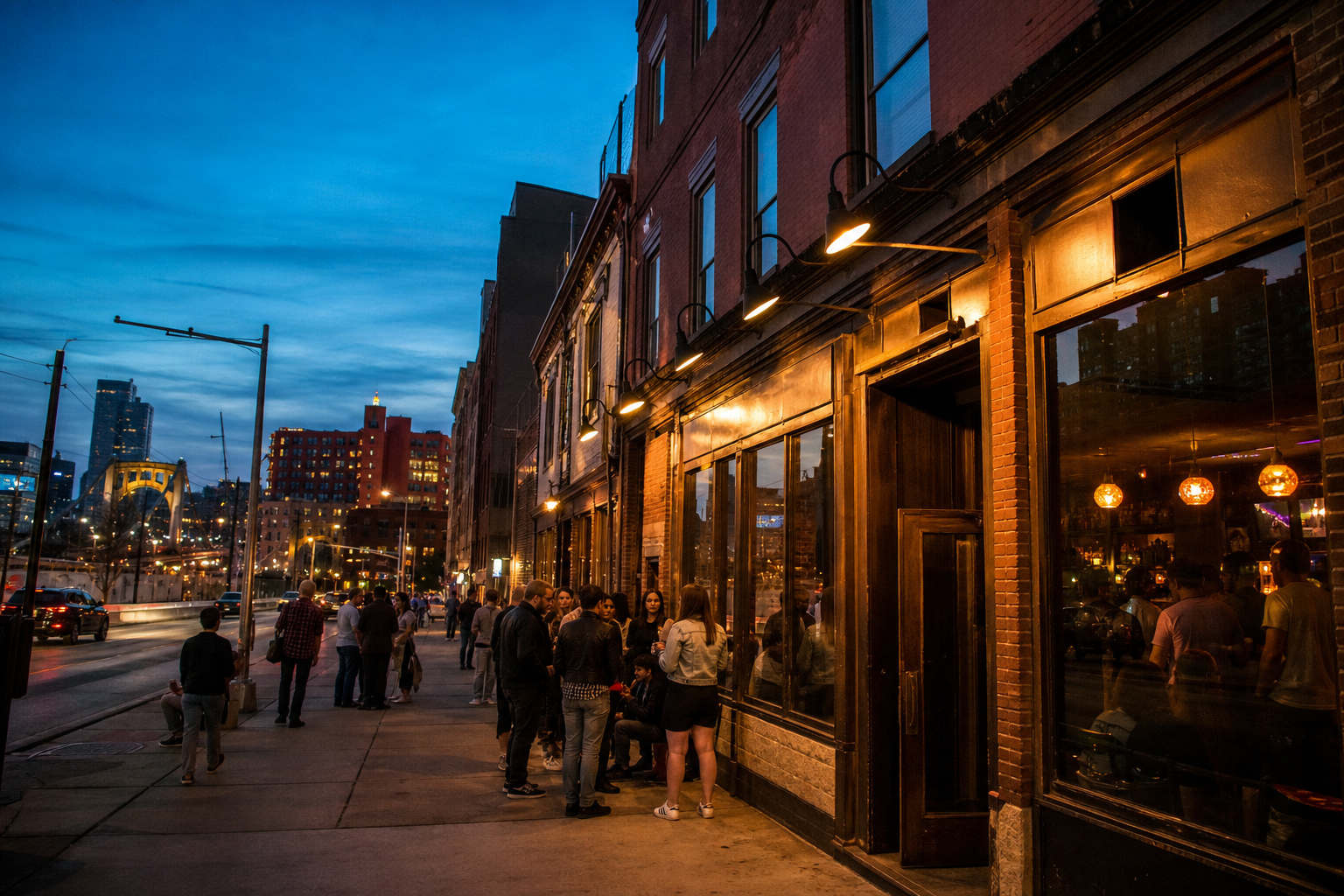
At 56 South 12th Street, just off East Carson, Pittsburgh music has spent nearly four decades proving that a room does not have to be large to matter. Club Cafe is a small venue by almost any measurement—roughly 125 to 150 people, depending on the era and accounting—but its history stretches far beyond the South Side block where the sign hangs.
This is the room that brought future stars and established favorites within arm’s reach of Pittsburgh listeners. John Mayer, Tori Amos, Norah Jones, Brandi Carlile, Billy Strings, The Avett Brothers, Gang of Four, Drive-By Truckers, Frank Black, Robyn Hitchcock and plenty of others have passed through. Just as important, Club Cafe has long made space for the regional touring acts and Pittsburgh artists who live in the musical middle ground between a bar gig and a theater date.
Its most Pittsburgh quality may be its refusal to stay in one category. It has been a piano bar, a songwriter room, a booking-room institution, a neighborhood hangout and, after a near-death experience, a locally owned comeback story. In a city where music history is often tied to a vanished club, Club Cafe is still here—and that changes the meaning of the story.
Before Club Cafe, there was Cardillo’s
The address at South 12th and East Carson has a longer musical memory than the Club Cafe name suggests. In 1988, the space opened as Cardillo’s Club Cafe, centered on father-and-son jazz pianists Bob and Harry Cardillo. The setup was intimate in the most literal sense: two grand pianos in a room built for close listening rather than spectacle.
That beginning matters because it established the venue’s basic character before the nationally touring acts arrived. This was never designed as an arena in miniature. The room’s appeal came from proximity—the sound of a piano, a voice, or a guitar reaching the audience without having to fight its way through a cavernous space.
In 1999, Marco Cardamone and Barney Lee took over the venue. Cardamone, who had operated Cafe Allegro nearby, shortened the name to Club Cafe and helped shape the room into a listening-focused stop for singer-songwriters, roots artists and alternative acts. The format had a local radio parallel in WYEP, which has long connected Pittsburgh audiences with music that sits outside the narrowest commercial lanes.
That connection is part of why Club Cafe became more than another East Carson bar. It offered a place where an artist could be known without yet being famous, and where a listener could see the next important voice before the larger rooms caught up.
A small room with an outsized guest list
Club Cafe’s alumni list tells the story in a particular Pittsburgh way. It includes artists who would later move into much bigger theaters, artists whose reputations were already secure, and artists who remain beloved precisely because they never needed the arena circuit.
John Mayer is the obvious example of the room’s early-career magic: a performer associated now with major tours who once fit naturally into a South Side club. Norah Jones, Brandi Carlile and Billy Strings represent different generations and musical worlds, but they share the same Club Cafe lesson. A room like this can make a national act feel local for one night.
Then there are the bookings that tell you what kind of audience Pittsburgh has cultivated. The presence of Gang of Four, The Mekons, The Blasters, The Meat Puppets, Nada Surf, Minus the Bear, Mike Doughty and Robyn Hitchcock points to listeners who want texture, history and a little risk. The room has also welcomed regional and hometown artists including Joe Grushecky and the Houserockers, The Commonheart and Charles Wesley Godwin.
Those names are not just decoration for a venue résumé. They show how Club Cafe functioned in the ecosystem. Mr. Smalls in Millvale could handle a different scale. Larger halls such as Stage AE or the Benedum Center served entirely different purposes. Club Cafe occupied the close-up space: the room where the artist’s arrival, the audience’s attention and the city’s musical conversation could all happen at once.
Why the South Side setting matters
Club Cafe sits inside the East Carson Street Historic District, in the South Side Flats. That neighborhood context is not incidental. East Carson is one of Pittsburgh’s defining commercial streets, lined with late-19th-century and early-20th-century buildings shaped by the area’s industrial and immigrant history. Bedford Square and the South Side Market House anchor the nearby streetscape, while the South Side Presbyterian Church and the old storefronts along Carson make the neighborhood feel layered rather than purpose-built for nightlife.
The South Side has changed dramatically across the decades. It has carried the imprint of steel and glassmaking, family businesses, taverns, restaurants, apartments, college nightlife and the uneven pressures that come with being one of the city’s best-known entertainment districts. Club Cafe’s location puts it inside that tension. It is close enough to East Carson’s louder weekend energy to benefit from the foot traffic, but its identity has always depended on giving people a reason to step away from the noise.
That distinction is useful when thinking about Pittsburgh neighborhoods through music. A neighborhood is not only its most crowded block or its most photographed building. It is also the rooms where people listen carefully. RadioPGH’s Pittsburgh Neighborhood Map, Heard Through Music works from that same idea: the city’s character changes block by block, and music is one of the clearest ways to hear those changes.
The closing that almost became the ending
In 2011, promoter Michael Sanders and Opus One Productions took over Club Cafe. For more than a decade, the venue continued as one of Pittsburgh’s most dependable intimate concert spaces. But in September 2024, Opus One announced that Club Cafe would close by the end of the year. The final shows ran through the holidays, with the room going dark after New Year’s Eve.
For a venue with a 25-year run under the Club Cafe name—and 36 years of music at the address—the announcement felt bigger than a business closing. It marked the possible loss of one of the last full-time live-music rooms on the South Side. Pittsburgh listeners know the pattern: a place becomes essential, the economics get harder, and suddenly the only way to experience its history is through stories about what used to happen there.
But Club Cafe’s audience and extended music community did not treat the closing as inevitable. Keystone Artist Connect co-founders Maddy Lafferty and Danielle Mashuda, both longtime participants in Pittsburgh’s music and event world, moved to purchase the venue. The sale from Sanders was completed in April 2025, and Club Cafe reopened that summer.
What Club Cafe means now
The reopening did not erase the closure. That is part of the point. The venue returned with a refreshed interior and upgrades, while the new owners emphasized protecting the room’s intimate feel. The goal was not to turn Club Cafe into a generic “reimagined” nightlife concept. It was to keep the history visible while making the room workable for another era of artists, audiences and operating realities.
Today, Club Cafe’s public identity remains rooted in live music at 56 South 12th Street. Its official schedule continues to present touring acts, Pittsburgh performers and the kind of bookings that reward curiosity. The bar is open Thursday through Saturday from 6 p.m. to midnight, with other hours tied to show activity. That rhythm fits the venue’s history: not a place you wander into by accident every night, but a place you choose because something specific is happening.
The new ownership also matters symbolically. Club Cafe was saved not by a distant entertainment conglomerate, but by Pittsburgh-based people who understood what the room meant because they had been in the audience. Lafferty and Mashuda inherited a difficult business and a beloved name at the same time. Their work turns Club Cafe into a contemporary Pittsburgh story about stewardship—how a music place survives when somebody is willing to take responsibility for both the memories and the bills.
For listeners, the test is simple. Does the room still make an unfamiliar artist feel worth hearing? Does a touring musician still get a real Pittsburgh welcome? Can a local act share a bill that changes the next step in its career? If the answer remains yes, Club Cafe is doing more than preserving the past.
That is the connection RadioPGH cares about. Pittsburgh music is not a museum display, even when the buildings and names carry history. It is a living signal moving through South Side, Millvale, Lawrenceville, the Hill District, the North Side and beyond. Check the RadioPGH Schedule for what is moving through the station, follow more Pittsburgh Stories & Takes, and when you want the city’s sound in the moment, Listen Live to RadioPGH.
Steelers Realm
You found the story. Now hear the station — independent Pittsburgh radio, live 24/7.
More from the Republic.
Meet RadioPGH.
Stay Tuned to Pittsburgh
New local music, RadioPGH stories, station updates, shows and events—straight to your inbox.