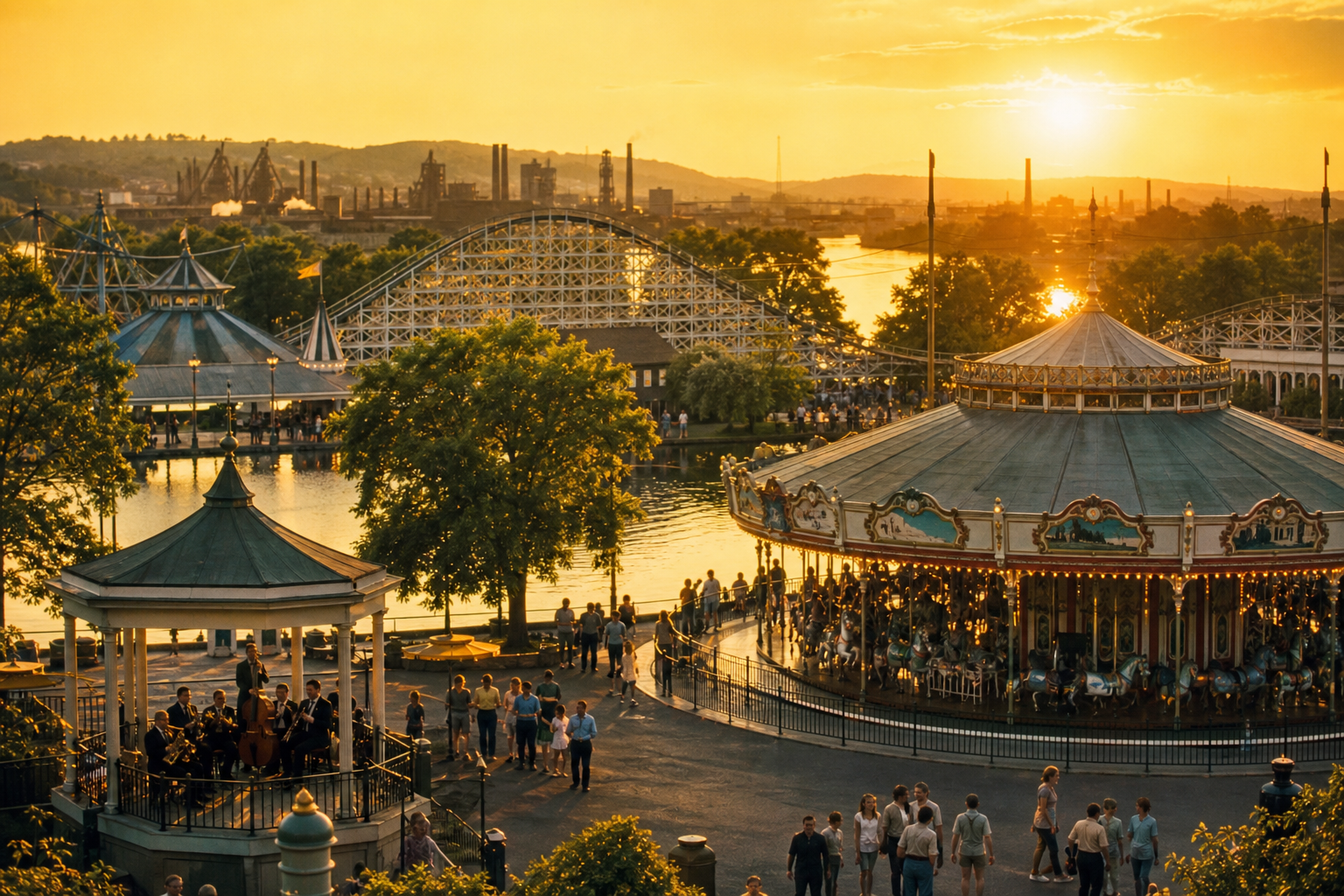
Before Kennywood had the Thunderbolt, before the Racer had a century of Pittsburgh bragging rights, there was music. In 1899, when families began riding the trolley out toward Kenny’s Grove, the park’s attractions included a dance pavilion, a carousel, and a small bandstand. The next year, Kennywood added a more formal bandstand and athletic field. The place was built to make a day out of it, and the soundtrack was part of the reason to make the trip.
That matters because Kennywood has never been only a collection of rides. It has been a stage, a ballroom, a broadcast location, a summer job, and a memory machine. The music changed as Pittsburgh changed: brass and marching bands, ballroom orchestras, big-band radio, carousel music, Dixieland, pop show tunes, ride sound effects, and whatever a teenager happened to hear through a park loudspeaker. The rides supplied the motion. The music supplied the atmosphere.
The trolley park had a bandstand before it had a coaster
Kennywood opened at the end of a streetcar line operated by the Monongahela Street Railway Company, a business strategy as much as a leisure idea. If the company could give Pittsburghers a reason to ride out to West Mifflin on a Sunday, it could sell more fares. Music was a natural draw: inexpensive to present, social by design, and loud enough to gather a crowd.
The park’s early identity was tied to dancing and public entertainment. Families could picnic near the Lagoon, couples could meet in the dance pavilion, and audiences could gather for concerts and performances. In those years, Kennywood belonged to the same regional amusement-park world as places such as West View Park, Luna Park, and White Swan Park, but its combination of surviving buildings, rides, and traditions allowed it to become the one Pittsburghers kept carrying forward.
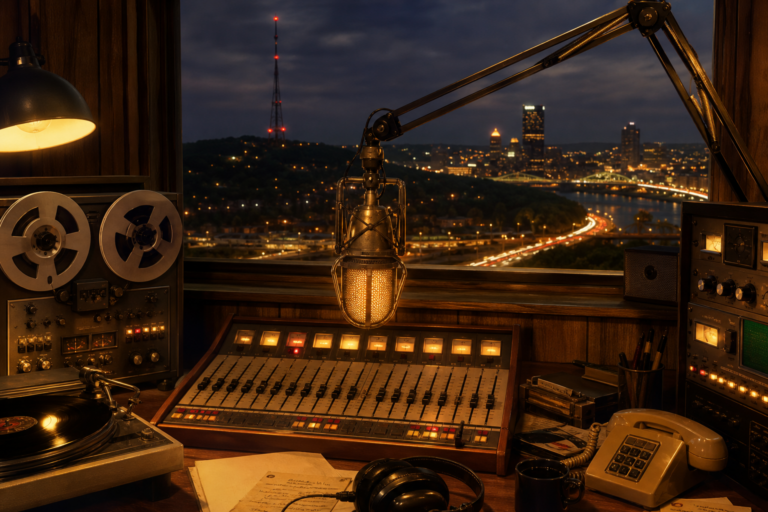
The best way to understand that beginning is through the history of Pittsburgh radio. Long before rock stations defined the region’s listening habits, amusement parks and ballrooms were already places where live music and broadcasting overlapped. Kennywood’s music did not sit in the background. It was an event people came to hear.
When Kennywood sounded like a ballroom and a radio station
The park’s bandstand became especially important during the big-band years. Kennywood hosted nationally known acts, including Harry James and Xavier Cugat, and performances were associated with radio broadcasts over WCAE. That connection turned a West Mifflin amusement park into a sonic address that could travel far beyond the rides and the river valley.
For Pittsburgh listeners, the image is unusually vivid: an orchestra playing at Kennywood while a local station carried the sound outward, with the park’s name folded into the broadcast introduction. The attraction was not simply that a famous band had come to town. It was that the music was coming from a recognizable place—Kennywood, the destination at the end of the trolley line, the place where a family outing and a national radio sound could occupy the same evening.
The big bands also helped Kennywood remain vital through the hard years of the 1930s. Popular entertainment could bring people through the gates even when money was tight, and the dance hall offered something a ride could not: a reason to stay, listen, and participate. Kennywood’s old entertainment model was closer to a combination of fairground, ballroom, concert venue, and radio studio than to the modern idea of a theme park.
The paper trail for that world is still being preserved. The Kennywood Park Records at the Heinz History Center include corporate archives that help document the park’s performers, promotions, buildings, and changing relationship with its audience. That history is valuable precisely because so much of amusement-park music was temporary: played for one night, heard by thousands, and then remembered decades later through fragments.
The carousel’s Wurlitzer is the sound that stayed
If the big-band era gave Kennywood its public musical reputation, the carousel gave it an intimate one. Kennywood’s Wurlitzer 153 band organ arrived in 1916, and its music became inseparable from the carousel pavilion. The organ’s sound is mechanical, bright, and slightly uncanny—too grand for a ride that lasts only a few minutes, but perfectly suited to the ritual of circling beneath the painted horses.
That music works differently from a concert. Nobody has to stop and watch. It follows riders as they choose a horse, reach for the brass ring, or wait near the edge of the platform. Parents hear it while looking for their children. Former employees hear it years later and are back inside the pavilion almost immediately. The organ is not just an instrument; it is an acoustic landmark.
That is one reason Kennywood memories often arrive as sounds before they arrive as stories: the carousel organ, the call of an attendant, the rattle of the Racer, the splash and machinery of the Old Mill, the relentless pulse of the Musik Express, or the sudden quiet before a coaster drops. A park soundtrack is a collage. It does not need to be arranged like an album to become part of someone’s personal history.
From the Garden Theater to the loudspeaker loop
Kennywood’s live-music tradition did not end when the old bandstand burned in 1961. The park continued to use entertainment as a way to shape the day, and since 1978 it has hired young performers for daily shows at the Garden Theater. The 1988 WQED documentary Kennywood Memories, hosted by Rick Sebak, captured that continuity: the old dance-hall history, the carousel organ, longtime workers, and newer performers sharing the same park.
That generational overlap is the secret to Kennywood’s musical identity. One person remembers a Dixieland group such as Razzmatazz. Another remembers a marching band appearance, a community concert, or a summer job spent around the rides. Someone else remembers the music attached to a particular attraction: the thump of a dark ride, the soundtrack inside a rotating dome, or the songs that seemed to follow the midway all afternoon.
And then there are the sounds that never made the official history: the band a school group brought for a picnic, the polka heard on a community day, the employee announcements at closing time, the tinny pop song bleeding from a game booth, the family arguing about which ride to hit before the music changed. Those details are not incidental. They explain why Kennywood feels less like a place people visited once than a place they have repeatedly re-entered through memory.
Why Kennywood still belongs in Pittsburgh’s listening history
Kennywood sits in West Mifflin, but its musical reach has always been regional. It connects the Monongahela River valley to Pittsburgh radio, the Heinz History Center to WQED, the carousel pavilion to the Garden Theater, and a century-old bandstand to the headphones of anyone who has ever tried to recreate a summer at the park.
For RadioPGH, that is the useful reminder: local music history is not only about records, clubs, or famous stages. It is also about the places where people learned to associate sound with belonging. Kennywood taught generations of Pittsburghers that an organ, an orchestra, a loudspeaker, or a ride soundtrack could mark a season of life as clearly as any song on the radio.
That is why the park’s music is worth revisiting as more than nostalgia. The soundtrack tells us what Kennywood was built to do: bring people together, keep them there, and give the day a rhythm. As summer gives way to fall on the 2026 calendar, those sounds remain easy to summon. Put on a favorite station, queue up the RadioPGH Listen Live stream, and somewhere between the carousel and the first drop, Pittsburgh’s amusement-park orchestra is still playing.
More from RadioPGH: Thank You — RadioPGH Contact
Steelers Realm
You found the story. Now hear the station — independent Pittsburgh radio, live 24/7.
More from the Republic.
Meet RadioPGH.
Stay Tuned to Pittsburgh
New local music, RadioPGH stories, station updates, shows and events—straight to your inbox.