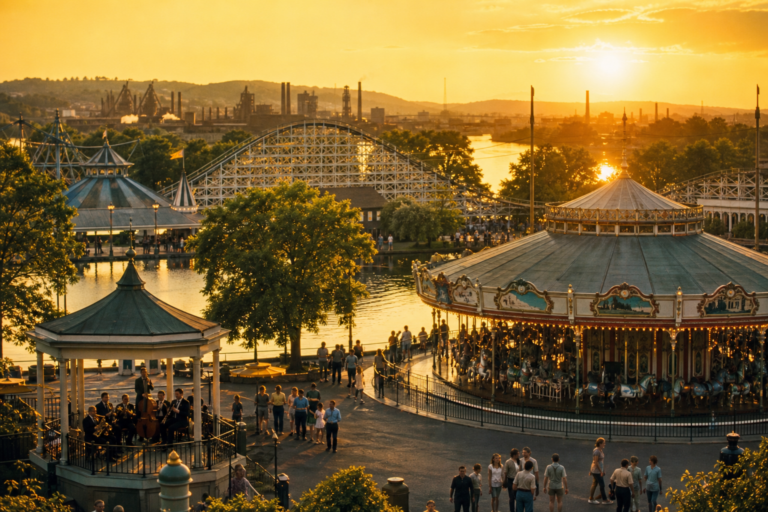
Before Point State Park became the place where office workers eat lunch beside the fountain, it was already becoming one of Pittsburgh’s most dramatic music rooms. The stage might be a barge on the Allegheny, a temporary platform on the lawn, or a full concert setup facing the Fort Pitt Museum. The backdrop never changes: three rivers, the Golden Triangle, and a city built around the water.
That setting has made The Point more than a convenient downtown event site. Across seven decades, music there has reflected what Pittsburgh was listening to, arguing about, celebrating, and trying to become. Jazz arrived with heavyweight names. Folk music carried protest into the open air. Radio turned the park into a mass gathering. Arts festivals made free concerts part of the summer routine. More recently, gospel, R&B, hip-hop, and national touring acts have widened the sound of the lawn.
The 1960s: Jazz, folk, and a new public park
The story starts alongside the creation of the park itself. Point State Park sits at the confluence of the Allegheny and Monongahela rivers, on ground tied to Fort Duquesne, Fort Pitt, and the French and Indian War. Pennsylvania recognizes it as a National Historic Landmark, and that layered history has always been part of the atmosphere when music takes over the grass.
In 1960, the Women’s Committee of the Carnegie Museum of Art launched the Three Rivers Arts Festival. The festival’s early programming treated music as a public art form rather than a separate attraction. Performances connected the Gateway Center plazas, the new park, and the riverfront, giving Pittsburghers a free way to hear serious music outside a concert hall. The point was practical and cultural: bring art into the daily path of people who might never spend an evening at Heinz Hall or Carnegie Music Hall.
The decade also brought major jazz into the open. The 1966 Pittsburgh Jazz Festival moved to Point State Park for a lineup that included Dizzy Gillespie, Ella Fitzgerald, Dave Brubeck, and Stan Getz. Those names mattered because they placed Pittsburgh inside the national jazz conversation, not at its margins. The park could hold an audience for sophisticated music while the riverfront made the event feel like a civic gathering.
In 1969, Joan Baez played a free concert at The Point before more than 7,000 people. The event, organized by Pittsburgh Students for Peace and Pittsburgh Draft Resistance, was both performance and political assembly. Baez’s presence connected Pittsburgh to the protest-folk movement, but the setting mattered just as much: a public park turned a national argument into a local, face-to-face crowd.
The 1970s: When the radio audience showed up
Point State Park’s biggest musical moment of the 1970s was also a warning about scale. On September 2, 1974, WKTQ sponsored a free rock concert that drew an estimated 100,000 people. The performance came from a barge, and thousands gathered along the river. A Pirates game at Three Rivers Stadium that same day added tens of thousands more people to Downtown, creating traffic and crowd conditions that Pittsburgh newspapers described as chaotic.
The event has endured in local memory not simply because of its size, but because it demonstrated what radio could do. A station announcement could turn a familiar patch of grass into a regional destination. WKTQ did not need a ticketed arena or a purpose-built amphitheater; the riverside itself became the venue, and the audience supplied the electricity.
By the end of the decade, Point State Park had also become a recognizable home for the Three Rivers Arts Festival’s music program. The festival’s free concerts were less about one blockbuster night than about repetition: return every June, find a place on the lawn, hear something unexpected, and accept that a Pittsburgh rainstorm might interrupt the set.
The 1980s and ’90s: The festival becomes a Pittsburgh ritual
Over time, the Three Rivers Arts Festival built a musical identity that could move comfortably between popular and experimental work. Ella Fitzgerald became an early major headliner. Later programs included Philip Glass, Steve Reich, Smokey Robinson, Judy Collins, Chuck Mangione, and other artists who did not fit neatly into one radio format. A person could arrive for the art market and end up hearing minimalist composition, jazz, soul, folk, or pop before heading back toward Gateway Center.
That range is important. Point State Park was never only a rock venue, and it was never only a backdrop for gallery culture. Its best music programming made the park porous. Downtown workers, families from the West End, students from Oakland, visitors staying near Penn Avenue, and longtime residents from the Hill District or North Side could all occupy the same audience without needing the same reason for being there.
The festival also made weather part of the local mythology. Rain was not an occasional inconvenience; it became part of the annual appointment. Still, Pittsburghers kept returning. The reward was a rare combination: nationally known artists, no admission charge, and the unmistakable visual drama of the fountain, river traffic, bridges, and skyscrapers.
The 2000s and 2010s: A park built for big civic sound
Point State Park’s physical design has always shaped its music history. The park includes the reconstructed Fort Pitt blockhouse and Music Bastion, reminders that the lawn is not an empty field but a historic site with limits. During the 2000s renovation discussions, planners and preservationists debated how much of the park’s historic landscape should be altered to accommodate concerts and other large events.
The argument was ultimately about what kind of public space Pittsburgh wanted. A park that could host music had to support crowds, staging, access, and sound. A National Historic Landmark also required care. That tension helps explain why performances at The Point feel unusually civic: every temporary stage sits on top of a place that is already carrying centuries of meaning.
Music continued in many forms. The American Wind Symphony Orchestra brought its floating concert vessel, Point Counterpoint II, to the Allegheny River side of the park in 2012. The image was almost too Pittsburgh to be fictional: an orchestra performing from a boat beside the park where the rivers meet.
Meanwhile, the Three Rivers Arts Festival’s stages kept expanding the audience. The Pittsburgh Cultural Trust, which took over production in 2009, continued a tradition that had presented more than 10,000 visual and performing artists over its history. Recent festival bills included Brandi Carlile, Norah Jones, The Avett Brothers, Wilco, Sonic Youth, The Wailers, India.Arie, and the Black Keys.
For listeners who track those changes through radio, Point State Park is a useful reminder that Pittsburgh music history is not only preserved in clubs and record collections. It also lives in recurring public rituals. RadioPGH’s RadioPGH Schedule carries that same idea forward by placing local listening inside an everyday routine rather than treating music as something reserved for a special night out.
Black music, national acts, and the park’s next chapter
The 2020s made the park’s role as a broad public stage especially visible. The Pittsburgh Black Music Festival brought jazz, gospel, blues, R&B, neo-soul, and hip-hop to Point State Park, with artists including Roy Ayers, Gerald Albright, Tye Tribbett, BlackStreet, Dwele, and the B.B. King Blues Band. The festival’s significance was not just its lineup. It placed Black musical traditions at the center of a major Downtown gathering and connected the Point to Pittsburgh’s long history of Black cultural life, from the Hill District to the city’s jazz legacy.
The Three Rivers Arts Festival eventually moved away from Point State Park after new state event regulations and site demands made its longtime footprint difficult to maintain. In 2026, the festival opened Arts Landing in the Cultural District as its long-term home. That move closes one chapter, but it does not erase the decades when “the Arts Festival” automatically meant tents, stages, river wind, and music at The Point.
And Point State Park is not becoming quiet. On June 27, 2026, the America250PA Commonwealth Concert Series brought Nelly, Third Eye Blind, and Pittsburgh artist Frzy to a free, ticketed concert hosted by former Steelers quarterback Charlie Batch. It was a very different bill from Ella Fitzgerald or Joan Baez, but the underlying idea was familiar: gather people at the rivers, make the music accessible, and let the park function as a shared civic room.
That is the through line. At Point State Park, the music has changed from jazz festivals and protest folk to radio rock, festival eclecticism, Black music celebrations, and contemporary pop. The audience has changed too. But the basic Pittsburgh instinct remains intact: if the rivers are already bringing everyone together, put a stage there.
For more on the station’s role in keeping Pittsburgh listening local, visit About RadioPGH and Listen Live. The Point’s stages may come and go, but the city’s habit of meeting through music is still very much on the air.
Steelers Realm
You found the story. Now hear the station — independent Pittsburgh radio, live 24/7.
More from the Republic.
Meet RadioPGH.
Stay Tuned to Pittsburgh
New local music, RadioPGH stories, station updates, shows and events—straight to your inbox.