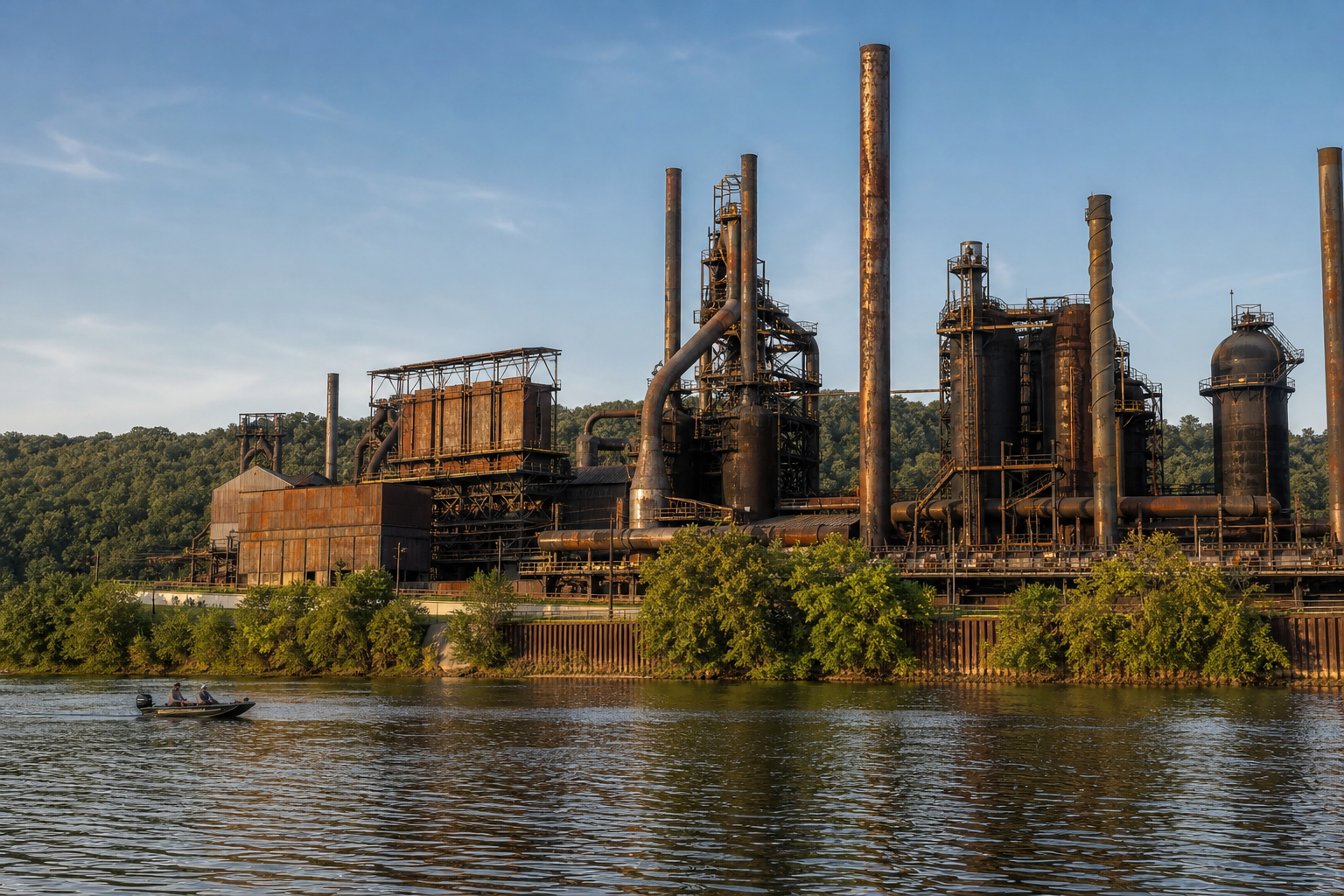
Along the Monongahela River, where Swissvale and Rankin meet the long industrial reach of the old Homestead Works, the Carrie Blast Furnaces still look like Pittsburgh’s past made physical. Furnaces 6 and 7 rise above Carrie Furnace Boulevard in a tangle of towers, pipes, brick, steel and weather. They are quiet now. The iron stopped flowing in 1982.
But quiet is not the same as finished.
The Carrie Blast Furnaces matter to Pittsburgh’s future because they show what a postindustrial place can do with the parts of its history that are too large, too complicated and too valuable to erase. The site is a National Historic Landmark, but it is also a classroom, an arts venue, a preservation challenge, an economic-development property and an unusually powerful public space. Its future will not be secured by nostalgia alone. It will depend on whether Pittsburgh can keep history, creativity, jobs and community access in the same conversation.
A monument that still has work to do
The first mistake is to treat Carrie as a finished museum. A museum usually puts the past behind glass. Carrie puts visitors inside the scale of industrial work: the height of the furnaces, the routes raw materials traveled, the danger built into every shift, and the way thousands of workers and families were organized around production.
That physical evidence matters in a region where the language of steel can become too polished. The Homestead Works is often reduced to a symbol of American industrial power, or to the collapse that followed when mills closed. Carrie holds both truths at once. It records engineering and exploitation, immigration and segregation, skilled labor and workplace danger, technological ambition and environmental cost.
Rivers of Steel, which manages the landmark and interprets the surrounding Rivers of Steel National Heritage Area, has continued to expand that story. Its student programs connect the science of ironmaking with the immigrant worker experience. Recent interpretation has also pushed toward a fuller account of the people connected to the site, including Carrie Clark, the woman whose name became attached to the furnaces but whose story was long overlooked.
That kind of interpretation is not an academic extra. It is how a landmark becomes useful to people who did not inherit a steel-mill story from a parent or grandparent. It gives younger Pittsburghers a way to ask who built the region, who benefited, who was excluded and what kind of work should shape the next chapter.
Preservation is infrastructure, not decoration
Keeping Carrie standing is a technical and financial task. The upper sections of the furnaces require stabilization, and in March 2026 Rivers of Steel announced a $732,869 Save America’s Treasures grant for major steel repair and preservation work. That investment protects more than a dramatic skyline. It protects the possibility of public access, education, performances, workshops and future interpretation.
In Pittsburgh, we understand infrastructure as something that moves people or carries utilities. Carrie asks us to add another category: infrastructure that carries memory. If the structures disappear, the region loses an irreplaceable reference point for understanding how its river valleys, neighborhoods, labor movement and economy were built.
Preservation also creates a discipline for redevelopment. The question is not whether every acre around the furnaces should remain frozen. The question is whether new construction can happen without severing the historic site from its meaning. That is the difference between reusing an industrial landscape and simply replacing it with a generic business park that happens to have a landmark nearby.
The creative economy already exists inside the ruins
There is a strong argument for Carrie as a cultural asset because the work is already happening there. Rivers of Steel’s Metal Arts program offers blacksmithing, bladesmithing, iron casting, aluminum casting and sculptural workshops. In 2026, the organization scheduled more than 60 workshops, turning the old industrial setting into a place where people learn by handling tools, patterns, sand, fire and metal.
That is a direct connection between Pittsburgh’s industrial inheritance and its creative future. The point is not to recreate a steel mill. No festival can replace a mill job, and no art program should pretend otherwise. The point is to preserve the knowledge that making things—understanding materials, solving problems, working safely, collaborating across skill levels—still has cultural and economic value.
The annual Festival of Combustion makes that argument in public. Live music, demonstrations, food, craft and an iron pour bring the site out of the category of “important but inaccessible.” The festival’s appeal is partly visual, but its deeper value is social: it gives families, artists, former mill workers, students and visitors a reason to share the same ground.
That is the kind of cultural programming RadioPGH pays attention to. Pittsburgh’s identity is not only in concert halls or clubs. It is also in places where sound, craft, labor and landscape overlap. Carrie belongs in that wider listening map, alongside the stories gathered in A Pittsburgh Listening Guide, because the site has its own rhythm: freight, river, machinery, voices, hammers and the sudden shock of fire.
Development should make the landmark more connected
The larger Carrie Furnace property is also part of an economic-development effort. Allegheny County has invested heavily in remediation, utilities, flood-plain work, access roads and a flyover bridge to prepare the former mill site for reuse. RIDC has developed tech-flex space at Carrie Furnace, with additional plans tied to a film production studio and related facilities.
Those projects could give the site a future beyond tourism. They could bring jobs, tenants, production work and new reasons for people to travel to the Mon Valley. They could also fail to deliver on their promise if development treats the furnaces as a backdrop rather than a partner.
The best version of Carrie’s future would make the historic landmark more connected, not more isolated. That means clear public access, coordinated programming, safe walking and cycling connections, and a visible relationship between the working businesses around the site and the history of the furnaces themselves. It means making sure new economic activity benefits nearby communities in Rankin, Swissvale, Munhall and the broader Mon Valley—not only outside investors or occasional visitors.
It also means being honest about the timeline. Large brownfield projects move slowly. Plans change. Funding arrives in stages. A proposed studio or new building is not the same thing as an operating facility. The responsible optimism here is practical: preserve what cannot be replaced, build what can support jobs, and keep the public story at the center.
A place for the next generation to hear Pittsburgh clearly
Carrie’s future will ultimately be measured by who feels invited into it. A landmark that serves only as a photo stop is useful, but limited. A landmark where students study engineering and labor, artists make objects, musicians perform, preservationists practice difficult work and neighbors recognize their own history has a much longer life.
That is why the furnaces matter now. They give Pittsburgh a way to remember without pretending the past was simple, and to imagine economic growth without pretending every new project is automatically progress.
For a station like RadioPGH, that connection is natural. Independent radio is built on the idea that a place becomes more legible when local voices have room to connect the dots. You can follow those connections through Pittsburgh Stories & Takes, then listen to RadioPGH everywhere as the city’s old industrial vocabulary keeps finding new forms—in music, in art, in work and in the sound of people deciding what should come next. When you are ready, Listen Live.
Sports Porch Black & Gold
You found the story. Now hear the station — independent Pittsburgh radio, live 24/7.
More from the Republic.
Meet RadioPGH.
Stay Tuned to Pittsburgh
New local music, RadioPGH stories, station updates, shows and events—straight to your inbox.