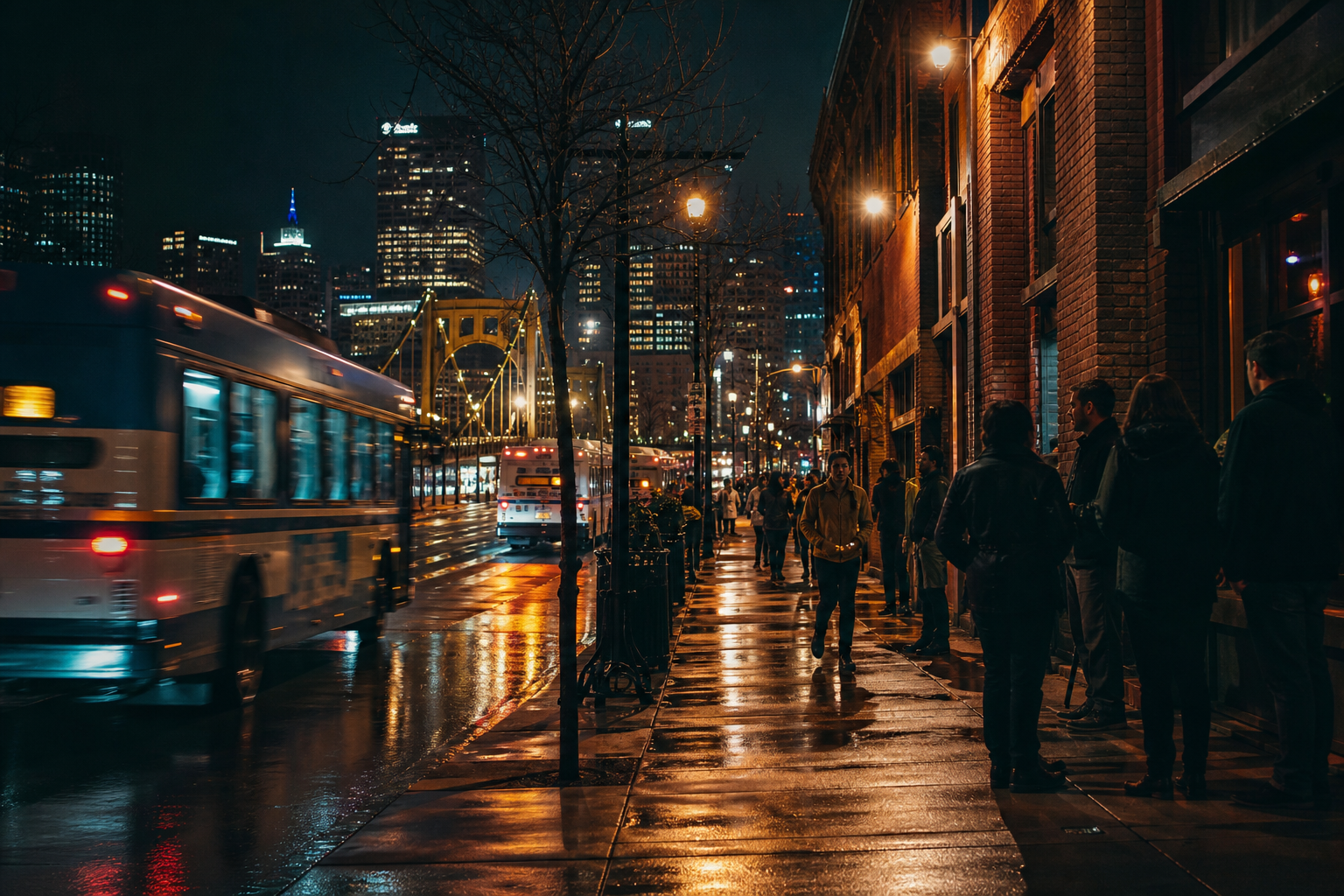
At 2:15 in the morning, Downtown Pittsburgh tells the whole story. The Warren Bar & Burrow is finishing its last round. Redbeard’s is still serving the people who made it through a late shift. A few blocks away, the sidewalks go quiet, the theater crowds are long gone, and the city’s next wave of workers has not arrived yet.
That gap is the question: Can Pittsburgh become a 24-hour city again?
The honest answer is yes, but probably not by recreating the old version. The Pittsburgh of all-night diners, 24-hour grocery stores, and bars that felt obligated to stay open until the final possible minute is mostly gone. What could return is something more useful: a city with several dependable nighttime centers, food after midnight, transportation for workers, music that does not treat 10 p.m. as closing time, and public spaces that feel inhabited rather than abandoned.
That is a cultural question, but it is also a practical one. People cannot build a night economy out of good intentions alone. They need a way home, somewhere to eat, a reason to stay, and confidence that somebody is paying attention.
The old Pittsburgh night was never everywhere
When Pittsburghers talk about the city being more alive after dark, they are usually remembering particular places rather than a uniformly sleepless metropolis. The Strip District had Primanti Bros. and the after-hours movement around the produce markets. Oakland had students, hospital workers, cheap food, and the regular churn of people who did not operate on a 9-to-5 schedule. South Side had bars, clubs, and the post-last-call migration along Carson Street. Bloomfield had Ritter’s Diner, where the night could end over eggs, fries, and coffee.
Those places mattered because they connected different kinds of Pittsburghers. A bartender, a nurse, a college student, a warehouse worker, a touring musician, and somebody who simply did not want to go home yet could occupy the same room. The all-night diner was not just a restaurant. It was part of the city’s social infrastructure.
Today, that infrastructure is thinner. Ritter’s now closes at 8 p.m. daily, and the nearest independently operated 24-hour diner is more than 40 miles from Downtown. Primanti Bros. still carries the late-night tradition, but its original Strip location is no longer the all-night anchor many older Pittsburghers remember. The change is not only about nostalgia. It means fewer places where night-shift workers can sit down, spend modestly, and be around other people.
At 2 a.m., transportation becomes culture
The most important late-night venue in Pittsburgh may not be a venue at all. It is Pittsburgh Regional Transit.
A bar can stay open until 2 a.m., but that does not create a real nighttime economy if the last bus leaves before the staff clocks out. The Pittsburgh Post-Gazette’s recent look at Downtown described T service ending around 1 a.m. on weekdays, with some Sunday service ending even earlier, while many bus routes finish well before bars close. That turns a night out into a rideshare calculation and makes late work more expensive than the wages justify.
That pressure falls hardest on the people who make the night possible: dishwashers, cooks, bartenders, security staff, hotel employees, hospital workers, cleaners, delivery drivers, and transit operators. A city that wants more nighttime activity has to design around their schedules, not just the preferences of people who arrive for a concert at 8 p.m. and leave before midnight.
The city’s Office of Nighttime Economy already frames the issue in those broader terms. Its work includes businesses and patrons, but also the people whose lives happen outside a standard workday. That is the right starting point. Pittsburgh does not need a louder nightlife sales pitch. It needs late-hour policy that treats workers and residents as part of the night, not as an afterthought.
Music is already doing the work
Pittsburgh’s music community has not waited for the city to become more convenient. In Lawrenceville, Spirit can move from a show to a dance party to a late meal under one roof. The Goldmark builds its identity around Pittsburgh DJs and keeps its doors open until 2 a.m. on its busiest nights. Cattivo gives the neighborhood a combination of live music, DJs, pinball, and bar culture that feels more like an ongoing room than a single event.
These places point toward a Pittsburgh version of the 24-hour city: not endless clubs on every block, but dependable nighttime rooms with distinct personalities. The future may belong to hybrid spaces that can support several kinds of audiences in one night. A concert venue that serves food. A bar that hosts DJs but also gives people somewhere to sit. A coffee shop that welcomes night workers and artists without requiring a drink purchase.
Afters Cafe is a small but telling example. Its Squirrel Hill and Lawrenceville locations stay open until 10 p.m., which is hardly 24 hours, but later than many Pittsburgh coffee shops. More important is the idea behind the business: a place designed for life after work or class, not just the morning rush. If Pittsburgh wants a stronger night culture, it should not define “nightlife” as alcohol and last call. Coffee, food, art, games, radio, and conversation all count.
That is where independent radio still fits naturally. RadioPGH’s Listen to RadioPGH Everywhere approach reflects how Pittsburgh listens now: in a kitchen after a shift, in a car crossing the West End Bridge, in a studio on Penn Avenue, or through headphones while a bartender closes up. The soundtrack does not have to stop because the office crowd went home.
Safety cannot mean emptiness
Any serious conversation about a 24-hour Pittsburgh has to address safety without using it as a reason to shut down public life.
Downtown businesses describe a familiar contradiction. There are still busy nights at The Warren, Redbeard’s, the Cultural District, and the sports venues. But once the crowds disperse, the streets can feel empty quickly. Empty streets do not automatically create safety. They can make workers feel isolated, discourage people from walking between destinations, and leave businesses responsible for problems that no single bar can solve.
The answer is not simply more police or more private security. It is more eyes on the street, better lighting, reliable transit, clean and usable public spaces, quicker responses to emergencies, and a mix of businesses that operate at different hours. A bakery opening before dawn can matter as much as a club closing at 2 a.m. A late pharmacy, a diner, a gallery event, or a public program can change who is present and why.
Safety also means respecting neighbors. Pittsburgh’s nighttime corridors run through residential neighborhoods, from Lawrenceville to Bloomfield to South Side. A sustainable night economy cannot ask residents to accept noise, litter, blocked sidewalks, and unsafe driving as the price of having something to do. The city’s nighttime office is right to treat conflict prevention and neighborhood cooperation as part of nightlife policy. A 24-hour city should be active, not hostile.
What coming back would actually look like
Pittsburgh probably will not become New York, New Orleans, or Las Vegas, and it does not need to. Its geography, population patterns, labor market, and state alcohol rules create a different ceiling. In Pennsylvania, licensed businesses generally stop alcohol service at 2 a.m., so a nightlife revival cannot depend on pushing every bar later.
A more realistic goal would be a network of late-night districts with different strengths. Downtown could connect theater, sports, restaurants, hotels, and residents instead of emptying after the final show. Oakland could better serve students, hospital workers, and musicians. Lawrenceville could continue building a music-and-food corridor. The Strip District could reclaim some of its old overnight energy without becoming a single-purpose party zone. South Side could support businesses that offer more than another bar.
That requires a few concrete commitments: later and more frequent transit on core routes; incentives for food businesses willing to operate overnight; affordable commercial space; worker transportation programs; better coordination between venues and city agencies; and public investment in lighting, sidewalks, and clean, welcoming gathering places.
It also requires Pittsburghers to show up. Late-night businesses cannot survive on memories of what Ritter’s, Eat’n Park, Primanti Bros., or South Side used to be. They need customers at 11 p.m. on a Tuesday, not just complaints when the doors close.
For now, Pittsburgh is not a 24-hour city. It is a city with islands of late life, connected unevenly and often cut off too early. But those islands are real: a DJ set at The Goldmark, a two-floor night at Spirit, a worker grabbing food Downtown, a coffee shop holding the lights until 10, a bus operator finishing the last run, a song still moving through the headphones after everybody else has gone home.
The question is whether Pittsburgh can connect those moments. Keep listening through the night with Listen Live, and you can hear the argument already happening: the city may not need to stay awake everywhere, but it does need to leave more doors open.
That is the RadioPGH version of a 24-hour Pittsburgh—not hype, not nostalgia, and not a copy of another city. Just more music, more movement, and more reasons for Pittsburghers to find one another after midnight.
More from RadioPGH: About RadioPGH
Steelers Realm
You found the story. Now hear the station — independent Pittsburgh radio, live 24/7.
More from the Republic.
Meet RadioPGH.
Stay Tuned to Pittsburgh
New local music, RadioPGH stories, station updates, shows and events—straight to your inbox.