
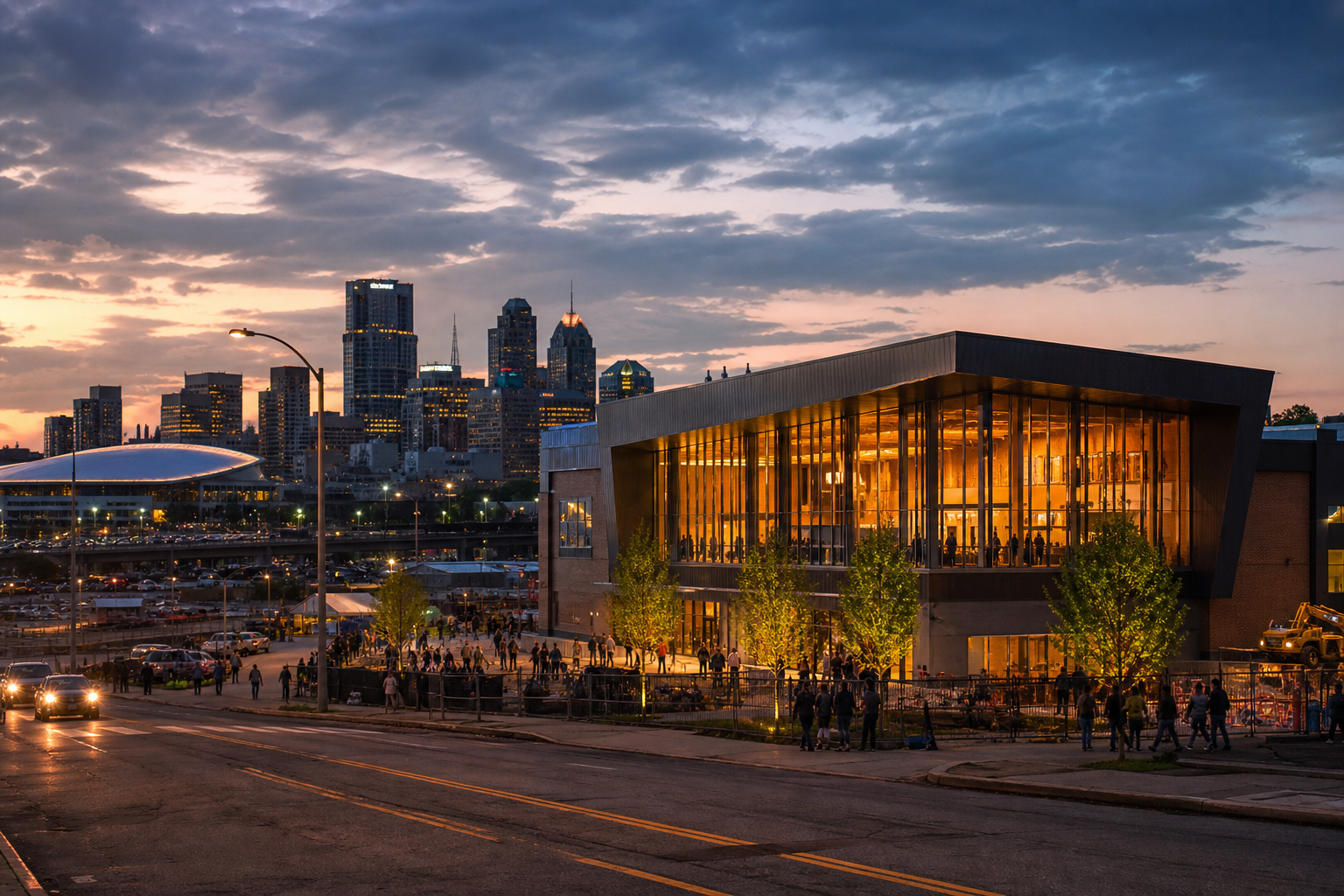
On October 1, Pittsburgh’s concert calendar gets a new address: 1201 Wylie Avenue, in the Lower Hill District. That is when Citizens Live at The Wylie is scheduled to open, with Role Model leading the first night and Wiz Khalifa, Styx, Foster the People, Two Door Cinema Club, Modest Mouse, Chance the Rapper, Boyz II Men, Jack White, and a long run of other touring acts already booked for the weeks that follow.
The building matters because it is large enough to catch artists who have outgrown a club but do not need an arena. It matters because Pittsburgh has not opened a major new entertainment venue since Stage AE arrived on the North Shore in 2010. And it matters because the room is being built on ground where the city once erased a dense, culturally influential neighborhood to make way for the Civic Arena.
That combination gives The Wylie a job beyond hosting concerts. It has to function as a working venue, a business, and a piece of the Lower Hill’s unfinished story.
A missing size in Pittsburgh’s live-music ecosystem
The basic pitch is straightforward: Citizens Live at The Wylie is a 98,500-square-foot venue with a capacity of approximately 4,500 people. That puts it in a useful space between the intimate rooms that define a club night and the much larger scale of PPG Paints Arena, Acrisure Stadium, or the Pavilion at Star Lake.
For concertgoers, that middle size can make a real difference. A developing artist may be too popular for a 1,000-person room but not yet ready for an arena. An established act may want a more concentrated audience and a closer sightline than a large bowl can provide. A touring production may need a serious backstage operation without filling 10,000 seats. The Wylie is designed to absorb those shows.
Its first run makes the strategy obvious. The schedule moves quickly between pop, hip-hop, rock, punk, metal, comedy, country, jam-oriented music, and legacy acts. Wiz Khalifa gives the venue an immediate hometown connection. Jack White and Modest Mouse point toward alternative and indie audiences. Boyz II Men and Smokey Robinson bring a different generation into the same room. An evening with Goose, presented by WYEP, suggests that the venue also wants a place in Pittsburgh’s broader listening culture rather than functioning only as a stop on the biggest national tours.
That range is important in a city where music audiences are often divided by room, neighborhood, and promoter. Stage AE remains a major North Shore destination. Roxian Theatre serves Millvale with a smaller indoor scale. Club Cafe continues to operate as one of the city’s essential listening rooms. The Wylie does not replace those spaces. Its long-term test will be whether it adds options without pulling oxygen from the venues that already do the detailed work of developing local scenes.
For some context on why room size and location matter here, RadioPGH’s Pittsburgh Listening Guide traces how Pittsburgh’s music history has always been tied to particular streets, clubs, radio signals, and social spaces. The Wylie arrives with that geography already attached to its name.
Wylie Avenue is not a decorative reference
Before the Civic Arena, Wylie Avenue was part of the commercial and cultural spine of the Hill District. The Lower Hill was home to residents, businesses, theaters, clubs, restaurants, and gathering places that helped make the neighborhood one of the most important Black communities in the country. Jazz musicians passed through. Local entertainers built careers there. The street was connected to Downtown by daily foot traffic and neighborhood commerce.
That street grid was broken apart in the 1950s, when the city cleared roughly 80 blocks of the Lower Hill to build the Civic Arena and related urban-renewal projects. Historic Pittsburgh records the displacement of approximately 8,000 residents. The demolition did not simply remove buildings; it scattered families, businesses, institutions, and the everyday routes that allowed a music culture to sustain itself.
The new venue cannot reverse that history. A concert hall is not a restored neighborhood. But the decision to call it The Wylie, rather than giving it an entirely placeless corporate identity, acknowledges that the address carries memory. The name puts Wylie Avenue into the conversation every time a ticket is bought, a show is announced, or somebody says where they are going after work.
The building’s interior design also attempts to make that acknowledgment visible. The venue is planned with photographs from Charles “Teenie” Harris’s Charles “Teenie” Harris Archive, the enormous collection of images documenting Black life in Pittsburgh and beyond. Harris was born and raised in the Hill District, and his photographs include the people, businesses, performances, political gatherings, and ordinary moments that give the neighborhood’s history its human scale.
That choice is more meaningful than a generic mural or a few historical captions because Harris’s work resists the idea that the Hill District can be reduced to either nostalgia or damage. His photographs show a living place: stylish, social, ambitious, funny, complicated, and full of people who were making culture rather than waiting to be remembered.
The question is what happens outside the doors
The Wylie is a partnership between Live Nation, the Pittsburgh Penguins, and Citizens Financial. It is also part of a larger redevelopment effort in the Lower Hill, an area that has spent decades moving between promises, surface parking, major construction, and community debate.
That means the venue will be judged on more than its sound system and booking calendar. Who gets hired? Who gets the contracts? Do show nights send business toward Hill District restaurants and organizations, or do crowds arrive through parking garages and leave without touching the neighborhood? Does the venue create pathways for Pittsburgh artists and workers, or does it operate as another national touring machine with a local address?
Live Nation has announced plans to hire approximately 350 workers, with wages starting at $20 an hour, and a hiring fair included a dedicated opportunity for Hill District applicants. Those are concrete steps, but they are starting points rather than proof of lasting impact. The measure will be continuity: repeat employment, local vendors, neighborhood partnerships, and programming that treats Pittsburgh’s Black musical history as part of the venue’s present rather than merely its lobby decoration.
The first season will also reveal how Pittsburgh audiences use the room. Will people treat it as an easy alternative to an arena? Will smaller touring acts find a dependable stop here? Can a 4,500-capacity hall support artists from different scenes without flattening their shows into the same commercial format? The answers will emerge gradually, one load-in and one crowd at a time.
A new room, with old expectations attached
Pittsburgh has a habit of making music venues carry more history than their walls can hold. The old Civic Arena was an engineering marvel and a civic landmark, but its creation was bound up with the destruction of the Lower Hill. The Wylie now stands nearby, in a redevelopment landscape shaped by that same history. It will host concerts under a name borrowed from the street that once led into a thriving neighborhood.
That does not make the venue automatically meaningful, and it does not settle the arguments around Lower Hill development. It does create a clear responsibility. The Wylie should be judged by the quality of the music, the treatment of workers, the relationship with Hill District residents, and the honesty of the story it tells about the land beneath it.
For listeners, the immediate invitation is simple: watch what comes through the doors this fall, and notice what the room makes possible. Keep an eye on the RadioPGH Schedule for local programming around the opening and the artists playing Pittsburgh’s growing circuit of rooms. When The Wylie begins filling up on October 1, it will not just be another stop on a tour route. It will be a new signal in an old neighborhood—one Pittsburgh will be listening closely to.
And when the next show catches your attention, you can Listen Live with RadioPGH for the music, context, and Pittsburgh connections that continue long after the encore.
The Revolution Is Live
You found the story. Now hear the station — independent Pittsburgh radio, live 24/7.
More from the Republic.

Meet RadioPGH.
Stay Tuned to Pittsburgh
New local music, RadioPGH stories, station updates, shows and events—straight to your inbox.