

In Pittsburgh, “Since I Don’t Have You” starts not in a glamorous recording studio but in the city’s Knoxville neighborhood, with Jimmy Beaumont still a teenager and a local music business that knew how to turn heartbreak into a record. The Skyliners’ 1958 ballad would travel from Pittsburgh radio to American Bandstand, the national charts, and generations of cover versions. But its emotional center stayed close to home: a young singer from Knoxville, a manager with a fresh breakup on his mind, and a city where a new record could become a hit before the rest of the country had even heard it.
That Pittsburgh origin matters because the song does not sound like a detached pop artifact. It sounds intimate, wounded, and carefully arranged all at once. The voices carry the ache, while the strings give the song a sweeping, almost cinematic lift. It was sophisticated enough for national pop radio, but its foundation was the same close-harmony culture heard in Pittsburgh neighborhoods, school hallways, dance halls, and late-night broadcasts.
A Knoxville singer and a group called the Crescents
Beaumont grew up in Knoxville, near Mount Oliver, and became fascinated by harmony through records and radio. In an era when families often gathered around music at home, he listened closely to singers including Nat King Cole and absorbed the sound of rhythm and blues and vocal groups. The eventual Skyliners did not emerge from a distant industry pipeline. They were Pittsburgh teenagers building a repertoire from the records available to them.
The original group came together in 1958 as the Crescents. The lineup brought together Beaumont on lead, Janet Vogel on soprano, Wally Lester and Joe Verscharen in the harmony sections, and Jackie Taylor on bass. Vogel’s presence was unusual for a male vocal group of the period, and her high part became one of the defining colors of the Skyliners’ sound.
The group’s Pittsburgh identity was reinforced by the city’s school and neighborhood networks. Members were connected to places including Allentown and St. George High School, while Beaumont’s Knoxville background gave the group a clear home base. This was not music invented in abstraction. It was music made by young people who were hearing one another across Pittsburgh’s hills and competing for attention in a crowded local scene.
The song begins at a stoplight
The story behind the song is almost perfectly suited to its title. Joe Rock, the group’s manager and promoter, wrote the lyric while sitting in his car between stoplights after a girlfriend left for flight attendant school on the West Coast. Beaumont took the words and wrote the melody the following night.
That division of labor became central to the record’s history: Rock supplied the direct, conversational heartbreak, and Beaumont found a melody that could make the loss feel enormous. A rough a cappella demo followed. During the recording, Vogel reportedly continued riffing after she thought the tape had stopped, creating the kind of unexpected vocal flourish that can define a record.
The demo was rejected by 13 established labels. The objections sound familiar in retrospect: the song was too negative, the title was supposedly wrong, and its repeated phrasing was considered commercially risky. In Pittsburgh, though, the song had something more important than a national executive’s prediction. It had a local audience and people willing to keep pushing it.
Calico Records and the sound of a local gamble
The answer came through Calico Records, a Pittsburgh-connected independent label associated with Lou Caposi, Bill Lawrence, and arranger Lennie Martin. The label gave the young group a chance, and Martin helped expand the song beyond a bare vocal-group performance.
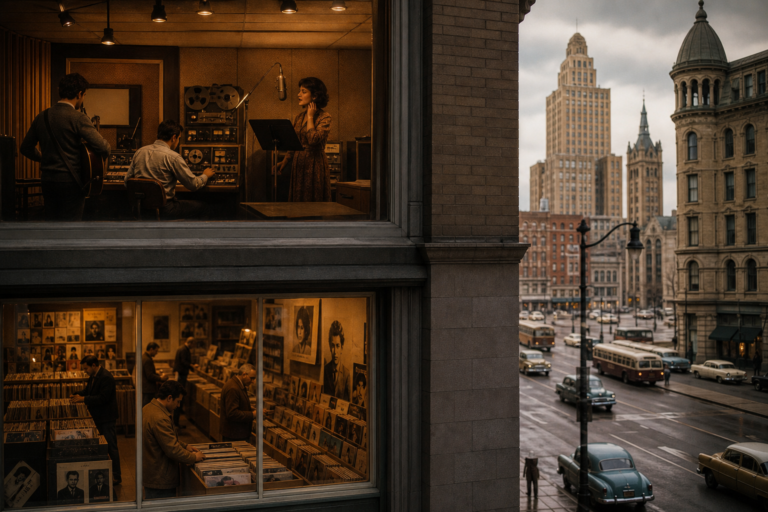
On December 3, 1958, the Skyliners recorded “Since I Don’t Have You” at Capitol Studios in New York. The session used a full complement of musicians, including strings, creating an orchestral frame around the group’s harmony. The combination was unusual for a young rock-and-roll vocal act. The arrangement did not erase the street-corner character of the singing; it magnified it.
The record was released just after Christmas 1958. Its first decisive victory came in Pittsburgh, where it rose to No. 1 locally. That early success reflects the power of the market at the time. Pittsburgh radio could make a regional record unavoidable, especially when influential disc jockeys were willing to play rhythm and blues and doo-wop before national programming followed.
From KDKA and KQV to national television
Stations such as KDKA, KQV, and WEEP helped put the song into the daily life of Western Pennsylvania listeners. Pittsburgh had already developed a strong appetite for vocal-group records, with DJs including Porky Chedwick and Mary Dee helping expose audiences to rhythm and blues. The city’s enthusiasm was not a footnote to the Skyliners’ success; it was the first engine of it.
The song’s local momentum led to a February 13, 1959, appearance on Dick Clark’s American Bandstand. The performance was lip-synched, as was standard for the program, but the national exposure pushed the record into the Billboard charts and helped turn the Skyliners from a Pittsburgh attraction into a touring act. The song reached No. 12 on the pop chart and No. 3 on Billboard’s R&B chart, while also topping the Cash Box R&B listing.
There is a telling Pittsburgh detail in that crossover. The Skyliners were a white group working in a musical world shaped heavily by Black rhythm and blues singers and vocal groups. Their influences included acts such as the Platters and the Moonglows, and the group later performed on the so-called chitlin circuit, including appearances at Harlem’s Apollo Theater. The record’s success crossed the categories that the music business tried to keep separate.
Why the arrangement still feels bigger than heartbreak
“Since I Don’t Have You” works because every part of it pulls in the same direction. Beaumont’s lead is controlled rather than theatrical. The group’s harmonies create a steady emotional pressure. The strings add grandeur without turning the song into something anonymous. The result is a teenage breakup song that feels almost operatic, even though its origin is remarkably ordinary: a car, a series of stoplights, and a melody written by a young Pittsburgh singer.
That tension between the local and the expansive is part of the Pittsburgh story. The song carries the close-knit logic of a neighborhood group, but it also reaches for the scale of a movie ending. It is easy to understand why later listeners heard possibilities in it. The record appeared in American Graffiti, and artists from Stevie Wonder to Guns N’ Roses brought their own interpretations to the composition. Those versions kept returning attention to the original without replacing it.
For more on the radio, neighborhoods, and performers that shaped Pittsburgh listening culture, RadioPGH’s Pittsburgh Listening Guide places the Skyliners in a larger but still distinctly local soundscape. The group belongs in that story not simply because it had a national hit, but because the hit was first tested and embraced here.
A song that stayed in the Pittsburgh conversation
The Skyliners followed “Since I Don’t Have You” with other successful records, including “This I Swear” and “Pennies from Heaven.” The original group eventually split in the early 1960s, just before the British Invasion changed the commercial landscape. But Beaumont continued performing with versions of the Skyliners for decades, and the song remained part of Pittsburgh’s living musical memory.
That memory has surfaced in local venues and institutions over the years, from Roots of Rock and Roll programs at the Benedum Center to Pittsburgh Rock ’N’ Roll Legends events at Stage AE. It also lives in the work of local broadcasters and historians who preserve the connections among songs, neighborhoods, and the people who first made them matter. RadioPGH’s Pittsburgh Stories & Takes carries that same idea forward: music history is strongest when it can still be located on a map.
So when “Since I Don’t Have You” comes through the speakers, listen past the familiar sadness. Hear Knoxville in Beaumont’s voice, Allentown in the group’s local network, Calico’s independent gamble, the old Pittsburgh radio stations taking a chance on a new record, and the carefully placed strings that made a neighborhood heartbreak sound universal.
That is the Skyliners’ Pittsburgh story: not a myth about instant fame, but a chain of local decisions. A singer listened. A manager wrote. Teenagers harmonized. A label took the risk. Pittsburgh radio made the record real. And decades later, the song still belongs on the air. Listen Live to RadioPGH for more of the city’s music history, heard in the same spirit that first carried the Skyliners out of Knoxville and into the world.
Steelers Realm
You found the story. Now hear the station — independent Pittsburgh radio, live 24/7.
More from the Republic.


Meet RadioPGH.
Stay Tuned to Pittsburgh
New local music, RadioPGH stories, station updates, shows and events—straight to your inbox.