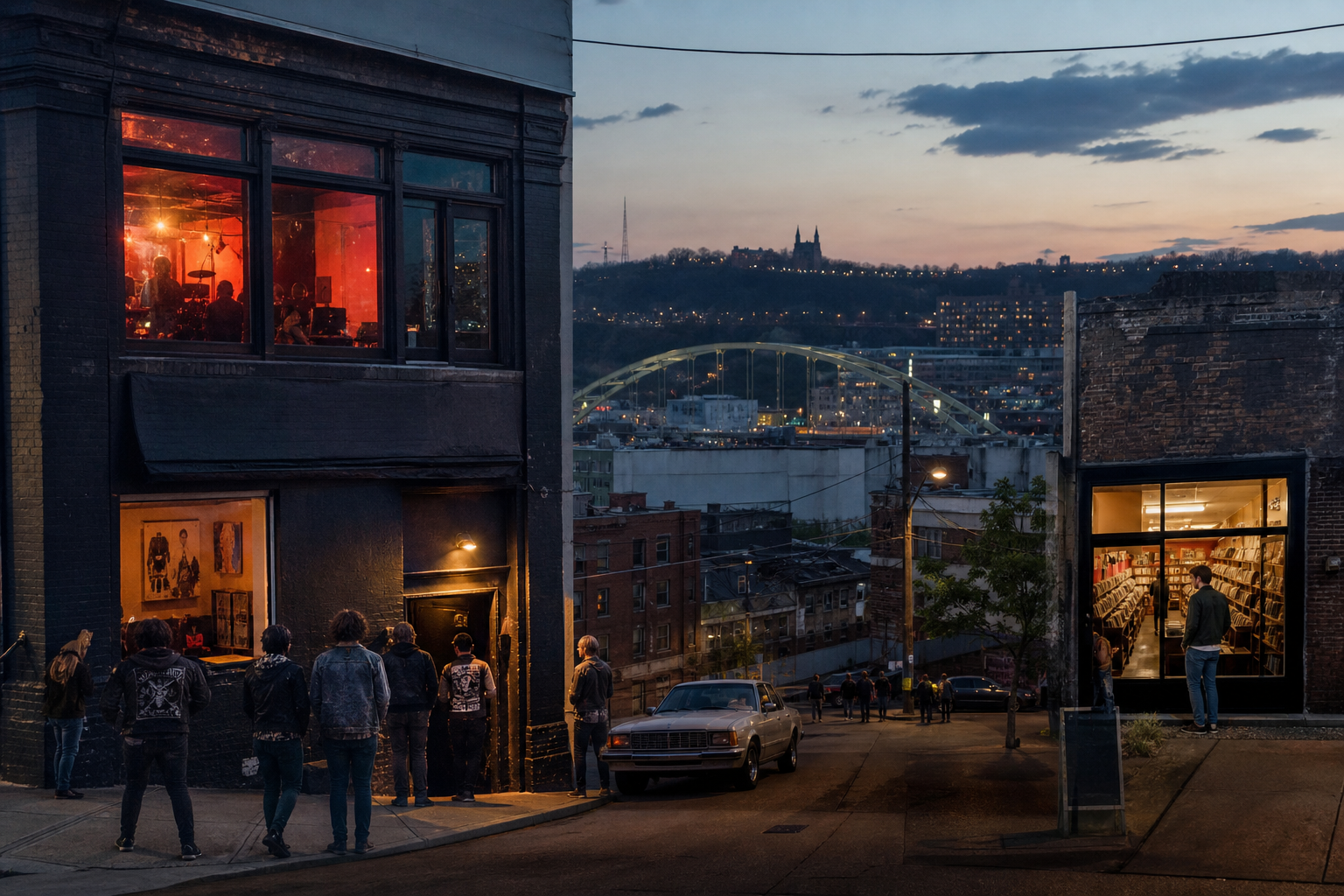
Stand on Wylie Avenue in the Hill District and Pittsburgh’s musical history stops feeling like a timeline. It becomes a set of overlapping rooms: a jazz club with the door propped open, a church rehearsal, a basement punk show, a DJ working a cassette deck, a dance floor still going after midnight. The city has never had just one sound. Its music comes from migration, work, neighborhood identity, immigrant traditions, college radio, independent venues, and the stubborn local habit of making something happen with whatever room and equipment are available.
That is why Pittsburgh music is best understood through scenes and communities rather than a single signature genre. Jazz made the Hill District internationally known. Hip-hop turned neighborhood detail into a calling card. Punk used difficult rooms and limited resources as creative fuel. Folk, bluegrass, gospel, polka, soul, house, techno, and experimental music all found their own routes through the region. The common thread is not style. It is access: who had a place to play, who built an audience, and who kept the sound moving when the obvious institutions were not interested.
Wylie Avenue made Pittsburgh a jazz city
From the 1930s through the 1950s, the Hill District was one of the most important Black entertainment centers in the country. The neighborhood’s nightclubs and theaters connected Pittsburgh to the national jazz circuit, while also giving local musicians a place to develop in public. Wylie Avenue was the central corridor, but the sound extended through the Crawford Grill, the Savoy Ballroom, the Granada Theater, the Hurricane Lounge, and other clubs and social spaces.
The names attached to that world are not minor footnotes. Billy Strayhorn, Mary Lou Williams, Art Blakey, Billy Eckstine, Lena Horne, and Earl “Fatha” Hines all had deep connections to Pittsburgh’s Black musical life. The Crawford Grill hosted figures including Louis Armstrong, Ella Fitzgerald, Dizzy Gillespie, Miles Davis, and Stanley Turrentine. The point is not simply that famous musicians passed through. The Hill gave them an audience, working musicians, entrepreneurs, and a cultural network that made ambitious music possible.
That network was shaped in part by the Great Migration, as Black migrants from the South brought musical traditions, church life, business knowledge, and new urban ambitions to Pittsburgh. Jazz in the Hill was therefore not an imported soundtrack pasted onto the city. It was part of how a community built a public life under pressure, turning restaurants, clubs, newspapers, churches, and social halls into an ecosystem.
For a deeper route through that history, RadioPGH’s Pittsburgh listening guide connects Wylie Avenue jazz to the broader experience of hearing Pittsburgh through records, radio, and place.
The city’s many immigrant rhythms
Pittsburgh’s musical identity also lives beyond the club district. Generations of immigrants brought dance music, sacred music, brass-band traditions, choral practices, and instruments that became part of everyday regional culture. The Pittsburgh Folk Festival helped make that diversity visible, while organizations such as the Slovenian Heritage Association kept particular traditions active across generations.
The accordion, polka band, tamburitza ensemble, and church choir are not decorative side notes to Pittsburgh culture. They are evidence of how music carried language and memory through neighborhoods that were changing quickly. The Kalik Orchestra’s “Steeler Fight Song,” documented in the Historic Pittsburgh collections, is a particularly Pittsburgh example of that crossover: ethnic dance-band musicians creating a recording that entered the city’s sports culture.
That same overlap appears in the region’s relationship to Appalachian and country music. Western Pennsylvania sits at a meeting point between industrial cities, coal-country communities, and rural migration routes. Bluegrass, old-time music, gospel, and country could sound equally at home at a festival, a church picnic, a union gathering, or a bar. Pittsburgh’s roots music is less about a museum version of Appalachia than about circulation: people moving into and through the region, carrying songs with them.
Punk found its room in Oakland, then built its own
Pittsburgh punk has always sounded practical. Not polished, necessarily, but resourceful: loud guitars in a small room, borrowed equipment, a show organized by people who needed somewhere to play. The Electric Banana became the city’s defining punk and metal venue after local musicians convinced owner Johnny Zarra to give the music a chance around 1980. The North Oakland club became a crucial stop for touring acts including Black Flag, the Circle Jerks, the Misfits, Hüsker Dü, the Dead Milkmen, the Butthole Surfers, and They Might Be Giants, while also giving Pittsburgh bands such as the Rave-Ups and the Cynics an important platform.
Its significance was not just the famous guest list. The Banana connected college students, East End residents, local bands, and touring underground musicians in a space that was rough around the edges and open to music that more conventional clubs did not understand. That is a very Pittsburgh kind of cultural infrastructure: not glamorous, but useful.
When the Banana closed in 2000, the DIY impulse did not disappear. The Mr. Roboto Project began as a volunteer-run cooperative in Wilkinsburg in 1999, then moved to the Penn Avenue Arts District in 2010. Its importance comes from the range of music it has made room for, including punk, experimental work, solo performers, and indie rock. More than a venue, Roboto represents a community deciding that affordability, participation, and safer-space values are part of the music itself.
That spirit runs through the city’s independent rooms, from house shows and art spaces to Club Cafe, whose long history is part of the story told in RadioPGH’s look at the South Side listening room. The room matters because continuity matters. Scenes survive when artists can return, audiences can gather, and somebody keeps the calendar.
Hip-hop made neighborhood geography audible
Pittsburgh hip-hop developed through radio, school, dance crews, record stores, parties, and neighborhood networks. Point Park University’s WPPJ had DJs playing rap as early as 1978, before “Rapper’s Delight” became a national landmark. WAMO helped bring the music to a wider local audience, while artists and DJs in the Hill District, Homewood, East Liberty, Garfield, Arlington Heights, McKeesport, and elsewhere built their own circuits.
That geography matters. Pittsburgh rap has often carried the sound of specific streets and borough lines: the clipped local vocabulary, the pride and frustration of being underestimated, the feeling that every neighborhood has its own history and code. Groups such as the Sinisters of Sound helped establish an early local foundation, while later artists including Wiz Khalifa, Mac Miller, and Jimmy Wopo showed different ways Pittsburgh could travel through hip-hop without losing its accent.
The city’s rap story also reveals the limits of Pittsburgh’s music economy. Talent has rarely been the central problem. Consistent stages, media attention, investment, and room for Black artists to define their own audiences have been harder to secure. That tension is part of the sound too: resourceful, self-released, collaborative, and often more visible outside the region than inside it.
Radio and late-night communities keep the map connected
Radio has long been one of Pittsburgh’s most important musical meeting places. WYEP began broadcasting in 1974 from South Oakland with an all-volunteer staff and an unusually broad mix of jazz, blues, rock, soul, folk, gospel, bluegrass, reggae, new wave, poetry, and ethnic programming. That range helped establish a local expectation that radio could be more than a pipeline for hits. It could be a guide to scenes listeners had not yet learned how to name.
Today, Pittsburgh’s musical communities continue to overlap in unexpected ways. Electronic music has its own deeply committed audience through parties such as Hot Mass. Indie and experimental artists move between clubs, galleries, colleges, and cooperative spaces. Gospel, jazz, metal, country, punk, and rap remain connected by musicians who play across stylistic borders, even when the city’s institutions sort them into separate categories.
That is the real Pittsburgh sound: not one genre, but a listening culture built from neighborhoods and persistence. It is Wylie Avenue remembered through a club recreation and an archive, a three-dollar punk show, a local rapper’s cassette, an accordion line that turns into a Steelers anthem, a DJ finding something strange after midnight, and a community radio host giving it context.
RadioPGH exists inside that tradition: listening locally, making room for discovery, and treating Pittsburgh music as a living conversation rather than a finished history. Follow the RadioPGH schedule, explore the city through Pittsburgh’s neighborhood map heard through music, and when the next unfamiliar local track comes on, listen live. That moment of recognition—or surprise—is where the city keeps sounding like itself.
The Revolution Is Live
You found the story. Now hear the station — independent Pittsburgh radio, live 24/7.
More from the Republic.

Meet RadioPGH.
Stay Tuned to Pittsburgh
New local music, RadioPGH stories, station updates, shows and events—straight to your inbox.