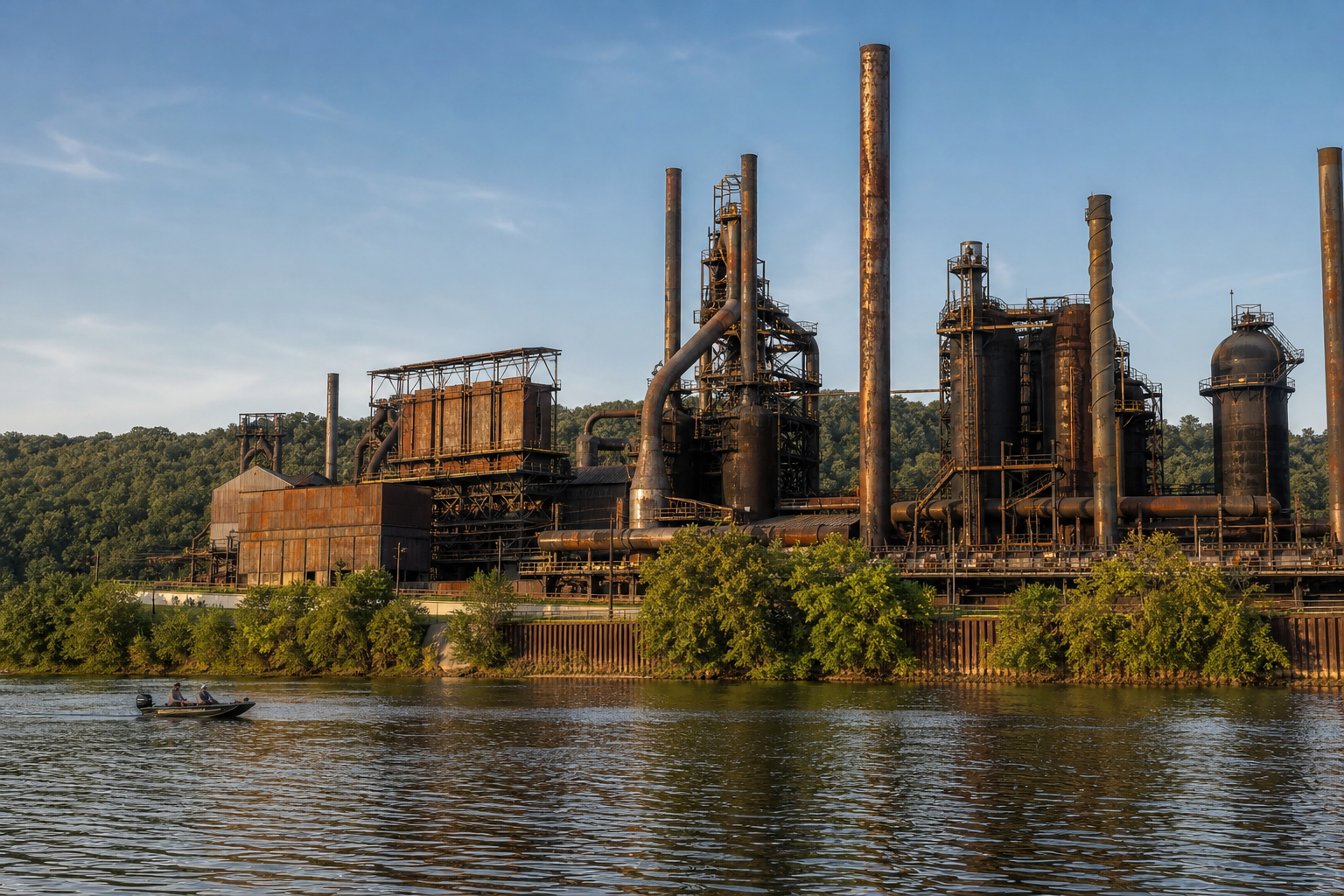
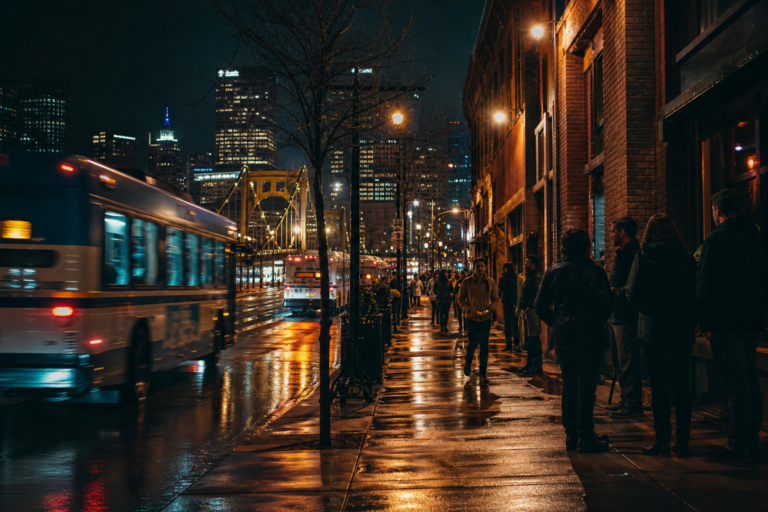
On a summer evening, Downtown Pittsburgh can still deliver the scene that makes the Golden Triangle feel unmistakably like Pittsburgh: a crowd moving between Point State Park and the Cultural District, buses rolling down Smithfield Street, the river air coming up through the streets, and music or theater pulling people toward the next block.
But the future of Downtown is no longer a question of restoring the old office district exactly as it was. The office-heavy model has changed, and the numbers make that plain. The Pittsburgh Downtown Partnership reported that average daily activity—residents, employees, and visitors—fell from 89,825 in 2024 to 85,843 in 2025. At the same time, Downtown’s residential inventory grew to 4,489 units, with residential occupancy reaching 93 percent.
That tension defines Downtown in 2026. People are returning, but not in the same pattern. The neighborhood has more residents, more public programming, and more reasons to visit after work. It also has aging office buildings, uneven foot traffic, affordability concerns, and the persistent question of whether a busy event weekend can turn into a dependable everyday neighborhood.
What’s working: public space that gives people a reason to stay
The clearest success stories are places that treat Downtown as a public room rather than a collection of office lobbies.
Market Square’s $15 million modernization was completed in April 2026, adding wider pedestrian areas, improved accessibility, more outdoor dining potential, a central pavilion, and infrastructure for year-round programming. That matters because Market Square already had a proven audience. The redesign is an attempt to make that energy more comfortable and more useful on an ordinary Tuesday, not only during a festival or holiday market.
Arts Landing, the new four-acre park on Penn Avenue between Eighth and Ninth streets, pushes that idea further. The project converted a vacant lot into Downtown’s first public playground, a one-acre great lawn, public art, a stage and canopy, and space for future pickleball courts and a fitness track. It opened into the national spotlight during the April 23–25 NFL Draft, but its real test is what happens after the cameras leave.
Arts Landing also gives the Three Rivers Arts Festival a permanent downtown home. That is a practical cultural investment: the festival can build an identity around a dependable space, while families, artists, and visitors gain a destination that is useful even when no major event is taking place. The Pittsburgh Cultural Trust has helped make the Cultural District a reliable anchor for theater, dance, film, galleries, concerts, and outdoor events. Arts Landing extends that cultural geography toward the river and Penn Avenue.
The lesson is straightforward. Downtown works best when the public realm is active, flexible, and welcoming to people who are not there to spend money immediately. A lawn, playground, pavilion, performance, or shaded place to sit can create the conditions for restaurants, shops, and galleries to benefit later.
What’s changing: housing inside the office district
The most consequential shift is happening above street level.
Pennsylvania’s 10-year, nearly $600 million Downtown revitalization plan is backing office-to-residential conversions, public-space improvements, safety, cleanliness, affordability, and small-business support. The strategy recognizes a basic problem: a Downtown designed around office workers cannot thrive if office attendance remains permanently below its pre-pandemic pattern.
One tangible example is Smithfield Lofts at 4 Smithfield Street. The 12-story, 120-year-old office building is being converted into 46 housing units, including 39 affordable units. The project also includes a community room, children’s playroom, bike room, fitness center, office space on the lower floors, and retail at street level. Completion is expected in 2027.
That kind of conversion does more than add apartments. Residents create demand at different hours. They need groceries, child care, coffee, prescriptions, repairs, dining, transit, and places to meet. They also make a quiet block feel less like a closed commercial corridor after 5 p.m.
Still, 46 apartments cannot solve Downtown’s housing challenge by themselves. The larger residential pipeline includes market-rate projects and additional conversions, but the neighborhood will need a real mix of incomes and household types if “mixed-use” is going to mean more than luxury apartments above restaurants. Affordability is not a side issue. It determines whether Downtown becomes a neighborhood for families, service workers, artists, students, and older residents—or primarily a high-cost extension of the region’s professional class.
What isn’t working yet: the gap between a busy event and a daily neighborhood
Pittsburgh has become very good at producing moments. Picklesburgh can fill the streets. The Cultural District can move thousands of people between theaters. The NFL Draft brought an enormous national audience in April. But an event is not the same thing as a sustainable downtown economy.
The Pittsburgh Downtown Partnership’s 2025 numbers show both progress and a warning. Downtown recorded more than 18 million visitors during the year, but total daily activity still declined from 2024. Parking utilization rose to 73 percent, which suggests demand remains strong in certain patterns, while the broader activity count shows that office-worker volume has not been fully replaced by residents and visitors.
That unevenness is visible block by block. One plaza can feel full while a nearby storefront sits empty. A theater crowd can make Liberty Avenue feel vibrant for two hours, then disappear into garages and transit stations. The future depends on connecting those islands of activity so that people linger, walk, and return.
Safety and cleanliness are part of that connection, but they cannot be separated from design and daily use. Better lighting, active storefronts, visible public services, dependable transit, and more residents all help a street feel cared for. So does consistent maintenance. The city’s proposed Downtown Transit Revitalization Investment District could create long-term funding for infrastructure, small-business support, residential conversions, facade improvements, and major development projects. The important word is long-term. Downtown cannot be rebuilt through one-time event money alone.
Why Smithfield Street matters
The planned Smithfield Street Reconstruction Project is one of the most important tests ahead. The city plans a full reconstruction from Forbes Avenue to Liberty Avenue, with expanded sidewalks, pedestrian safety bump-outs, landscaping, improved signage and markings, artistic-lighting infrastructure, and continued transit access. Phase one, from Forbes Avenue to Sixth Avenue, is expected to begin in late summer 2026.
Smithfield is not just another roadway. It links the Cultural District, Market Square, Mellon Square, the subway, office towers, hotels, restaurants, and the riverfront. If the redesign works, it can become a spine for the next version of Downtown: more walkable, more comfortable, and better able to support outdoor dining, small businesses, public art, and neighborhood life.
The proposal to investigate restaurant use in the storefronts beneath Mellon Square points in the same direction. It connects an underused edge of the park to food, seating, and activity. But the city will need to protect access, affordability, and the park’s civic character while adding commercial uses. Activation should mean more than finding a tenant; it should mean creating a place people feel welcome using without having to buy something.
What comes next: make Downtown useful between the big moments
The next phase should be judged by ordinary measures. Can someone living Downtown get through a week without leaving the core for basic needs? Can a small retailer survive outside festival season? Can a parent use the public spaces with a child? Can a concertgoer move safely from the T to a theater and then find a late meal? Can a local artist find affordable space to work, perform, or show? Can a bus rider rely on the street design as much as a driver does?
Those questions connect Downtown to the neighborhoods around it. The planned bus rapid transit improvements between Downtown, Uptown, and Oakland matter because Downtown’s future is tied to students, hospital workers, artists, service employees, and residents arriving from across the region. A more useful core should not be isolated from the East Busway, the Hill District, the Strip District, North Shore, or Oakland.
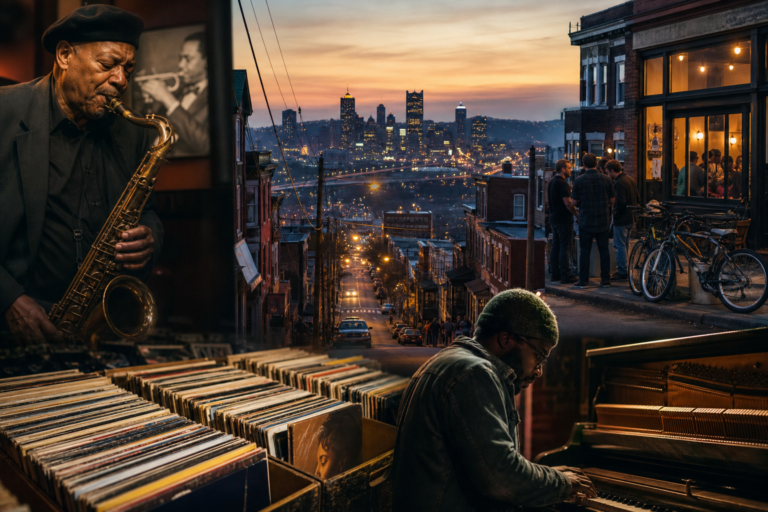
For Pittsburgh listeners, this is where culture becomes more than a calendar of events. A live performance at the Benedum Center, a film at the Harris Theater, a DJ set, a public-art installation at Arts Landing, or music spilling out around Market Square can turn infrastructure into memory. RadioPGH’s Can Pittsburgh Become a 24-Hour City Again? asks the right larger question: what would it take for Pittsburgh to remain alive after the office day ends?
The answer will not be one shiny development or one huge event. It will be a Downtown with enough housing to support daily life, enough affordable space for culture and small business, enough transit to connect the region, and enough well-designed public space for people to stay when they are not buying a ticket.
That is the version of Downtown worth listening for now: the construction noise on Smithfield, the crowd crossing from Market Square, the bass from a Cultural District performance, the voices gathering at Arts Landing, and the steady movement of people who are choosing to make the Golden Triangle part of their day. Find that evolving mix on the RadioPGH Schedule, or Listen Live as Pittsburgh’s next chapter takes shape.
The Revolution Is Live
You found the story. Now hear the station — independent Pittsburgh radio, live 24/7.
More from the Republic.
Meet RadioPGH.
Stay Tuned to Pittsburgh
New local music, RadioPGH stories, station updates, shows and events—straight to your inbox.