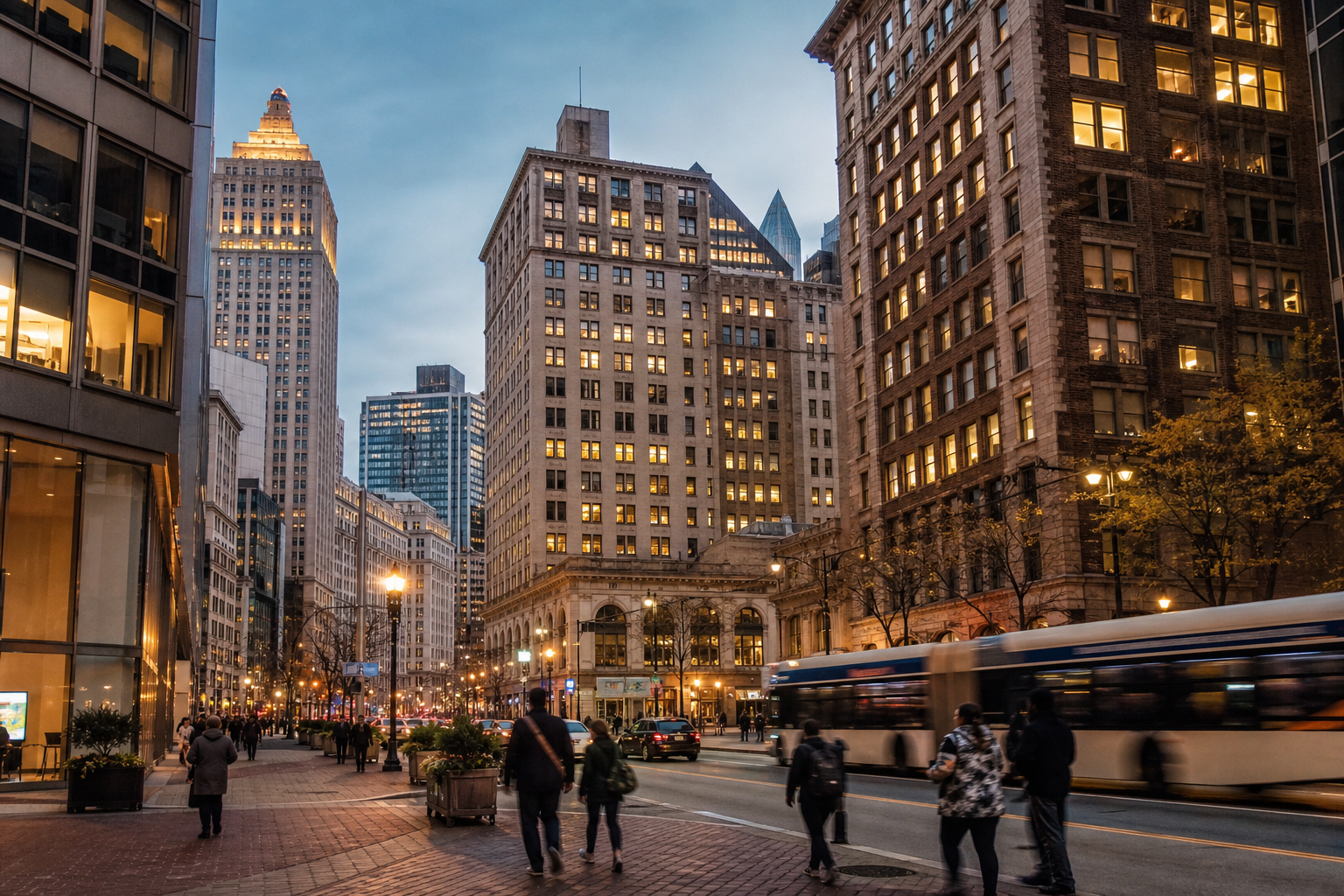
At the corner of Sixth Avenue and Wood Street, one of Downtown Pittsburgh’s most familiar office addresses is learning a new language. The former GNC headquarters is now LiveWell Apartments, and the next tenant announced for its ground floor is not another corporate suite: Caffeena Coffee House, a Yemeni-American coffee company planning a 4,500-square-foot flagship with coffee, bakery and deli service, specialty groceries, meeting rooms and a children’s play area.
That detail matters because it captures the larger shift underway in the Golden Triangle. Downtown is no longer being pitched only as the place where Pittsburgh goes to work, catch a matinee at Heinz Hall, or hurry across Market Square between appointments. It is being rebuilt as the place where people wake up, buy groceries, meet friends, raise children, attend classes, hear music and stay out after the office lights go dark.
The question is not simply whether more apartments are coming. The more interesting question is who those apartments are meant to hold — and what kind of neighborhood their arrival will create.
From office district to actual neighborhood
The Pittsburgh Downtown Partnership has set a clear target: grow Downtown’s residential population from roughly 7,300 people to 15,000 over the next decade. That is an ambitious number, but it is tied to a practical problem. A district dominated by office workers can support weekday lunch, parking and commuter transit. A district with residents can support the less glamorous but more important parts of daily life: a pharmacy, a late coffee, a Saturday breakfast, a playground, a dog walk and a reason to keep storefronts open year-round.
The population has already moved in the right direction. Recent Pittsburgh Downtown Partnership reporting cited by local outlets put the Golden Triangle’s population at about 7,000 in 2024, up 23 percent from 2019. Apartment occupancy was reported at roughly 91 percent in late 2024, suggesting that the demand is not only theoretical. People are choosing Downtown, even while the daytime office economy is still recovering.
That recovery is uneven. Downtown’s daily activity remains below its pre-pandemic level, largely because fewer office workers are present every day. Residential growth is therefore being asked to do more than add bodies to empty towers. It is being asked to change the rhythm of the streets.
RadioPGH has followed that question in RadioPGH’s look at the future of Downtown Pittsburgh, where housing, public space, culture and street-level business all become part of the same conversation. In the Golden Triangle, those subjects are inseparable.
So who is moving in?
The first answer is familiar: young professionals, recent graduates and students. Downtown offers what many of them are actually shopping for — compact apartments, quick access to transit, proximity to Point Park University and other institutions, and a front door within walking distance of the Cultural District, PPG Paints Arena, Acrisure Stadium, PNC Park and the North Shore.
That does not mean every new resident is a twenty-something renter. Downtown’s housing mix also appeals to empty nesters and older residents looking to trade a house and a long commute for elevators, views and cultural access. The neighborhood’s appeal is less about a single demographic than about convenience. A resident can walk from Firstside to Point State Park, take light rail toward the South Hills, cross the river for a game, or catch a performance at the Benedum Center without getting into a car.
Families are part of the intended future, too, although they face a more difficult housing market. Many existing Downtown units are studios and one-bedrooms, a pattern that naturally favors single adults and couples without children. The new pipeline is beginning to widen that picture. Smithfield Lofts, a twelve-story office conversion at 4 Smithfield Street, is planned to include four efficiency units, 25 one-bedroom apartments and 17 two-bedroom apartments, along with a child playroom, community room, fitness room, bike storage and laundry facilities.
Those amenities are not decorative extras. They signal that developers and public agencies understand the difference between a residential building and a neighborhood building. A two-bedroom apartment gives a family more room; a playroom and community room give that family somewhere to exist outside the apartment.
The affordable-housing piece is becoming central
The most important answer to “who is moving in?” may be found in the projects that do not fit the luxury-apartment stereotype.
In February 2026, the Housing Authority of the City of Pittsburgh and its development arm, Allies & Ross Management and Development Corporation, announced more than $17 million in gap financing and project-based vouchers for seven Downtown developments. Together, the projects represent nearly 500 affordable and mixed-income units, including First & Market, Smithfield Lofts, Ross Lofts, 421 Seventh Avenue, 901-903 Liberty Avenue, the May Building and 120 Cecil Way.
120 Cecil Way is especially revealing. The project will reuse a decommissioned steam plant as housing connected to Pittsburgh Scholar House’s Wayfinders program. Forty-nine project-based vouchers are intended for single parents pursuing two- or four-year degrees, with childcare, counseling, career preparation and transportation assistance incorporated into the development.
That is a very different picture of Downtown than the one created by glossy renderings of rooftop lounges. It says the Golden Triangle’s future residents may include parents studying for a better job, children growing up near the river, and workers who need a stable home more than they need a luxury amenity package.
Smithfield Lofts will add 46 apartments, 39 of them affordable, but its construction schedule also shows why the transformation will take time. The nearly $30 million conversion broke ground in May 2026 and is expected to be completed in fall 2027. First & Market, a separate conversion at 100 First Avenue, was expected to deliver 93 affordable units in 2026. Other projects are at different stages, from construction to financing and closing.
Old towers, new routines
The Golden Triangle’s residential revival is largely an adaptive-reuse story. The Gulf Tower is planned for conversion into apartments, a hotel and street-level commercial space. The Porter is slated to bring 165 residential units to an office complex. The former YWCA site at 305 Wood Street is planned as City Club Apartments, a 294-unit residential complex with restaurant and retail space. Office buildings along Penn Avenue, Liberty Avenue and Seventh Avenue are also being reconsidered as housing.
Not every office tower can become an apartment building. Window placement, plumbing, elevators, fire codes, financing and historic-preservation requirements can make conversions expensive and technically awkward. That is why public money matters here. The state’s ten-year, $600 million Downtown revitalization plan is supporting a broader effort expected to create or preserve up to 1,000 residential units, with roughly a third designated as affordable for low- and moderate-income residents.
The public-space work is just as important as the unit count. Market Square’s renovation, improvements at Point State Park and the Pittsburgh Cultural Trust’s 8th Street Block project are meant to make Downtown more usable between major events. A resident does not experience a neighborhood as a spreadsheet of apartments. They experience it through sidewalks, shade, benches, lighting, parks, storefronts and the distance between home and an ordinary errand.
What kind of culture follows the residents?
Culture is one of Downtown’s strongest existing assets, but residential growth changes how that asset functions. The Cultural District already offers the Pittsburgh Cultural Trust, the August Wilson African American Cultural Center, the Benedum Center, the Byham Theater and Heinz Hall. The challenge is turning those destinations into part of a weekly routine rather than occasional outings.
That is where a place like the planned Caffeena becomes a useful signpost. A coffeehouse with Yemeni and Turkish coffee, food, groceries, meeting rooms and a children’s area is designed for more than pre-theater traffic. It reflects a Downtown trying to serve residents at different hours and life stages. The same is true of public performances, outdoor events and new gathering spaces tied to the Cultural District.
For RadioPGH, this is the part worth listening to. Pittsburgh’s music life has never belonged to one neighborhood or one audience. It moves through the Cultural District, the North Side, the Hill District, the South Side and the East End, carried by venues, artists, listeners and the people who make a city feel inhabited. A growing Downtown audience adds another layer: more people who can hear a late set, walk home from a concert, or discover a local artist because the sound is happening downstairs.
There are still real tests ahead — affordability, street safety, retail stability, transit access and whether families can find the right kind of housing. Doubling the population will not solve those questions by itself. But it does create the possibility of a stronger loop: residents support businesses, businesses make the streets feel lived-in, public spaces invite people outside, and culture gives the neighborhood a reason to gather.
In August 2026, Pittsburgh’s Golden Triangle is not finished, and it is not suddenly transformed. It is in the middle of becoming something more complicated than an office district: a place for students, young workers, downsizers, artists, parents and neighbors who want the city close at hand. Keep an ear on that transition with the RadioPGH schedule, and when Downtown starts sounding less like a corridor and more like home, Listen Live.
The Revolution Is Live
You found the story. Now hear the station — independent Pittsburgh radio, live 24/7.
More from the Republic.
Meet RadioPGH.
Stay Tuned to Pittsburgh
New local music, RadioPGH stories, station updates, shows and events—straight to your inbox.