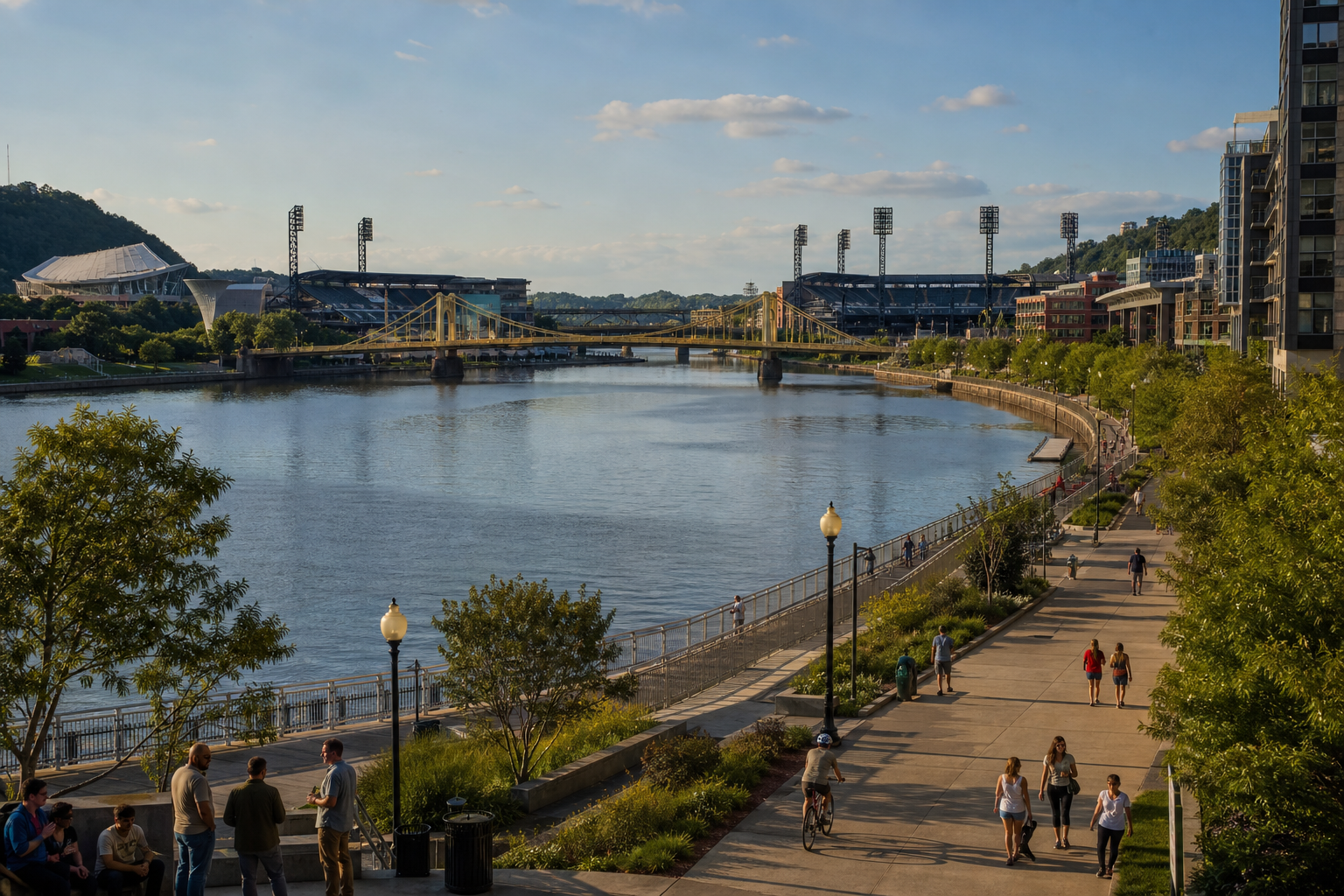
On a September evening, the North Shore can still look like the most efficient sports district in America: PNC Park glowing over Mazeroski Way, Acrisure Stadium looming west of it, the Roberto Clemente Bridge carrying pedestrians toward Downtown, and a steady stream of people moving with the purpose of a first pitch or kickoff.
But the more revealing version of the North Shore is the one that appears between events. A child heads into the Kamin Science Center. Cyclists follow the Three Rivers Heritage Trail. A concert crowd gathers at Stage AE. People linger near Allegheny Landing, where Riverlife’s Shore Thing has turned a set of working barges into a seasonal floating hangout. Across the water, the Downtown skyline becomes less of a backdrop and more of a neighbor.
That in-between life is the real story. Pittsburgh’s stadium district is no longer just a place built to absorb enormous crowds a few dozen times a year. It is becoming a connected North Side waterfront, with entertainment, housing, science, trails, public space, and increasingly ambitious plans for what happens when nobody is wearing a jersey.
From destination to district
The North Shore has always had more going on than its stadium names suggest. The former Carnegie Science Center—now the Kamin Science Center—has made the riverfront a destination for school groups, families, planetarium audiences, and anyone willing to climb aboard the USS Requin. The Andy Warhol Museum gives the eastern end of the district a different cultural gravity, one rooted in North Side history and contemporary art rather than professional sports.
Stage AE is the hinge between those worlds. Its indoor music hall, club, and outdoor amphitheater allow the North Shore to host everything from a mid-sized touring act to a large summer concert without pretending every show belongs in an arena. That flexibility matters in a city whose music calendar depends on rooms of very different sizes. The North Shore is not replacing neighborhoods such as Lawrenceville, Bloomfield, or the South Side as places where music culture develops. It is adding a high-capacity, river-facing piece to the network.
Rivers Casino adds another layer: not a civic institution in the same way as Kamin or the Warhol, but a year-round entertainment operator with restaurants, bars, gaming, and an event center. Taken together, these places create a concentration that Pittsburgh formally recognized in 2026 when City Council established the North Shore Entertainment District. The new district stretches generally from the Rivers Casino area toward Sandusky Street and divides the waterfront into five subdistricts: Acrisure Stadium, PNC Park, Casino, Science Center, and Pop.
The signage ordinance may sound like a technical planning matter, but it reveals how the city now understands the area. The North Shore is being managed and marketed as a single entertainment landscape rather than as two stadiums surrounded by leftover parcels.
The riverfront is becoming part of the program
For years, the river was the North Shore’s great visual asset and its least fully used public room. The trail and parks offered spectacular views, but the experience could feel like a corridor between parking, stadium walls, and isolated attractions. New programming is beginning to test a different idea: the riverfront itself can host culture.
Shore Thing, launched by Riverlife in 2025 near Allegheny Landing and the Sister Bridges, is a small but telling experiment. Built from ten steel barges, it offers a place to sit, eat, hear music, encounter art, or simply look back at Downtown from the water. It is temporary and seasonal, which is part of its value. A floating platform does not solve the North Shore’s larger urban questions, but it demonstrates how quickly a familiar piece of infrastructure can become a social space when people are invited to use it differently.
The location is important. Allegheny Landing is not an anonymous patch of lawn; it was dedicated in 1984 as one of Pittsburgh’s first modern riverfront parks and one of the country’s early urban sculpture parks. The Andy Warhol Bridge and Roberto Clemente Bridge frame it. That combination of art, bridges, baseball, and public space gives the North Shore a stronger cultural vocabulary than “stadium district” suggests.
The next challenge is continuity. A riverfront trail is most useful when it connects places people actually want to reach, not just when it provides a scenic walk after parking. Better links among the stadiums, the Science Center, Allegheny Landing, the Warhol, the T stations, and nearby North Side neighborhoods will determine whether the North Shore feels like a district or a collection of destinations separated by traffic.
Housing changes the rhythm
The clearest sign of an everyday North Shore is residential construction. For much of its modern life, the area between PNC Park and Acrisure Stadium was dominated by offices, hotels, garages, restaurants, and event-day activity. New apartments are changing the basic question from “What are you here for?” to “Where do you live?”
The Plaza at North Shore, rising near PNC Park’s home-plate entrance, is part of that shift. So is 21 West, an 11-story apartment project planned along West General Robinson Street. Earlier approvals for a 305-unit mixed-use building at 200 West General Robinson Street also show how the district is being asked to support residents, not just visitors. Ground-floor retail, bike amenities, public restrooms, and proximity to the Allegheny T station all matter because they point toward ordinary routines: coffee, groceries, commuting, walking a dog, meeting a friend.
That does not automatically make the North Shore a neighborhood. Residential buildings can sit beside highways and parking garages without producing much street life. The test will be whether new residents have useful daily destinations close by, and whether the public realm connects them to Manchester, Central Northside, Chateau, and Downtown rather than leaving them in an island of luxury apartments and event traffic.
The Esplanade pushes the idea west
The biggest bet is Esplanade, the planned 15-acre mixed-use development on former industrial land in Chateau, near Rivers Casino. Its program includes apartments, condominiums, retail and food businesses, a hotel, public open space, an amphitheater, a marina, trail improvements, and a Ferris wheel intended to rise roughly 250 feet above the Ohio River. Site work began in late 2025, with phased construction and an expected first opening in 2028.
Esplanade matters less because Pittsburgh needs another attraction than because it could extend the North Shore’s center of gravity. The project is designed around 1,600 feet of river frontage and includes a substantial public realm, including a seasonal splash park and ice-skating ribbon. It also promises incubator kiosks for small businesses, which could give local operators a foothold in a development otherwise shaped by large capital and destination branding.
The connection to Chateau and nearby neighborhoods will be crucial. If Esplanade functions only as a self-contained entertainment complex, it will add another stop to the map. If its trails, streets, housing, and public spaces connect outward, it could help turn the Ohio River edge into a civic corridor. Pittsburgh has spent decades learning that riverfront access is not the same as riverfront connection.
What Pittsburgh should listen for
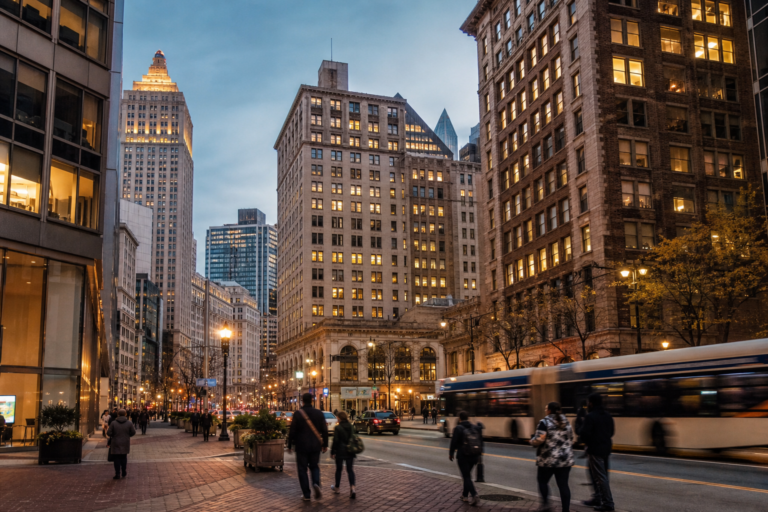
The North Shore’s future will not be measured only by cranes, apartment counts, or the height of a Ferris wheel. It will be audible in the mix of people and uses: a Pirates crowd crossing paths with a science-camp family, a Stage AE audience spilling toward the trail, a neighborhood resident using the riverfront on a quiet Tuesday, a museum visitor discovering that the bridges are part of the experience rather than scenery behind it.
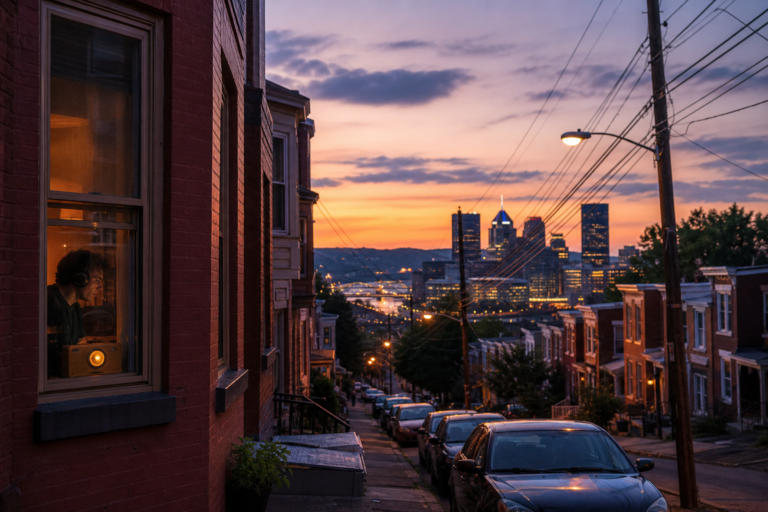
That is also where RadioPGH fits. Pittsburgh listening is built from movement between scenes—between the stadiums and the clubs, the museums and the river, the old industrial landscape and the new public spaces. You can follow that wider conversation through the future of Downtown Pittsburgh, then check the RadioPGH Schedule for what is on the air.
The North Shore is still a sports district. Nobody is taking that away, and nobody in Pittsburgh would want them to. But between the first pitch and the final whistle, the waterfront is learning a new role: not merely the place where the crowd goes, but a place where the city keeps listening. When you are ready, Listen Live.
The Revolution Is Live
You found the story. Now hear the station — independent Pittsburgh radio, live 24/7.
More from the Republic.
Meet RadioPGH.
Stay Tuned to Pittsburgh
New local music, RadioPGH stories, station updates, shows and events—straight to your inbox.