At a Pittsburgh wedding, the first important question is not always whether the chicken is coming out. It may be: where’s the cookie table?
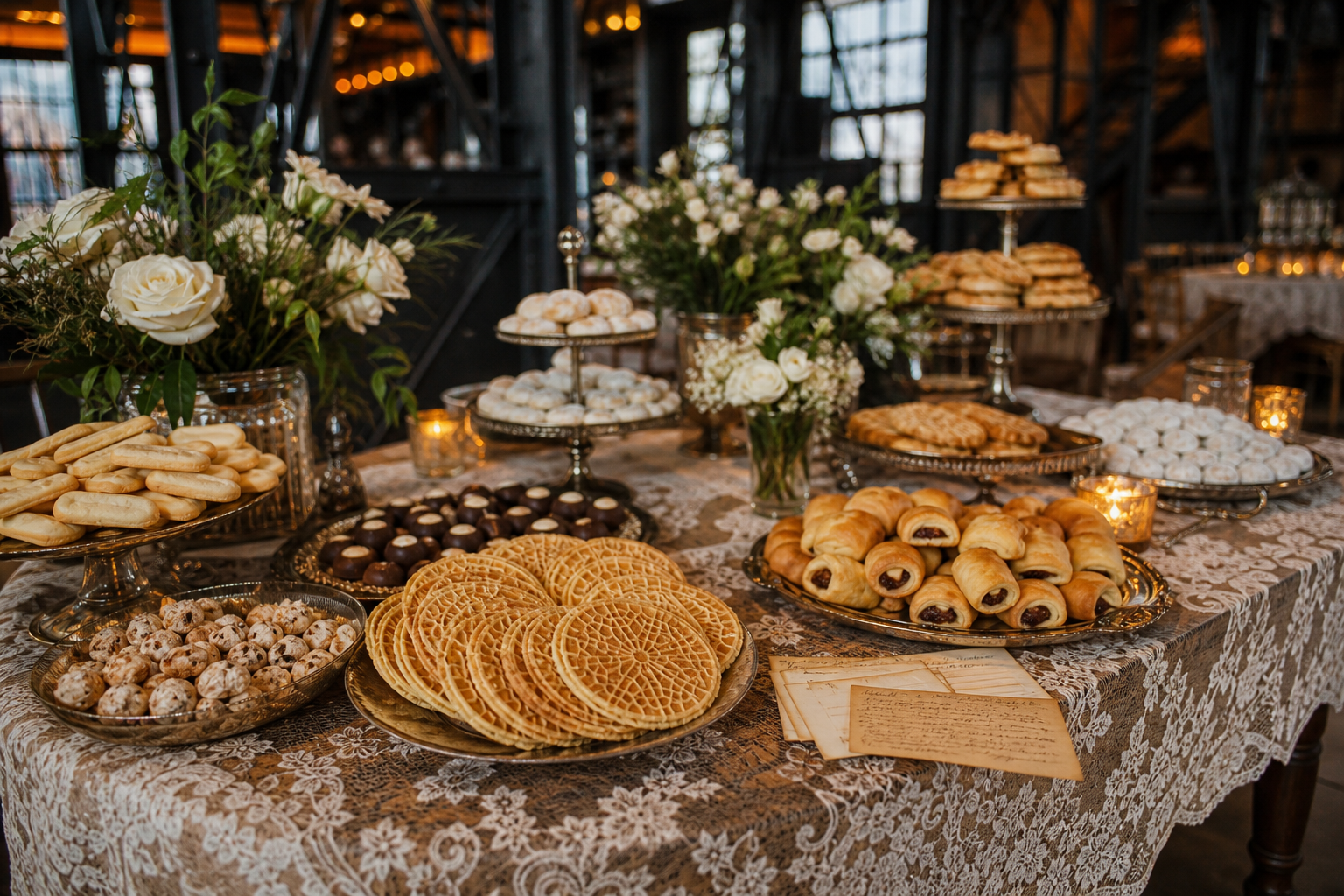
Usually, it is impossible to miss. Near the cake, the bar, or the entrance to the reception room, there is a long table crowded with pizzelles, lady locks, buckeyes, nut rolls, peanut butter blossoms, Italian wedding cookies, and whatever else a family considers non-negotiable. The scale can be modest or frankly astonishing. The principle is the same: wedding guests should not have to choose between one dessert and another when they can have a little of everything.
That abundance is what makes the Pittsburgh cookie table more than a dessert display. It is a record of family history, a community baking project, and one of the clearest examples of how Western Pennsylvania turns everyday food into a cultural institution.
A tradition with no single birthplace
The cookie table is strongly associated with Pittsburgh and the surrounding region, but its origin story is not pinned to one kitchen, neighborhood, or wedding hall. The tradition is also deeply established in Youngstown, northeastern Ohio, and northern West Virginia. People in each part of the region have reasons to claim it, and nobody has produced a final answer that settles the argument.
That uncertainty is part of the story. The tradition grew in communities connected by steel mills, coal mines, churches, ethnic clubs, extended families, and working-class neighborhoods rather than by a single founding institution. Italian, Polish, Greek, German, Eastern European, and other immigrant families brought baking habits and celebration foods into the same industrial region. Over time, recipes crossed family lines, religious lines, and state borders.
The most common explanation places the cookie table in the economic pressures of the twentieth century, including the Great Depression. Cookies could be made in batches by relatives and friends, often well ahead of the wedding, then stored until the reception. A table built from homemade contributions offered a generous dessert without requiring one family to purchase a towering cake for every guest.
That explanation makes sense, but it should not be treated as proven fact. Historians and local researchers have found plenty of evidence that cookie tables are longstanding regional customs, but not a single document announcing when the first Pittsburgh cookie table appeared. The absence of a neat origin story is revealing: this was probably a tradition that spread through kitchens, not one invented by a celebrity baker or formal organization.
Why the table feels so Pittsburgh
The cookie table fits a familiar Western Pennsylvania pattern: many small contributions become one large communal gesture. One aunt makes pizzelles. A cousin handles the lady locks. Somebody’s mother freezes trays of nut cookies months ahead. A neighbor offers a recipe that has been treated like a family secret since before anybody remembers writing it down.
That labor matters. A wedding cookie table is often assembled by people who will never appear in the formal photographs. They are baking late at night, labeling containers, transporting trays, arranging the cookies, and quietly checking whether the good ones are disappearing too quickly. The table gives relatives a job, but it also gives them a visible place in the celebration.
It is also a map of the region’s food vocabulary. In one family, the star may be a pizzelle made with an old iron. In another, it is a clothespin cookie, known around Pittsburgh as a lady lock. Buckeyes connect the table to Ohio and the broader Appalachian and Midwest dessert tradition. Kolache, nut rolls, thumbprints, and Italian wedding cookies show how recipes traveled and settled into new family identities.
Those categories are never completely fixed. A Pittsburgh cookie table is not a museum display. It changes when someone marries into the family, moves away, brings back a new recipe, or decides that a favorite store-bought cookie belongs beside the homemade ones. The point is not culinary purity. The point is recognition: somebody at the reception should see something they know.
From family custom to regional institution
The tradition has become visible far beyond private receptions. The Heinz History Center in the Strip District now treats cookie table organization as part of its wedding planning services, an unusually direct acknowledgment that this is not merely a cute local detail. It is part of what couples and families expect from a Pittsburgh celebration.
The Heinz History Center is an especially fitting place for that recognition. Its work is built around the ordinary objects and habits that explain Western Pennsylvania: food, work, migration, neighborhoods, industry, and family life. A cookie table belongs in that story because it preserves history in a form people can eat.
Regional enthusiasm has also produced bigger public spectacles. In 2019, Monongahela’s 250th-anniversary celebration included an effort to create the largest wedding cookie table, turning a tradition usually confined to a reception hall into a town-wide display. The event reflected something locals already understand: a cookie table can be competitive, sentimental, practical, and theatrical all at once.
There is even a growing infrastructure around the custom. The Wedding Cookie Table Community has helped document the tradition, share recipes and etiquette, and connect people who grew up with it to people encountering it for the first time. That matters because many Pittsburghers do not realize how regional the practice is until they attend a wedding somewhere else and discover that “a table of cookies” is not understood as a complete sentence.
The rules are informal, but real
Cookie table etiquette is rarely printed on the invitation, yet guests know there are customs. The cookies should be plentiful. Variety matters. Homemade specialties deserve attention. If the hosts provide take-home containers, they are probably encouraging guests to pack a few favorites for later. If they do not, the message may be: enjoy yourself, but leave some for the people still making the rounds.
There is also an unspoken ranking system. Lady locks disappear quickly. Buckeyes tend to attract defenders. Pizzelles are easy to underestimate until somebody brings a family recipe with an unmistakable anise flavor. The best tables balance familiar favorites with one or two cookies that make guests ask, “What is that?”
And despite the wedding cake standing nearby, the cookie table often becomes the real gathering point. Guests circle back to it between dances. Children inspect the options at eye level. Older relatives compare techniques. People who arrived as strangers start talking about the cookie their grandmother used to make.
A Pittsburgh tradition worth listening to
The cookie table endures because it behaves less like a rule than a song passed from one generation to the next. The arrangement changes, the ingredients vary, and every family insists its version is the correct one. Still, the basic melody remains: bring what you can, put it on the table, and make sure everybody gets some.
That is the kind of local culture RadioPGH is built to notice—not just the famous landmarks, but the habits that reveal how people here actually live together. You can learn more about the station through About RadioPGH, check the RadioPGH Schedule, or keep Pittsburgh’s sound close wherever you are through Listen to RadioPGH Everywhere.
And when the next reception comes around, save room for the table. Then tune in live at Listen Live. In Pittsburgh, the best stories—like the best cookie tables—are meant to be shared.
Sports Porch Black & Gold
You found the story. Now hear the station — independent Pittsburgh radio, live 24/7.
More from the Republic.



Meet RadioPGH.
Stay Tuned to Pittsburgh
New local music, RadioPGH stories, station updates, shows and events—straight to your inbox.