In Pittsburgh, a concert at the Three Rivers Arts Festival has never been just a concert. It might be Ella Fitzgerald turning a downtown crowd toward jazz, Smokey Robinson drawing an estimated 70,000 people to Point State Park, or Buffalo Rose bringing Pittsburgh Americana back to the festival stage. The setting changes, the audience changes, and the definition of a headliner changes—but the basic idea remains remarkably steady: put live music in the middle of the city and let everybody in.
That idea started in 1960, when the first Three Rivers Arts Festival occupied Gateway Plaza downtown for four days. The event was organized by the Women’s Committee of the Carnegie Museum of Art as a free public showcase for local artists and a broad mix of creative work. Music was part of the design from the beginning. One of the earliest performances came from the American Wind Symphony, playing from a barge on the river. It was an unusually Pittsburgh image before it became a familiar one: musicians on the water, listeners gathered at the Point, and the city’s geography functioning as part of the stage.
The weather also made its contribution immediately. A violent storm closed that first festival, sending paintings into the river and damaging others. The story has become part of the event’s folklore, but it also says something important about the festival’s musical identity. These were not sealed-off performances in a conventional hall. They were public, exposed, free, and subject to the same wind and rain as everyone standing on the lawn.
From civic program to citywide ritual
During the 1960s and 1970s, the festival grew longer, moved into Point State Park, and expanded through downtown buildings and public spaces. Music helped make that expansion feel less like an exhibition people had to attend and more like a civic ritual people could stumble into. A person might arrive to look at paintings, hear a band, wander toward the rivers, and stay for an evening performance without ever buying a ticket.
The programming was broad enough to resist a single label. The 1970 festival, for example, included the Pittsburgh Savoyards performing The Pirates of Penzance, alongside musical performers such as the Four Tops, Sergio Mendes, Stanley Turrentine, and the Nitty Gritty Dirt Band. That mixture matters. The festival was not trying to build a genre brand. It was building a public audience for the arts—one that could move from musical theater to soul, Brazilian-influenced pop, jazz, and country-rock in the same week.
It also established a pattern that still feels familiar to Pittsburghers: a major outdoor stage surrounded by smaller discoveries. The big name got people downtown, but the festival’s larger ecosystem gave regional artists, experimental performers, dancers, and emerging acts a chance to share the same civic space. The music was part of a larger argument that art belonged in the open, alongside the sidewalks, bridges, office towers, and river traffic.
Ella Fitzgerald changes the scale
The festival’s musical history took a major turn in 1982, when Ella Fitzgerald performed. Her appearance is often remembered as the moment the event embraced the national headliner in a serious way. Fitzgerald’s presence did more than add a famous name to a schedule. It confirmed that a free Pittsburgh arts festival could present a performer whose career belonged to the highest levels of American music—and do it in a public setting where longtime fans, curious passersby, and families could all share the same audience.
That same year, the Three Rivers Film Festival debuted, adding another layer to the event’s cultural reach. The point was not to turn the Arts Festival into a conventional music festival. Rather, music became one of several ways the festival could bring ambitious work to people who might not encounter it through a ticketed institution. The festival’s musical stage was part concert, part invitation, and part demonstration of what free public programming could accomplish.
For a deeper look at the city’s musical context around that period, RadioPGH’s piece What Pittsburgh Sounded Like in 1985 offers a useful companion—not a history of the Arts Festival itself, but a snapshot of the musical world surrounding its most important growth years.
Point State Park, rain, and the big-stage years
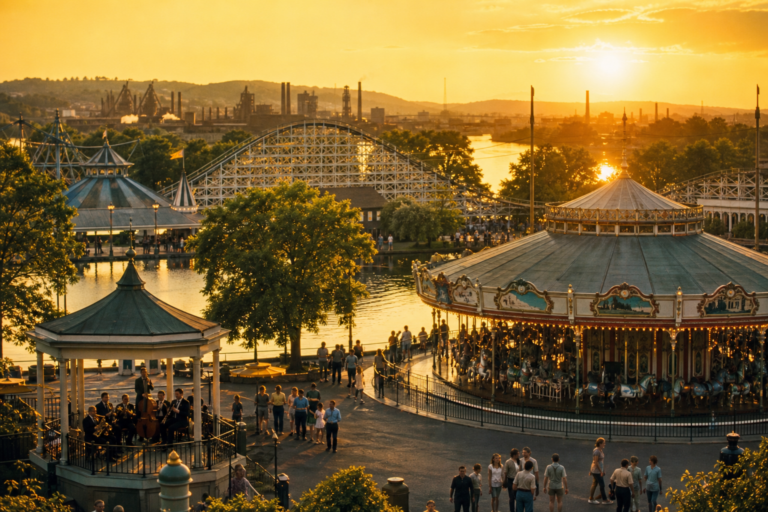
By the 1980s, the Point had become the emotional center of the festival’s concert life. The location supplied its own production value: the Monongahela and Allegheny rivers, the Fort Duquesne Bridge, the city skyline, and a lawn large enough for a crowd that did not need to behave like an audience in a theater.
Smokey Robinson’s 1986 performance showed how powerful that setting could be. The festival timeline records an estimated 70,000 people turning out for the Motown legend. A year later, the main concert by Ray Charles was rained out, but the festival still offered performances by Steve Earle, the Kronos Quartet, and Huey Lewis. In 1988, the Neville Brothers and Buckwheat Zydeco brought New Orleans-rooted energy to the schedule, while the festival also presented “Inside the Edge,” a series focused on performance art.
Those lineups explain why the Three Rivers Arts Festival never fit neatly into the category of a pop concert series. It could move from Ray Charles to Steve Earle, from string-quartet modernism to zydeco, without treating those choices as contradictory. The range was the point. Pittsburgh audiences were being asked to cross musical borders in the same afternoon they crossed from the Artist Market to the riverfront.
And then there was the rain. The festival’s weather reputation became almost a second program director. A soaked crowd could turn a canceled headliner into a story, while a clear night at the Point felt like a civic holiday. The unpredictability was frustrating, but it reinforced the event’s difference from a controlled indoor venue. The concert was inseparable from the place.
From Wilco to local pride
In later decades, the festival continued to bring major touring acts into a free downtown setting. The Pittsburgh Cultural Trust’s historical account lists Brandi Carlile, Norah Jones, the Avett Brothers, Wilco, Sonic Youth, the Wailers, India.Arie, and the Black Keys among the artists who have appeared in more recent years. That list is musically wide-ranging, but it also reveals a shift in the festival’s role. The Arts Festival was no longer simply introducing Pittsburgh to established cultural names; it was giving national touring artists a distinctive kind of room to play.
A festival stage at the Point could feel less formal than an arena and more consequential than a club. It allowed a band to reach listeners who might not follow its tour schedule, while giving regular concertgoers a free night with an artist they already valued. In that sense, the festival acted as a bridge between Pittsburgh’s everyday music culture and the national touring circuit.
The move away from Point State Park after 2021 changed that experience. State regulations limited the length and timing of events in the park, and the 2022 festival moved into downtown streets in the Cultural District. The setting became more urban and more dispersed, with stages and vendors folded into the blocks around theaters and cultural institutions. It was not simply a logistical adjustment; it changed how people encountered the music. Instead of gathering at one riverfront lawn, audiences moved through a neighborhood built for performance.
Arts Landing starts the next chapter
The 2026 festival introduced another major transition with Arts Landing, the Pittsburgh Cultural Trust’s new outdoor civic space and the festival’s long-term home. The seven-day event ran June 5–7 and June 11–14, with a permanent stage and great lawn designed to hold music, public art, family activities, and the Artist Market in one setting.
The featured music made the point clearly. Spin Doctors and The Pharcyde represented very different chapters of popular music; Trousdale brought contemporary harmony-driven songwriting; The War and Treaty supplied a forceful blend of soul, gospel, and roots; Delfeayo Marsalis & The Uptown Jazz Orchestra connected the festival to New Orleans jazz tradition; Joan Osborne returned the schedule to a major singer-songwriter voice. And Buffalo Rose, the Pittsburgh Americana band, occupied a particularly meaningful place in the lineup during the group’s tenth anniversary year.
Buffalo Rose’s appearance mattered because it showed the festival’s old model still working in a new location. The Arts Festival can bring an internationally known act to the stage, but it can also make room for a Pittsburgh band whose story is still unfolding. That combination—national reach and local investment—has been one of the event’s strongest musical habits for more than six decades.
For RadioPGH, that is the lasting lesson of the Three Rivers Arts Festival. Pittsburgh music is not one sound, and the festival has never needed it to be. Its history is a sequence of open doors: a wind ensemble on a barge, Ella Fitzgerald at the Point, Smokey Robinson before a massive crowd, experimental and roots artists sharing a schedule, and Buffalo Rose stepping into a new civic room. You can follow more of that ongoing conversation through the RadioPGH Schedule, learn more about About RadioPGH, or Listen Live while Pittsburgh’s next soundtrack takes shape.
The Revolution Is Live
You found the story. Now hear the station — independent Pittsburgh radio, live 24/7.
More from the Republic.
Meet RadioPGH.
Stay Tuned to Pittsburgh
New local music, RadioPGH stories, station updates, shows and events—straight to your inbox.