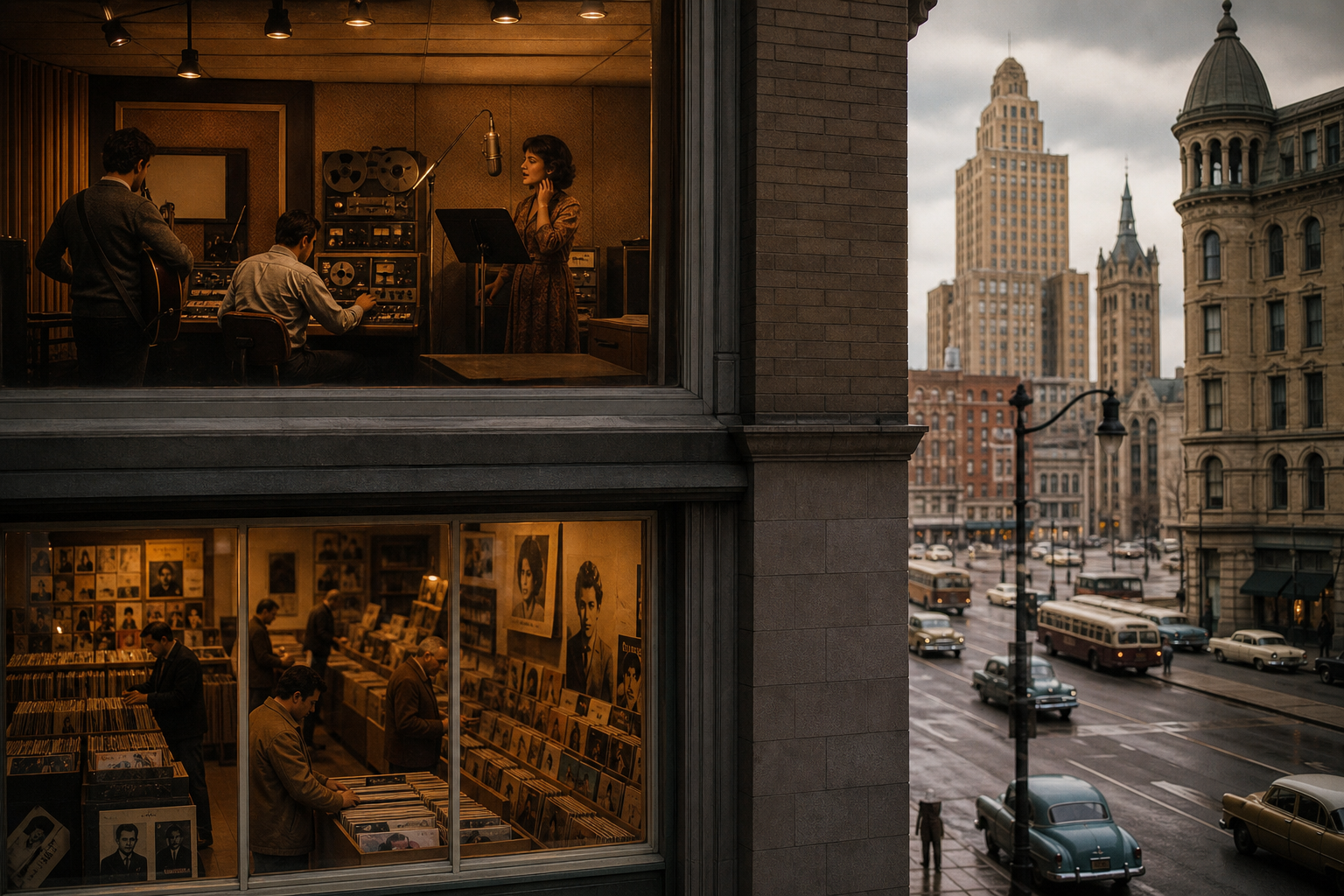
Before downtown Pittsburgh had Market Square restaurants, the brick building at 234 Forbes Avenue held a different kind of destination. National Record Mart occupied the street level, selling the records Western Pennsylvania wanted to take home. Upstairs, Gateway Records operated a compact recording studio where musicians made the records that would travel back down those stairs, into the store, onto local radio, and sometimes far beyond the region.
Gateway was founded in 1961 by Robert W. Schachner, a young producer who had come to Pittsburgh to study at Carnegie Tech and became fascinated with recording. With backing from National Record Mart owners Sam and Howard Shapiro, Gateway developed into a label, production company, and studio. Its catalog crossed the lines that later histories often draw between jazz, rock, folk, R&B, bluegrass, comedy, and polka.
That range is what makes Gateway worth revisiting. It was not simply a place where famous outsiders passed through. It was a working Pittsburgh operation, built around local musicians, local retail, local radio, and the particular fact that this city had audiences for many different kinds of music at once.
A studio above a record store
The physical setup tells us something about the business. Gateway’s studio was above National Record Mart on Forbes Avenue, near Market Square, in the middle of downtown’s everyday commercial traffic. The store gave Gateway a built-in outlet for its releases. The label could record an album, manufacture it, and place it in front of customers through the National Record Mart chain.
Schachner was central to nearly every part of the process. He produced sessions, engineered recordings, wrote liner notes, and helped steer the label’s catalog. A University of Pittsburgh study of the city’s jazz recordings describes Gateway as being operated largely under Schachner’s direction, with the studio occupying the second floor above a record shop. At its busiest, the company had a small staff that included sound engineers, but this was never a giant corporate facility. It was an independent shop trying to make the next session work.
The practical limitations were real. Rich Engler, who later became one of Pittsburgh’s best-known concert promoters and had been a member of the Grains of Sand, remembered carrying equipment up narrow stairs because there was no elevator. He also recalled Schachner moving quickly from one session to the next, sometimes allowing only a couple of hours to capture two songs.
That pressure was part of the sound and part of the story. Gateway was not a retreat in the country or a purpose-built studio complex. It was a downtown room, close to the record buyers, nightclubs, radio stations, and musicians who made Pittsburgh’s music economy function.
Harold Betters makes Gateway a jazz address
Gateway’s most important Pittsburgh relationship was with trombonist Harold Betters. Known as “Mr. Trombone,” Betters was a major draw at the Encore nightclub and one of the city’s most visible jazz musicians. His album Harold Betters at the Encore, recorded live at the club and released by Gateway in 1962, established the label’s jazz ambitions.
Betters’ association with Gateway produced more than a local calling card. His single “Ram-Bunk-Shush” became a Pittsburgh favorite, and “Do Anything You Wanna,” released in 1964, reached a national audience. The recording helped show that a Pittsburgh jazz musician could move from a neighborhood club and a downtown studio into the national pop marketplace without abandoning the city’s own audience.
Gateway also documented a broader Pittsburgh jazz network. Walt Harper recorded several albums for the label, including Harper’s Ferry and a live recording made at Soldiers and Sailors Hall. Pianist Charles Bell was recorded in concert at Carnegie Lecture Hall, while Jon Walton and other local players added to the label’s jazz catalog. Trombonist Slide Hampton, a Pittsburgh native who had built an international reputation, returned to record with Betters.
For anyone interested in the history of Pittsburgh jazz, the Gateway catalog matters because it preserves more than individual performances. It captures the city’s clubs, concert halls, musicians, and audiences at a moment when local talent could still be documented by a locally rooted company.
The room was bigger than the label
Gateway’s own releases were only part of the studio’s importance. Artists working with other labels also used the Forbes Avenue facility. Among them were The Fenways, The Vogues, Lou Christie, and The Grains of Sand. The studio’s value was not limited to the records carrying a Gateway logo; it was available to musicians and producers who needed a Pittsburgh room with working equipment and a fast turnaround.
Lou Christie is the clearest example of what could happen there. Born Lugee Sacco, Christie recorded “The Gypsy Cried” at Gateway in 1962 with producer Nick Cenci. The song first gained momentum on Pittsburgh radio before spreading to other markets. Picked up for national distribution by Roulette Records, it became a major hit and sold more than a million copies.
Gateway’s role in that story was not just technical. The studio connected a young singer, a Pittsburgh producer, local radio programmers, and a record business that still operated through personal relationships. A recording made above a downtown record shop could become a national single because the people around it knew how to move it through the next door, the next station, and the next market.
Other sessions showed the same flexibility. Donnie Elbert recorded “A Little Piece of Leather” at Gateway, playing the instrumental parts himself. The Four Coins cut material there for Laurie Records. The Del-Vikings recorded a single for Gateway during one of the group’s later chapters. The studio served singers, vocal groups, R&B performers, and rock acts without being defined by just one genre.
Louis Armstrong at 3 a.m.
The most cinematic Gateway story involves Louis Armstrong. In April 1966, Armstrong was performing with his All Stars at the Twin Coaches nightclub outside Pittsburgh. After the show, he and the band reportedly arrived at Gateway around 3 a.m. to record “Mame,” the new song from the Broadway musical.
The session moved at the speed of the era. The master was sent to New York, and Mercury released the single soon afterward. Armstrong’s version became a radio success, reaching the adult contemporary chart and the Billboard Hot 100. The image is hard to beat: Louis Armstrong, fresh from a Western Pennsylvania nightclub, climbing the stairs to a downtown studio in the middle of the night to cut a song that would be in stores almost immediately.
That story also explains why small studios mattered. Gateway did not need to resemble a national recording center to be useful to national artists. It needed a capable engineer, a room that could handle the musicians, and a producer who could make the necessary decisions before dawn.
Polka, folk, and the sound of Western Pennsylvania
Gateway’s catalog eventually moved deep into the music that filled family halls, ethnic clubs, and dance floors across Western Pennsylvania. Schachner acquired Dyna Records in 1966 and developed a substantial polka operation under the Gateway and Dyno Polkas names. Acts such as Walt Cieslik and the Ambassadors, the Polka Kings, Lil’ Ronnie, and Frank Wojnarowski became part of that catalog.
That business was not a side note. Gateway recognized that the region’s musical identity could not be reduced to jazz and rock. The label also issued folk recordings, including work by Pittsburgh singer Liz Seneff, and helped document Mac Martin and the Dixie Travelers, a bluegrass group with deep local ties.
The connection to Duquesne University mattered, too. Gateway’s early releases included recordings by the university’s Tamburitzans, linking the label to one of Pittsburgh’s most distinctive traditions of Eastern European music and dance. In the same downtown operation, a jazz trombonist, a folk singer, a bluegrass band, a polka orchestra, and a touring comedy performer could all find a place on the schedule.
Why Gateway still matters
Gateway did not last forever. The company struggled with the changing economics of pop music, the Shapiros eventually sold their interest, and Schachner left Pittsburgh in 1970. But the studio’s short life was unusually productive. It recorded local artists before they were nationally known, hosted established performers when they needed a fast session, and helped turn Pittsburgh radio airplay into a path toward wider attention.
For RadioPGH, Gateway is a useful reminder that Pittsburgh music history is not only a story of bands and venues. It is also a story of rooms: the third floor above National Record Mart, the club where Harold Betters played, the Carnegie Lecture Hall stage, the Twin Coaches after-hours session, and the downtown record store where the finished product could be bought.
That chain still shapes how we listen. A record made in a vanished room can remain present when a station gives it context, places it beside newer Pittsburgh artists, and lets the connections emerge. To hear what RadioPGH is putting into that conversation, Listen Live; for the station’s broader mission, explore About RadioPGH and the RadioPGH Schedule.
The Revolution Is Live
You found the story. Now hear the station — independent Pittsburgh radio, live 24/7.
More from the Republic.


Meet RadioPGH.
Stay Tuned to Pittsburgh
New local music, RadioPGH stories, station updates, shows and events—straight to your inbox.