
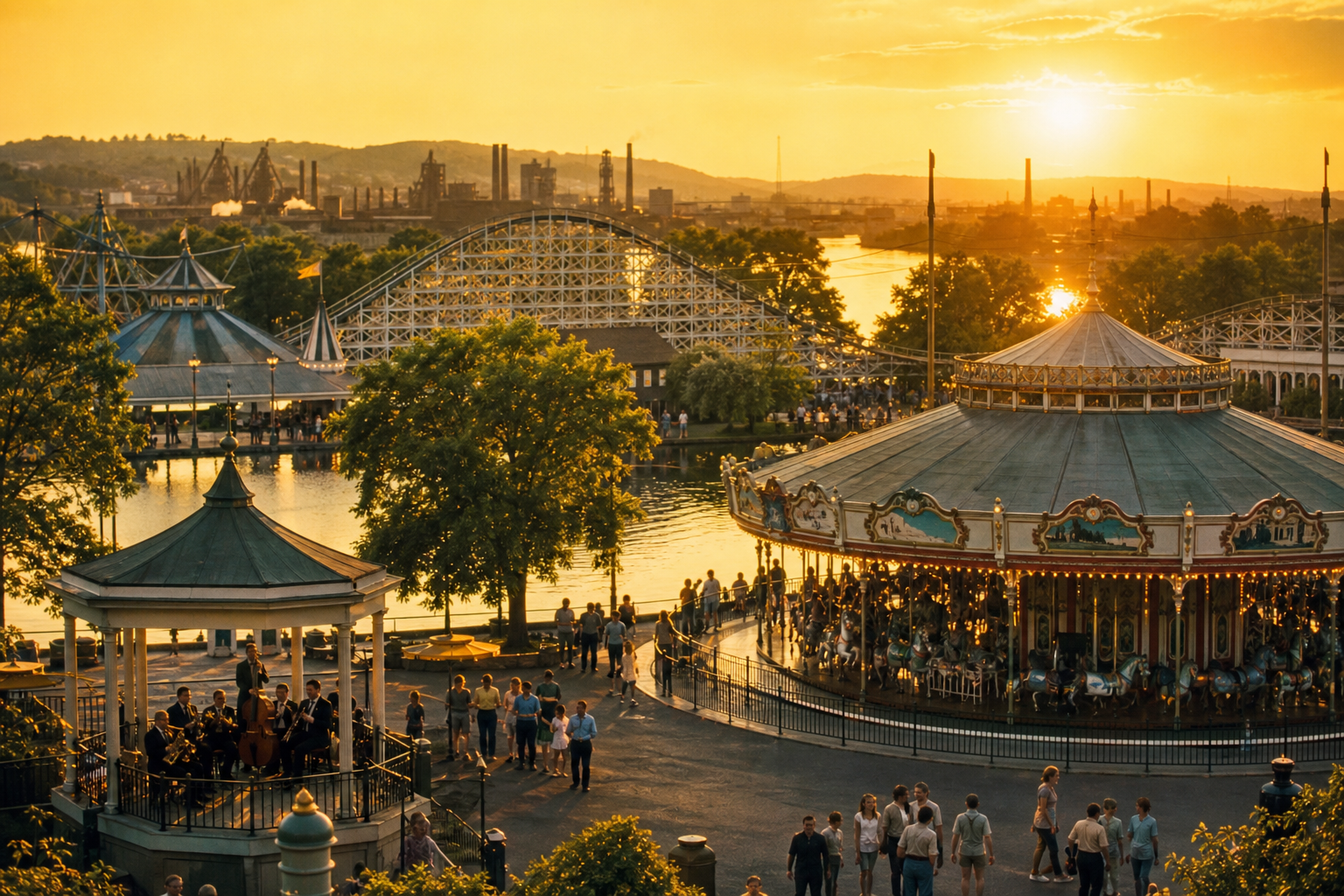
On June 19, 1905, Pittsburghers lined up on Smithfield Street for a new kind of night out. Harry Davis and John P. Harris had opened a small storefront theater devoted entirely to moving pictures, charging a nickel at the door. They called it the Nickelodeon, combining the price of admission with an old Greek word for theater.
The room is gone. The crowds are gone. But the idea it launched is still written into Pittsburgh’s neighborhoods: a cinema close enough to reach on foot, connected to the street outside, and woven into the ordinary rhythm of a community. Before the multiplex, moviegoing here meant the Manor on Murray Avenue, the Regent on Penn Avenue, the Fulton downtown, the Lando in the Hill District, and dozens of smaller houses whose names survive mostly in photographs, newspaper ads and family stories.
Pittsburgh’s forgotten theaters matter because they were never only about films. They were social rooms, commercial anchors and, in many cases, some of the most ambitious buildings in their districts. Their histories trace the city’s immigrant life, Black cultural institutions, downtown decline, neighborhood reinvention and the long Pittsburgh tradition of finding a second act for an old performance space.
The Nickelodeon started the neighborhood habit
The first Nickelodeon stood at 433–435 Smithfield Street, in the middle of the Golden Triangle. Its success helped send five-cent movie houses into nearly every part of the region. In the years that followed, Pittsburgh developed a dense exhibition culture: storefront theaters, purpose-built photoplay houses, vaudeville venues that added movies, and elaborate downtown palaces that treated a night at the cinema as a full civic occasion.
That expansion was especially important in an industrial city whose residents lived across sharply defined neighborhoods. A theater in East Liberty did more than show the same picture as a theater downtown. It gave a commercial district its own evening traffic. A cinema in the Hill District could sit within a broader network of restaurants, clubs, churches and performance spaces. In Squirrel Hill, a theater became part of a walkable route along Murray and Forbes avenues.
The Pittsburgh idea, as film historians have called the city’s early exhibition culture, was not simply that Pittsburghers liked movies. It was that movies could be fitted into the city’s existing patterns of work, transit and neighborhood life. That is why the loss of a theater often felt bigger than the loss of a business.
East Liberty once had a whole theater corridor
Today, the Kelly Strayhorn Theater is known as a Black-led multidisciplinary arts institution. Its building began life in 1914 as the Regent Theatre, a 1,100-seat silent-film house designed by architect Harry S. Bair. A theater organ supplied the soundtrack before talkies changed the business.
The Regent was not an isolated attraction. East Liberty’s Penn and Highland avenues once supported a cluster of movie houses, including the Camera-Phone, Enright, Harris Family Theatre, Liberty, Sheridan and Triangle. The neighborhood’s theater map also intersected with Pittsburgh’s own cultural history: Gene Kelly grew up in East Liberty, while Billy Strayhorn came from nearby Homewood. Their names now frame the building’s contemporary identity, but the connection to film runs deeper than the marquee.
The Regent closed and reopened several times as East Liberty changed around it. Its 1965 reopening came after a major renovation, but the theater eventually went dark again. In 2001, it reopened as the Kelly Strayhorn Theater. That reuse is more than preservation by another name. It keeps a historic gathering room in active circulation while allowing the neighborhood’s present-day artists to define what happens inside.
The story also shows what disappeared. East Liberty did not merely lose individual screens; it lost an entire concentration of evening destinations. When theaters vanish, the result is a quieter commercial corridor, fewer reasons to linger and fewer places where strangers share the same program at the same time.
Squirrel Hill kept one, lost another
The Manor Theatre opened on Murray Avenue in 1922 with a single, roughly 1,500-seat auditorium. Its original design emphasized the movie palace experience: a grand room, decorative finishes, heavy curtains and enough space to make a trip to the movies feel like an event.
The Manor survived by changing without abandoning its neighborhood identity. It divided into two screens in 1978 and four in 1992, eventually building a specialty around independent, documentary, foreign-language and limited-release films. That programming made the theater useful in a way a generic multiplex could not. It became a place where Squirrel Hill audiences could see movies that might otherwise require a trip downtown or a wait for a home release.
Only a short distance away, the Squirrel Hill Theater represented another path. Opened in the 1930s, it carried a varied program of art-house films, blockbusters and family pictures. Former employees and patrons remembered it as a neighborhood institution, with longtime manager Bernie Elinoff becoming part of the theater’s public personality. The building closed in 2010 and was demolished in 2021, ending the possibility that the old cinema might return.
That contrast is the central drama of Pittsburgh’s surviving neighborhood theaters. The Manor adapted and remains part of Squirrel Hill’s daily life. The Squirrel Hill Theater could not make the same transition. Both buildings served the same basic purpose, but their futures were shaped by ownership, technology, redevelopment and the economics of a city where a screen has to compete with streaming, suburban parking lots and rising real-estate pressure.
Downtown’s movie palaces found different second acts
Two of Pittsburgh’s grandest former movie houses still dominate the Cultural District, even though most current audiences know them by different names.
Heinz Hall began in 1927 as Loew’s Penn Theatre, a lavish movie palace designed by Rapp & Rapp. The theater closed in 1964 as television, changing movie habits and the cost of maintaining enormous interiors took their toll. It was headed toward demolition and a possible parking lot until civic and philanthropic leaders, including Henry J. Heinz II and Pittsburgh Symphony president Charles Denby, helped redirect the building’s future. After a three-year reconstruction, it reopened as Heinz Hall in 1971.
The former Stanley Theatre followed a related but distinct route. Built in 1927 and opened the following year, it was one of Western Pennsylvania’s largest movie palaces. After later use as a movie house and rock-concert venue, it became the Benedum Center through the Pittsburgh Cultural Trust’s restoration work. In both cases, the movie theater’s architecture survived because Pittsburgh recognized that a large, well-built room could serve live music, opera, dance and touring theater as effectively as it once served Hollywood.
The former Fulton Theatre, now the Byham Theater, offers another version of the city’s layered entertainment history. Built as the Gayety Theatre in 1904 for vaudeville, it became the Fulton and operated as a full-time movie theater in the 1930s. The Pittsburgh Cultural Trust purchased it in 1990, restoring the building and returning it to active performance use. Its history is a reminder that Pittsburgh theaters have always crossed categories: stage house, picture palace, concert room and neighborhood landmark.
The theaters that held more than one Pittsburgh
Some of the city’s most revealing cinema histories are less visible. The Lando Theater at 1851 Centre Avenue in the Hill District served as a Yiddish playhouse, movie theater and meeting hall. It belonged to a small group of American theaters outside New York dedicated specifically to Yiddish productions. That history places Pittsburgh’s movie culture inside the city’s immigrant and Jewish communities, not apart from them.
Other neighborhood theaters disappeared through demolition, conversion or simple loss of memory. The names may still surface on old street maps or in advertisements: a theater near a streetcar line, a small house beside a bakery, a venue where Saturday matinees gave children a few hours of adventure. Their importance was not measured by whether they became landmarks. It was measured by how often people passed through their doors.
That is also why Pittsburgh’s theater history belongs in the same conversation as its radio history. Both depend on shared attention: people gathering around a screen, a speaker or a signal and allowing a piece of culture to become part of the neighborhood’s memory. RadioPGH keeps that listening tradition moving through its RadioPGH Schedule, while stories about places like the Manor, the Regent and Loew’s Penn remind us that local culture has always needed rooms, routines and regular audiences.
The buildings may be gone, renamed or repurposed. The habit remains. When you pass the Kelly Strayhorn Theater, walk Murray Avenue toward the Manor, or enter Heinz Hall and look up at the old movie-palace details, you are moving through a Pittsburgh shaped by cinema long before the multiplex. For another soundtrack to the city’s neighborhoods, Listen Live with RadioPGH.
More from RadioPGH: About RadioPGH
The Revolution Is Live
You found the story. Now hear the station — independent Pittsburgh radio, live 24/7.
More from the Republic.
Meet RadioPGH.
Stay Tuned to Pittsburgh
New local music, RadioPGH stories, station updates, shows and events—straight to your inbox.