Balancing Political Rights and National Security: Finding the Sweet Spot in Modern Democracy
In today’s interconnected world, democracies face an increasingly complex challenge: how do we protect our citizens from genuine security threats while preserving the fundamental political rights that define our free societies? This delicate balancing act has become one of the most pressing issues of our time, touching everything from surveillance programs to freedom of speech protections.
The tension between national security and political rights isn’t new, but it has intensified dramatically in recent decades. From the aftermath of 9/11 to the rise of cyber warfare, governments worldwide grapple with questions that would have seemed like science fiction just a generation ago. How much privacy should citizens sacrifice for security? When does protecting democracy require limiting democratic freedoms?

These aren’t just abstract philosophical questions—they affect real people in real ways. Whether it’s a journalist investigating government corruption, a activist organizing peaceful protests, or an ordinary citizen concerned about digital privacy, the balance between security and rights shapes our daily lives more than many of us realize.
Understanding the Fundamental Tension
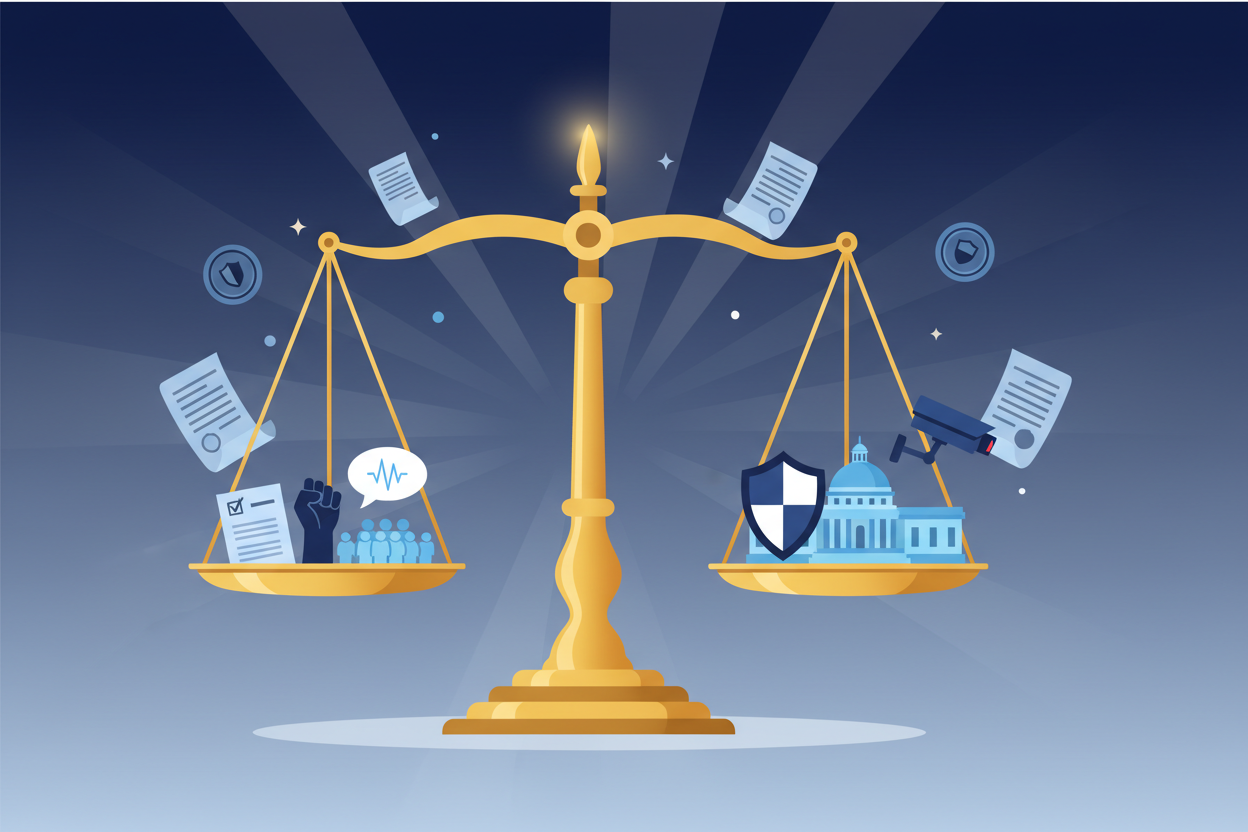
At its core, the relationship between political rights and national security represents a fascinating paradox. Strong democratic institutions and robust civil liberties actually contribute to national security by fostering social stability, legitimacy, and public trust. Yet protecting these very institutions sometimes requires measures that can limit individual freedoms.
Political rights—including freedom of speech, assembly, press, and due process—form the backbone of democratic society. They ensure that citizens can participate meaningfully in governance, hold leaders accountable, and express dissent without fear of retribution. These rights aren’t just nice-to-have luxuries; they’re essential mechanisms that help societies identify problems, adapt to challenges, and maintain legitimacy.
National security, on the other hand, encompasses the protection of a nation’s citizens, institutions, and interests from threats both foreign and domestic. In our modern era, these threats have evolved far beyond traditional military concerns to include terrorism, cyber attacks, economic espionage, and information warfare.
The challenge lies in recognizing that both security and rights serve the same ultimate goal: protecting and preserving democratic society. The question isn’t whether one matters more than the other, but how to optimize both simultaneously.
Historical Perspectives on Rights vs Security
History offers valuable lessons about what happens when this balance tips too far in either direction. During World War II, the United States interned Japanese Americans based on security fears that we now recognize as largely unfounded and deeply unjust. The internment camps represent a stark example of how security concerns can override constitutional protections with devastating consequences for innocent citizens.
Similarly, the McCarthy era of the 1950s demonstrated how anti-communist security measures could spiral into widespread violations of political rights. Careers were destroyed, lives were ruined, and democratic discourse was chilled—all in the name of protecting national security from a threat that was often more perceived than real.
More recently, the post-9/11 era has provided fresh examples of this tension. The USA PATRIOT Act expanded government surveillance powers in ways that many civil libertarians found deeply troubling, while supporters argued these measures were necessary to prevent future terrorist attacks. The ongoing debate over these policies illustrates how reasonable people can disagree about where to draw the line.
What these historical examples teach us is that the pendulum can swing too far in either direction. Excessive focus on security can undermine the very democratic values we’re trying to protect, while inadequate attention to legitimate security threats can leave societies vulnerable to real harm.
Modern Challenges in the Digital Age
The digital revolution has fundamentally transformed the landscape of both political rights and national security. On one hand, technology has democratized information and empowered citizens in unprecedented ways. Social media platforms enable grassroots organizing, smartphones document police misconduct, and encrypted communications protect dissidents from authoritarian regimes.
On the other hand, these same technologies have created new vulnerabilities and security challenges. Foreign adversaries can spread disinformation at scale, hackers can cripple critical infrastructure, and terrorist organizations can recruit and coordinate across borders with alarming ease.
Consider the challenge of online surveillance. Intelligence agencies argue that monitoring digital communications is essential for preventing terrorist attacks and other serious crimes. Privacy advocates counter that mass surveillance programs violate Fourth Amendment protections and chill free expression. Both sides have valid points, and finding the right balance requires nuanced thinking rather than absolutist positions.
The rise of artificial intelligence and machine learning has added another layer of complexity. These technologies can enhance both security capabilities and rights protections—AI can help identify terrorist plots while also detecting bias in policing. However, they also raise new questions about algorithmic accountability and the potential for automated systems to systematically violate civil liberties.
Legal Frameworks and Constitutional Protections
Democratic societies have developed sophisticated legal frameworks to manage the tension between rights and security. In the United States, the Constitution provides the foundational structure, with the Bill of Rights establishing core political freedoms while also granting government the power to provide for the common defense.
The court system plays a crucial role in interpreting these constitutional provisions and resolving conflicts between security needs and rights protections. Landmark cases like Korematsu v. United States (which upheld Japanese internment but was later discredited) and more recent decisions about NSA surveillance programs demonstrate how judicial review serves as a check on executive power.
However, legal frameworks alone aren’t sufficient. They must be supported by strong democratic institutions, an independent judiciary, and a vibrant civil society that can hold government accountable. The most elegant constitutional protections are worthless if there aren’t mechanisms to enforce them in practice.
International law and treaties also play an important role, particularly as security challenges increasingly cross national borders. The European Convention on Human Rights, for example, provides a framework for balancing security measures with fundamental rights protections across multiple countries.
The Role of Transparency and Oversight
One of the most effective ways to balance political rights and national security is through robust transparency and oversight mechanisms. When security agencies operate in complete secrecy, it becomes impossible to ensure they’re respecting constitutional limits or acting proportionally to actual threats.
Congressional oversight committees, inspector generals, and specialized courts like the Foreign Intelligence Surveillance Court (FISA) provide important checks on security agencies. However, these oversight mechanisms are only as effective as the people who staff them and the resources they’re given to do their jobs.
Public transparency is equally important. While some security operations must remain classified, the basic legal authorities, policies, and procedures governing security agencies should be public knowledge. Citizens can’t hold their government accountable for programs they don’t know exist.
The Edward Snowden revelations highlighted both the importance and the challenges of transparency in this area. While his disclosures sparked important public debates about surveillance programs, they also demonstrated the complex tradeoffs involved when classified information becomes public.
International Approaches and Best Practices
Different democratic countries have developed varying approaches to balancing rights and security, and there’s much to learn from comparative analysis. Germany’s approach to counterterrorism, shaped by its historical experience with both Nazi totalitarianism and East German surveillance, emphasizes strong judicial oversight and constitutional protections.
Canada’s approach to national security legislation includes explicit requirements for regular parliamentary review and sunset clauses that force lawmakers to periodically reconsider emergency powers. These mechanisms help ensure that temporary security measures don’t become permanent features of the legal landscape.
The European Union’s General Data Protection Regulation (GDPR) represents an interesting attempt to protect privacy rights while still allowing for legitimate security operations. By establishing clear rules about data collection and use, GDPR provides a framework that both individuals and security agencies can understand and work within.
These international examples suggest that there’s no one-size-fits-all solution to balancing rights and security. Different countries will reach different conclusions based on their history, culture, legal traditions, and threat environment. However, certain principles—like proportionality, accountability, and regular review—appear to be universally important.
Public Opinion and Democratic Participation
Ultimately, the balance between political rights and national security must reflect the will of the people in a democratic society. Public opinion polling consistently shows that most citizens want both security and freedom—they don’t want to choose between them.
However, public opinion can be volatile and influenced by recent events. After terrorist attacks, support for security measures typically increases, while revelations of government overreach tend to boost support for civil liberties protections. This volatility makes it important to have institutional safeguards that prevent hasty decisions made in the heat of the moment.
Civic education plays a crucial role in helping citizens understand these complex tradeoffs. When people better understand how security and rights interact, they’re better equipped to make informed decisions about the policies they want their representatives to pursue.
Democratic participation in these decisions is essential not just as a matter of principle, but as a practical necessity. Policies that lack public support are unlikely to be sustainable over the long term, and security measures that citizens see as illegitimate may actually undermine rather than enhance national security.
Finding the Right Balance: Principles and Practices
So how do we actually achieve the right balance between political rights and national security? While there’s no perfect formula, several key principles can guide our thinking.
First is the principle of proportionality. Security measures should be proportional to the actual threat they’re designed to address. Massive surveillance programs might be justified in response to an imminent terrorist threat, but they’re harder to justify as a general crime-fighting tool.
Second is the principle of necessity. Before implementing measures that limit political rights, governments should demonstrate that less intrusive alternatives have been considered and found inadequate. This helps ensure that rights restrictions are truly necessary rather than merely convenient.
Third is the principle of accountability. Security agencies must be subject to meaningful oversight and review. This includes both internal oversight mechanisms and external review by courts, legislatures, and independent bodies.
Fourth is the principle of temporality. Emergency security measures should include sunset clauses and regular review requirements. What might be justified as a temporary response to a specific threat becomes much more problematic as a permanent feature of government power.
Finally, there’s the principle of transparency. While operational details may need to remain classified, the legal authorities and general policies governing security operations should be public knowledge whenever possible.
Conclusion
Balancing political rights and national security will always be challenging, but it’s a challenge that democratic societies must embrace rather than avoid. The goal isn’t to find a perfect, permanent balance—it’s to develop robust processes for continuously calibrating that balance as circumstances change.
This requires strong institutions, informed public debate, and a commitment to both security and freedom as complementary rather than competing values. It also requires humility—recognizing that we won’t always get it right and building in mechanisms to correct course when we don’t.
The stakes couldn’t be higher. Get the balance wrong in one direction, and we risk becoming the kind of authoritarian society that our security measures are supposed to protect us from. Get it wrong in the other direction, and we leave ourselves vulnerable to real threats that could undermine our democratic way of life.
But when we get it right—when we successfully protect both security and freedom—we demonstrate that democratic societies can meet the challenges of the modern world without sacrificing the values that make them worth defending. That’s a goal worth striving for, even when the path forward isn’t always clear.
Frequently Asked Questions
Q: Can a society have both complete security and complete freedom?
A: No, there will always be some tension between security and freedom. Even basic laws against violence represent a limitation on absolute freedom in service of collective security. The goal is to optimize both rather than maximize either at the expense of the other.
Q: How do we know when security measures have gone too far?
A: Warning signs include lack of judicial oversight, indefinite detention without trial, restrictions on peaceful protest, censorship of legitimate criticism, and surveillance programs that lack clear legal authority or proportionality to actual threats.
Q: What role should the public play in security decisions?
A: While operational details must sometimes remain classified, the public should have input on the basic legal frameworks and policies governing security operations. Democratic oversight through elected representatives is essential.
Q: Are there security threats that justify suspending constitutional rights?
A: Most democratic constitutions include provisions for emergency powers, but these should be temporary, subject to judicial review, and proportional to the actual threat. History shows that emergency powers are often abused and difficult to roll back.
Q: How has technology changed the balance between rights and security?
A: Technology has created new capabilities for both protecting and violating rights. Digital surveillance can be more intrusive than ever before, but encryption and other technologies also provide new tools for protecting privacy and enabling free expression.
Q: What can individual citizens do to help maintain this balance?
A: Citizens can stay informed about security policies, participate in democratic processes, support independent journalism and civil society organizations, and hold elected officials accountable for both protecting security and preserving rights.