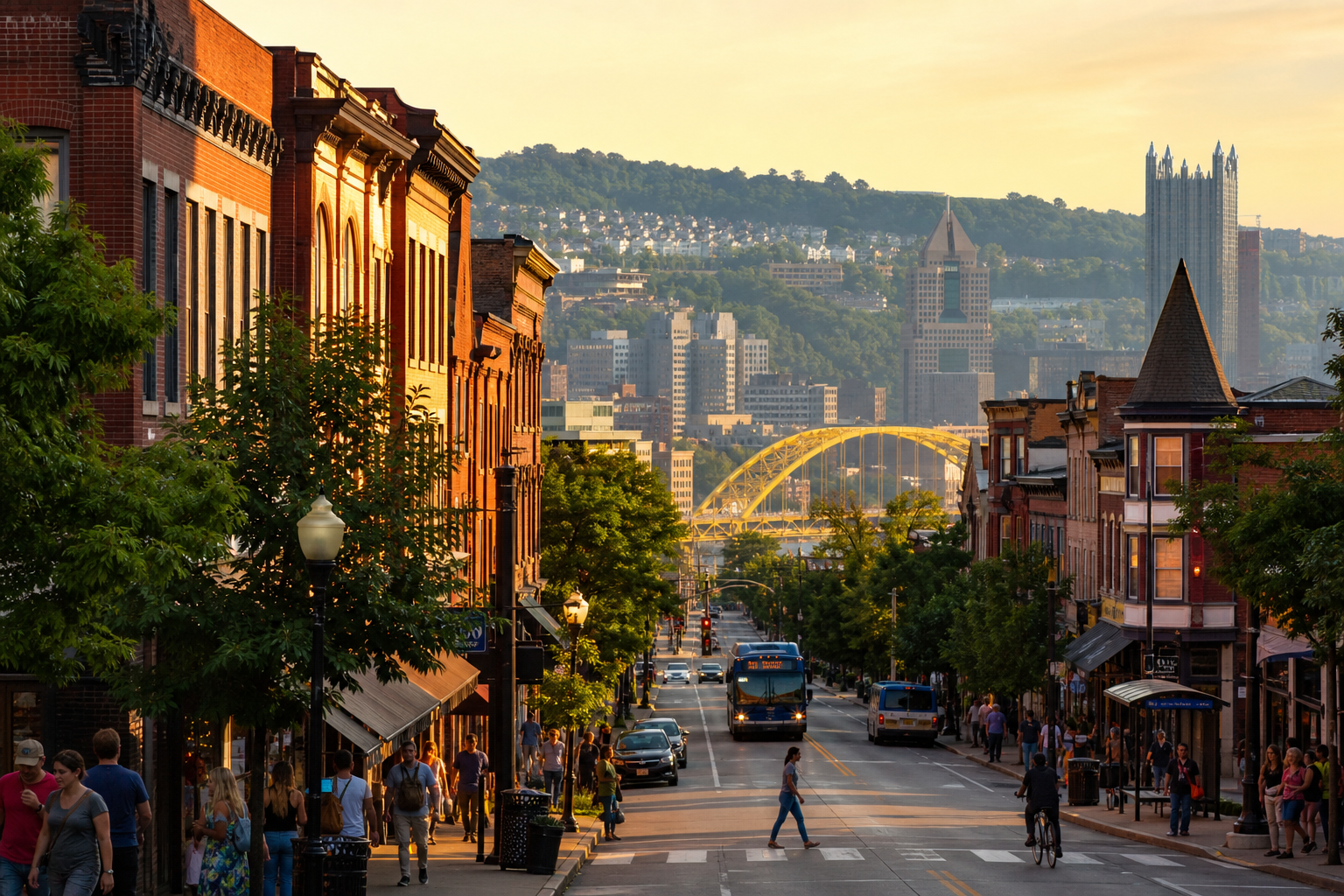
For Pittsburghers, the best shopping street is rarely the one with the tallest building at the end of it. It is the corridor where somebody is picking up dinner, a neighbor is locking a bike outside a bookstore, a bus is groaning up the hill, and the storefronts still feel connected to the blocks behind them.
That is why Pittsburgh’s strongest business districts are mostly outside Downtown. They are not interchangeable “walkable neighborhoods,” and they are not just collections of restaurants. Each one has a distinct local rhythm: the historic bar-and-shop energy of East Carson, the creative sprawl of Butler Street, the family and immigrant continuity of Bloomfield, the layered retail life of Squirrel Hill, the polished variety of Shadyside, and the market-to-modern transformation of the Strip.
These are the places that make a neighborhood feel like more than a residential address. They are Pittsburgh’s everyday third places — a subject RadioPGH has explored in The Places Between Home and Work — where commerce, culture, and routine overlap.
East Carson Street: Pittsburgh’s most visible neighborhood main street
East Carson Street remains the obvious starting point because it does so many jobs at once. The South Side corridor is a shopping street, restaurant row, nightlife zone, neighborhood service center, and one of the city’s most concentrated historic commercial districts. The City of Pittsburgh recognizes the East Carson Street Historic District, whose Victorian-era storefronts give the street much of its visual continuity.
The best way to understand East Carson is to move beyond the loudest version of it. Yes, the corridor has bars and late-night crowds. But its deeper identity is in the long blocks of connected storefronts, the small businesses that serve residents during the day, and the way the street opens toward the Monongahela River. The Carson Street Business District describes the corridor as the economic and cultural heart of the South Side, and that claim makes sense because few neighborhood streets combine this much architectural character with this much daily activity.
East Carson is also a reminder that “best” does not mean universally calm or universally curated. It is a street with friction, history, and competing uses. That tension is part of what makes it recognizably Pittsburgh.
Butler Street: the city’s most complete creative corridor
Lawrenceville’s Butler Street is the district most associated with Pittsburgh’s contemporary small-business identity. The corridor runs through Lower and Central Lawrenceville, linking restaurants, bars, design shops, galleries, personal services, coffee counters, music spaces, and longtime neighborhood institutions. The URA has described Butler Street and Penn Avenue as two of the city’s strongest small-business districts, with hundreds of businesses and a notable concentration of women-owned enterprises.
Butler’s strength is its length and variety. It does not depend on a single anchor or one entertainment category. A person can spend an afternoon moving from a used-media shop to a restaurant, from a specialty retailer to a bar, without feeling that the street has switched neighborhoods. Recent additions such as Afters Cafe and Lost Lizard Video fit into that pattern: they are distinctive enough to draw people from elsewhere, but specific enough to give the corridor more texture rather than flattening it into a generic destination.
The important thing about Butler Street is the way it supports browsing. Pittsburgh’s best commercial districts allow for an unplanned hour. You might arrive for lunch and leave with a record, a book, a gift, or a new place to hear a band. That open-ended quality is central to Lawrenceville’s appeal and to the way its businesses reinforce one another.
Bloomfield: Liberty Avenue with memory built into the storefronts
Bloomfield’s Liberty Avenue has one of the clearest neighborhood identities in Pittsburgh. The Bloomfield Development Corporation defines the district around the Liberty and Main corridors, while the City describes Liberty Avenue as one of Pittsburgh’s largest and most active business districts. The street’s importance comes from the combination of old-world Italian markets, independent restaurants, services, bars, and newer businesses that have arrived without erasing the neighborhood’s earlier layers.
Bloomfield is sometimes reduced to a nickname — Pittsburgh’s Little Italy — but the district is more interesting than a heritage label. The continuity is visible in places such as Bloomfield Groceria and Merante’s, where food traditions remain part of the neighborhood’s commercial life. It is also present in Tessaro’s, whose hardwood-grilled burgers have made the restaurant a local landmark. Nearby, White Whale Bookstore adds a literary and event-driven gathering place, while venues and bars such as Trace Brewing and Brillobox contribute a more contemporary nighttime vocabulary.
What makes Liberty Avenue especially valuable is that it still feels useful. It serves residents, not just visitors looking for a themed afternoon. The groceries, shoes, meals, books, drinks, and services all matter because they create repeat traffic — the most durable foundation a business district can have.
Squirrel Hill: a neighborhood district built for errands and discovery
The Forbes and Murray Avenue business district is one of Pittsburgh’s best examples of a commercial corridor that works at several scales. It is a practical neighborhood center, a destination for independent retail, and a meeting ground shaped by Jewish, Asian, student, family, and longtime Pittsburgh communities.
Uncover Squirrel Hill identifies the district across Forbes, Murray, and Forward avenues and traces the formal business association back to a grassroots effort that became the Squirrel Hill Business and Professional Association in 1992. That history matters because the district’s vitality is not accidental. It comes from years of merchants, residents, and community organizations treating the corridor as shared infrastructure.
Squirrel Hill is particularly strong for independent shopping. Little’s Shoes, established in 1932, represents the kind of specialized, relationship-based retail that is increasingly difficult to find in American cities. Elsewhere along Forbes and Murray, shoppers encounter books, games, records, gifts, clothing, food, and restaurants that reward curiosity. The district feels less like a lifestyle zone than a real neighborhood with an unusually rich storefront mix.
For visitors, Squirrel Hill offers a useful correction to the idea that Pittsburgh’s best commercial streets are all about nightlife. Its energy is conversational and daytime-oriented. It is a place to walk with a purpose, then find another reason to keep walking.
Shadyside: three business districts, three different moods
Shadyside is often treated as a single shopping destination, but its commercial life is divided among Walnut Street, Ellsworth Avenue, and South Highland Avenue. VisitPittsburgh identifies all three as separate business districts, and that distinction helps explain why the neighborhood feels more varied than its polished reputation suggests.
Walnut Street is the most recognizable, with boutiques, restaurants, national retailers, and long-established local businesses arranged along a compact, highly walkable corridor. Ellsworth Avenue has a more neighborhood-scaled mix, while South Highland connects Shadyside’s commercial life to the institutions and cultural destinations around East Liberty and the universities.
The Shadyside Community Partnership works across those corridors to support local businesses, public life, and cleaner, greener streets. That broader approach is important: the district’s appeal is not only what sits inside individual storefronts, but how the three corridors create options for different kinds of visits. Shadyside can be an afternoon of shopping, a dinner stop, a gallery detour, or a short walk between errands.
The Strip District: the commercial corridor that keeps changing without losing its appetite
The Strip District is Pittsburgh’s most dramatic example of a business district in transition. Its identity began with wholesale markets, industrial buildings, rail access, and food commerce. Today, that legacy shares the neighborhood with restaurants, specialty grocers, offices, housing, technology companies, cultural institutions, and nightlife.
The Strip District Terminal’s history describes the 13-block site as a major part of Pittsburgh’s commercial story from 1850 through 1964. Strip District Neighbors points to enduring institutions such as Wholey’s Fish Market, Pennsylvania Macaroni Company, Primanti Bros., and the Senator John Heinz History Center as evidence of the neighborhood’s long relationship with food, trade, and regional identity.
The Strip is not as tidy a recommendation as Walnut Street or Squirrel Hill. It can feel crowded, fragmented, and caught between old wholesale patterns and new development. That is precisely why it remains compelling. On Smallman Street and Penn Avenue, Pittsburgh’s past and future are negotiating in public. The result is a district that still has a working-market pulse even as it becomes one of the city’s most popular places to live, eat, shop, and spend an entire Saturday.
What these districts have in common
The best neighborhood business districts do not succeed because every storefront is full or every block is perfectly designed. They work because they have repetition and memory. People return for a specific shop, recognize a familiar sign, meet friends after work, hear music nearby, or discover something they were not looking for.
That is also the logic behind independent radio. A station such as RadioPGH connects Pittsburgh’s neighborhoods through the habits of listening: the song heard on the bus, the local artist encountered between errands, the voice that makes a distant corner feel close. You can find more about the station through About RadioPGH, check what is playing through the RadioPGH Schedule, or Listen Live while you make your own route through Butler, Liberty, Forbes, Walnut, Carson, or the Strip.
Downtown may be Pittsburgh’s official center, but these districts are where the city’s daily soundtrack gets its texture: storefront by storefront, block by block, and always with another corner worth turning toward.
Steelers Realm
You found the story. Now hear the station — independent Pittsburgh radio, live 24/7.
More from the Republic.
Meet RadioPGH.
Stay Tuned to Pittsburgh
New local music, RadioPGH stories, station updates, shows and events—straight to your inbox.