On Homewood Avenue, the comeback story is not a ribbon-cutting or a glossy downtown rendering. It is the slower work of getting storefronts occupied, housing built, permits moving, and neighbors back into the habit of using the avenue as a daily part of life.
That is the larger Pittsburgh story in September 2026. Across the city, neighborhood main streets are being treated less like leftovers from an earlier economy and more like essential civic infrastructure. The goal is not to make every corridor look the same. It is to help each one become more useful, more welcoming, and more capable of supporting the people who already live nearby.
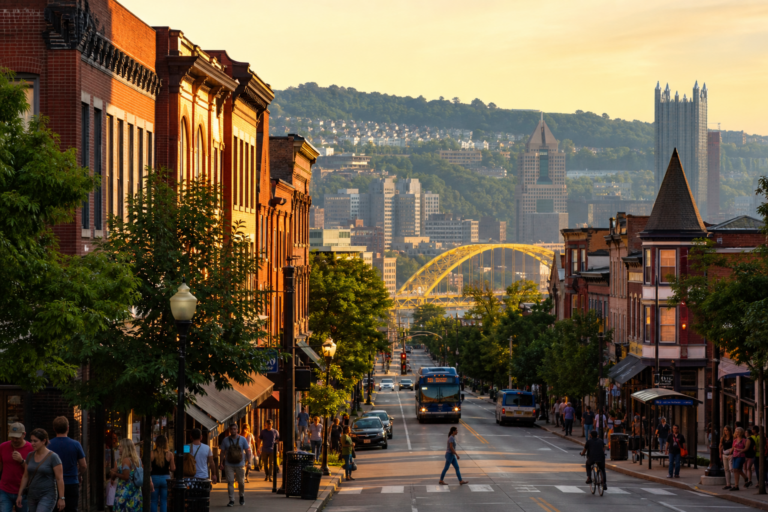
The city’s neighborhood business districts beyond Downtown have always carried more than retail. They are where residents run errands, meet friends, hear campaign news, find a barber, buy dinner, and recognize somebody from the block. When those places struggle, the loss is economic, but it is also social. When they recover, the change can be felt before it shows up in a development report.
The new push is about the basics
Pittsburgh’s Main & Main initiative, announced in January 2026, is built around an unglamorous truth: small businesses often need help with the parts of development that are hardest to finance and easiest to delay. The city has pointed to storefront renovations, small-business lending, housing incentives, zoning, permitting, and gap funding as pieces of the same neighborhood strategy.
That approach matters because a business district is not revived by one attractive tenant. It needs a functioning rhythm: occupied upper floors, active sidewalks, buildings that are maintained, places to sit, transit connections, and enough everyday services that residents do not have to leave the neighborhood for every basic need.
The Urban Redevelopment Authority’s 2026 Commercial Façade Grant Program made that physical challenge visible. The program offered reimbursable grants covering up to 75 percent of eligible façade work, with awards of up to $20,000, supporting improvements such as signs, lighting, windows, doors, paint, and brick pointing. Those details may sound minor, but a row of cared-for storefronts changes how a corridor reads from the sidewalk. It tells customers that a place is open for business and tells owners that investment is possible.
Homewood Avenue: rebuilding a district without erasing its identity
Homewood is one of the clearest examples of why a neighborhood main street cannot be reduced to a restaurant list. Homewood Avenue sits inside a community with a deep African American cultural history, strong institutions, and a long record of residents organizing around housing, safety, education, and economic opportunity.
The city’s Main & Main announcement highlighted the Homewood Gateway project, which is planned to deliver 44 housing units, with 85 percent designated as affordable for lower-income families, along with 4,000 square feet of ground-floor retail. That combination is important. New retail needs nearby customers, and new housing works better when it connects to a real commercial street rather than standing apart from one.
Homewood’s own community planning documents have also identified the need for mixed-use, mixed-income development along Homewood Avenue and for a dedicated business-district liaison who can help connect merchants, residents, developers, and city government. That is the kind of infrastructure that rarely gets celebrated, but it is often what determines whether a promising project becomes a lasting neighborhood asset.
For Homewood, a comeback should mean more than attracting outside attention. It should mean making it easier for existing entrepreneurs and residents to shape what comes next.
East Ohio Street: façade work meets a changing corridor
In East Allegheny’s historic Deutschtown, East Ohio Street offers another version of the same story. The corridor has benefited from historic building restorations and growth in neighborhood-serving businesses, while still carrying the visible challenges of vacancy, aging commercial spaces, and uneven investment.
In August 2026, the city and URA announced a $600,000 partnership focused on renovating façades along the East Ohio Street business district. The investment includes $100,000 from the URA and $500,000 from East Ohio Capital. It is a substantial commitment to a very specific kind of improvement: making the existing street more coherent, attractive, and ready for the businesses that need a strong physical setting.
That distinction matters. East Ohio Street does not need to become a copy of Butler Street or East Carson Street. Its value is tied to its own architecture, its connection to the North Side, and the particular mix of residents, longtime businesses, and new arrivals shaping Deutschtown. Good corridor investment strengthens those local traits instead of sanding them away.
East Carson Street is trying to become a district again
East Carson Street has long been one of Pittsburgh’s best-known commercial corridors, but recognition is not the same thing as stability. The South Side business district has had to contend with shifting nightlife patterns, storefront turnover, public-safety concerns, and the challenge of balancing visitors with the needs of people who live there year-round.
In January 2025, the East Carson Street Business District management program launched through a collaboration among the South Side Community Council, South Side Community Action Network, South Side Chamber of Commerce, and South Side Hospitality Partnership. The Pittsburgh Downtown Partnership is managing the program during a two-year transition through 2026, with leadership expected to move to a South Side–based organization afterward.
That structure signals a more mature understanding of what the corridor needs. Marketing and events matter, but so do clean sidewalks, coordinated communication, storefront support, business recruitment, and a clear sense of who is responsible for the district between headline events. A main street works when its management is continuous, not just seasonal.
For South Side, the question is not whether East Carson can draw a crowd. It can. The question is whether the street can convert attention into a durable neighborhood economy that includes restaurants and bars but is not dependent on them alone.
Penn Avenue shows how culture can seed commerce
Along Penn Avenue, the Bloomfield-Garfield Corporation’s Arts & Commercial District connects Garfield, Friendship, Bloomfield, and Lawrenceville. The Penn Avenue Arts Initiative began in 1998 as a strategy to help artists renovate formerly vacant and deteriorated buildings, creating a creative presence along the corridor while supporting broader commercial activity.
That history is a useful reminder that cultural development is not decoration added after the economic work is finished. Studios, galleries, performance spaces, restaurants, and small shops can make a corridor feel inhabited at different hours. They give people reasons to return and give entrepreneurs a visible network of nearby activity.
But culture alone cannot carry a main street. Penn Avenue’s next chapter depends on the less glamorous pieces too: affordable space, safe and walkable connections, reliable services, and the ability for longtime residents and smaller businesses to remain part of the district as property values change.
The comeback is measured in ordinary days
Pittsburghers have heard plenty about revitalization. The useful question now is what happens on a Tuesday afternoon in February, not just during a summer festival or a major sports weekend. Is there a grocery option nearby? Can a small business afford to renew its lease? Are the upper floors occupied? Do the sidewalks connect people to transit, housing, schools, libraries, and parks?
That is why neighborhood main streets belong in the same conversation as Pittsburgh’s music and listening culture. A song on the radio is never only a recording; it is part of a route, a room, a bar, a storefront, or a neighborhood memory. The places where people gather determine what gets heard and who gets included.
RadioPGH pays attention to those connections because Pittsburgh’s sound does not live in one district or one genre. It travels from Homewood Avenue to Penn Avenue, from East Ohio Street to East Carson Street, through independent businesses and community spaces that give local life a place to happen. When you are ready to hear what Pittsburgh is making now, Listen Live to RadioPGH.
More from RadioPGH: Advertise on RadioPGH
Steelers Realm
You found the story. Now hear the station — independent Pittsburgh radio, live 24/7.
More from the Republic.
Meet RadioPGH.
Stay Tuned to Pittsburgh
New local music, RadioPGH stories, station updates, shows and events—straight to your inbox.