
By the time the last Steelers fans left Acrisure Stadium on Sunday, September 13, Pittsburgh had already spent two days turning football into an economic system. Pitt played UCF on Saturday afternoon at the North Shore, drawing 45,926 people, and the Steelers followed Sunday with their 2026 home opener against the Atlanta Falcons. That is not just a sports schedule. It is a concentrated weekend of tickets, parking, hotel rooms, restaurant checks, transit rides, merchandise purchases, concession shifts and overtime hours.
For Pittsburgh, the important question is not whether a home game creates excitement. Of course it does. The more useful question is where the money travels, who captures it, and how much of it remains in the region after the Terrible Towels disappear from the bridges.
The $61 million question
A Steelers-commissioned PwC study released in 2024 estimated that fans spend an average of $61 million during Steelers home-game weeks, a 14 percent increase over non-game weeks. The study also found a 16 percent increase in average spending around the North Shore during those weeks. Those figures include more than purchases inside Acrisure Stadium. They reflect the broader orbit of a home game: Downtown restaurants, hotels, convenience stores, retail, transportation and travel-related spending.
That distinction matters. A ticket sale is easy to see, but the real regional footprint comes from all the smaller transactions attached to the ticket. A visitor may pay for parking in the Strip District, grab breakfast near Market Square, take the T to the North Side, buy a jersey at Rally House, stop for a drink on East Carson Street and book a hotel room in Oakland. None of those businesses is inside the stadium, but all are participating in the weekend economy.
The PwC report calculated $2.6 billion in direct and indirect contributions to the City of Pittsburgh over four years, $3.4 billion for Allegheny County and more than $139 million in tax revenues for state and local governments over that period. Those are large numbers, and they should be read as a multi-year economic model rather than a cash register total from one Sunday. Still, they show why Steelers weekends matter to public agencies, hospitality businesses and downtown planners.
Acrisure Stadium is the anchor, not the whole story
The geography of this past weekend made the point clearly. Pitt’s Saturday game against UCF ended at Acrisure Stadium around 7:47 p.m., according to the official box score. Less than 18 hours later, the same North Shore district was preparing for the Steelers’ 1 p.m. kickoff. That creates a rare overlap of customers, employees, vendors and transportation demand.
For nearby businesses, the value is not simply that thousands of people are present. It is that they arrive in waves and make decisions under time pressure. Fans need coffee, breakfast sandwiches, beer, wings, parking, souvenirs and somewhere to watch the pregame. After the final whistle, they need another drink, a late meal or a way to wait out the traffic. A restaurant that normally plans around a predictable Saturday or Sunday can instead face a sharp, highly concentrated rush.
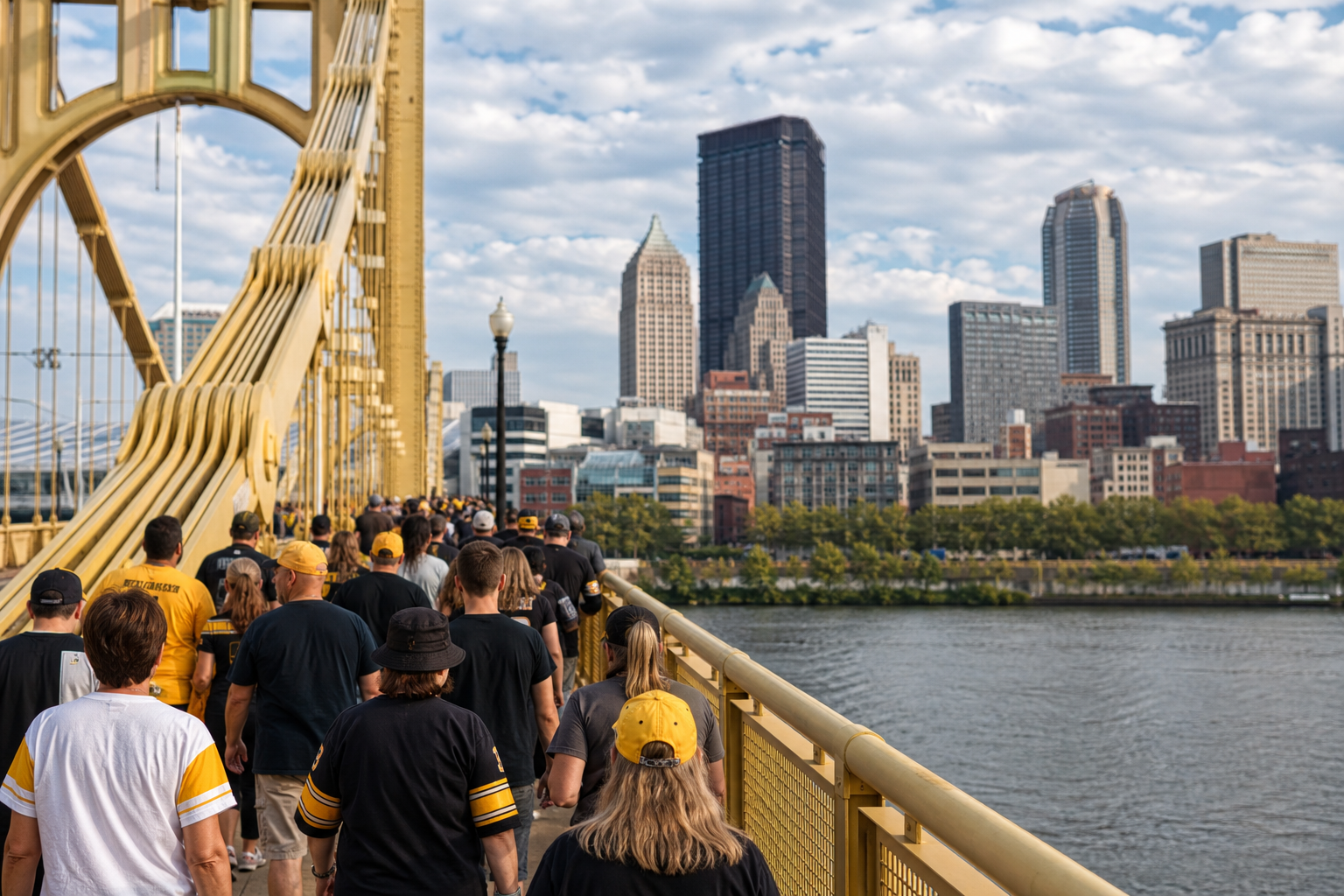
The North Shore absorbs much of the immediate benefit because it sits beside Acrisure Stadium, PNC Park and the Rivers Casino. But Downtown Pittsburgh is part of the same circuit. Fans cross the Roberto Clemente Bridge, walk along the riverfront, use garages on the Golden Triangle side and spread out toward hotels and restaurants. The stadium’s location makes a game feel like a North Shore event, but the spending pattern is regional and connected.
Hotels feel the visitor economy first
Nearly 60 percent of Steelers home-game fans travel more than 75 miles, according to figures cited by the team. That turns a Sunday game into a potential overnight stay, particularly when kickoff times, weather or traffic make a same-day drive less attractive.
Hotels do not need every fan to come from out of state to benefit. A family from Erie, a group from Youngstown or a couple from Washington County may decide that a room is easier than a late drive home. That room can produce additional spending at breakfast, a hotel bar, a rideshare pickup, a convenience store or a nearby restaurant. It also explains why a home game can affect occupancy beyond Downtown, reaching Oakland, the airport corridor and communities in surrounding counties.
The strongest effect comes when a game is paired with another event. This weekend had Pitt football on Saturday and the Steelers on Sunday. That combination gives hotels two separate reasons to fill rooms and gives visitors more time to spend in Pittsburgh. It also creates more work for housekeepers, servers, parking attendants, drivers, security staff and stadium vendors.
Parking is a price signal
Every Steelers fan makes an economic choice before arriving at the gate: pay for convenience, trade time for a cheaper space, or avoid the car entirely. Event parking turns the street grid around Downtown, the North Shore and the North Side into part of the ticket price.
The Pittsburgh Parking Authority has increasingly pushed advance reservations and event-rate pricing at its garages. That system is not only about collecting more revenue. It is a way to distribute demand. A garage closer to the stadium can charge for convenience, while facilities farther away can encourage people to walk, use transit or spend time Downtown before heading across the river.
For a household, the difference between a $20 garage, a higher-priced event lot, a rideshare or a transit trip can change the total cost of the day. For the city, those choices affect congestion, curb management, enforcement, bridge traffic and the amount of time people remain in surrounding business districts.
The public side of the game-day ledger
Pittsburgh Regional Transit is part of the home-weekend economy even when a fan spends little or nothing on the ride itself. The light rail’s North Side and Allegheny stations put visitors within walking distance of Acrisure Stadium, while Downtown connections allow fans to leave their cars in the Golden Triangle and cross the river on foot or by transit.
That access has an economic purpose. Transit expands the number of people who can attend without paying for stadium-area parking, and it gives bars, restaurants and retailers a chance to capture spending before and after the game. It also shifts some of the cost from private vehicles to a public system that must staff, maintain and operate during a major crowd event.
The public ledger includes more than transit. Police, traffic management, sanitation, emergency services, roads, bridges and stadium-area operations all support the weekend. The tax revenue cited in the Steelers’ economic-impact materials is one return, but the debate is more complicated than simply comparing tax collections with game-day expenses. A home game produces visible benefits for businesses while also concentrating public responsibilities in a few hours.
What reaches the neighborhood level?
Economic-impact reports are useful, but Pittsburghers experience the weekend in smaller units: a full dining room, a temporary parking job, a sold-out hotel, a busy merchandise counter or a bartender working an extra shift. The game does not distribute money evenly. The biggest gains tend to cluster near the stadium, Downtown, hotels and businesses equipped to handle large crowds.
That is why independent operators and neighborhood businesses need to be part of the conversation. The question is not whether every business benefits equally. It is whether the city’s transportation, event planning and visitor infrastructure help fans move beyond the immediate stadium footprint. A visitor who stays on the North Shore creates one kind of value. A visitor who walks Downtown, books a room in Oakland and eats in a neighborhood restaurant creates another.
There is also a cultural economy underneath the transaction. Steelers radio, sports bars, streetwear, local advertising and the familiar rituals of game day turn a schedule into a shared listening experience. Radio has always helped Pittsburgh connect the stadium to the rest of the region, from the history of WDVE and the making of Pittsburgh rock radio to the live sound of a Sunday afternoon.
That connection is part of what RadioPGH understands: Pittsburgh listening does not stop when a football broadcast ends. It moves through the car ride home, the bar after the game, the kitchen during cleanup and the next morning’s conversation. You can find more of that local perspective in Black & Gold Republic and across Pittsburgh Stories & Takes.
A Steelers home weekend is therefore both spectacle and infrastructure. It fills Acrisure Stadium, but it also tests bridges, transit, hotels, restaurants, parking systems and the workers who make the city usable at full volume. For the next game, the money will move again—across the Allegheny, through Downtown, into the North Shore and out over the radio. Listen Live from wherever you are in the Black and Gold orbit.
Sports Porch Black & Gold
You found the story. Now hear the station — independent Pittsburgh radio, live 24/7.
Meet RadioPGH.
Stay Tuned to Pittsburgh
New local music, RadioPGH stories, station updates, shows and events—straight to your inbox.