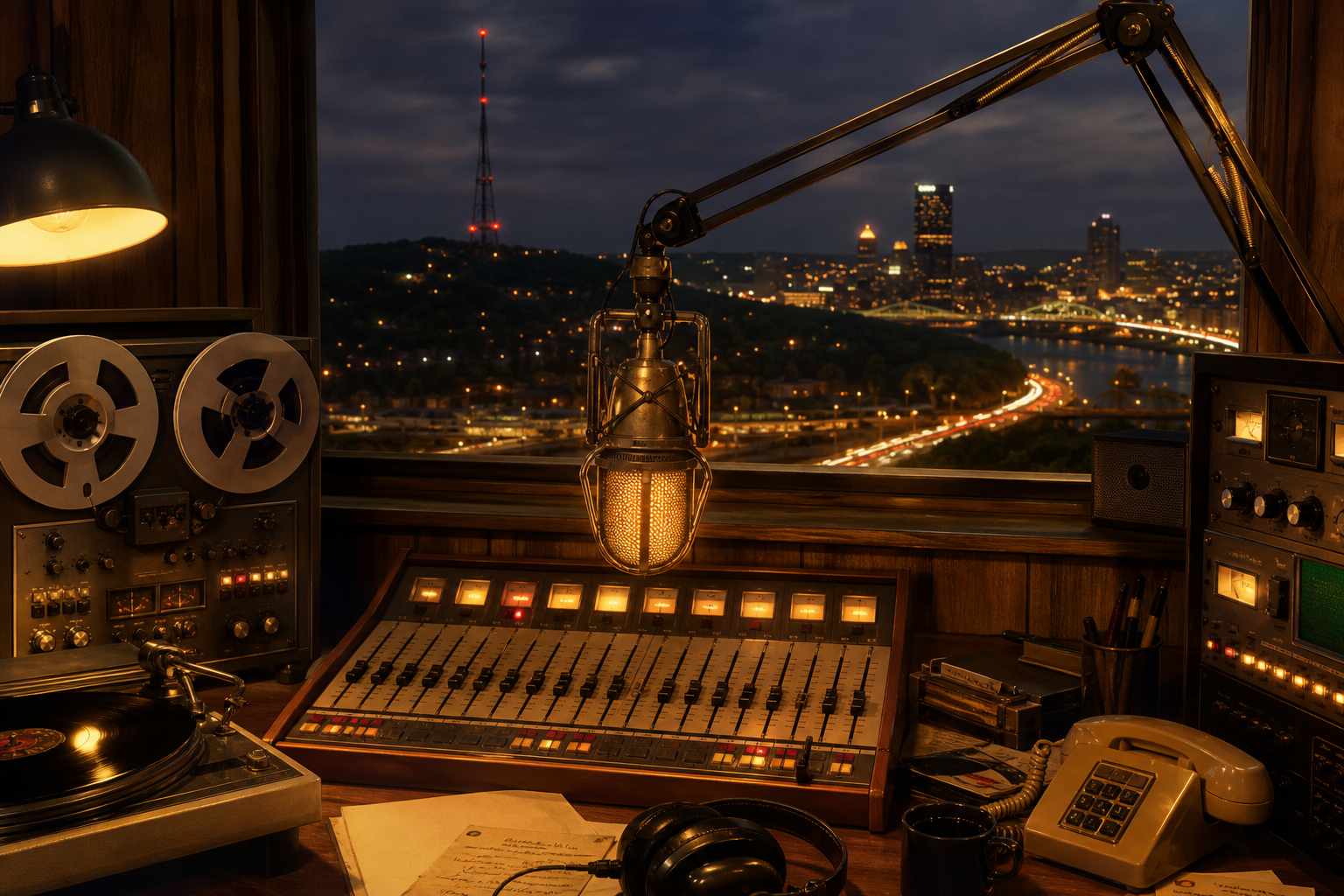
On a Pittsburgh workday, the story of rock radio has always started with a signal moving across hills, rivers, bridges, and industrial neighborhoods. For generations, that signal was 102.5 FM. Before it became WDVE, the frequency was KQV-FM. By the early 1970s, it had turned into something much more important than a place to hear records: it became a shared Pittsburgh voice.
That voice was deep, slightly rough around the edges, and comfortable with both a guitar solo and a bad joke. It could sound big enough for the Civic Arena and familiar enough for somebody parked on a side street in Green Tree. WDVE helped establish the idea that Pittsburgh rock radio did not have to imitate New York, Cleveland, or Philadelphia. It could build its own habits, its own personalities, and eventually its own definition of what counted as a hometown record.
From KQV-FM to WDVE
The station’s transformation came during a larger shift in American radio. In 1969, KQV-FM was part of ABC’s short-lived “Love” network, an automated format distributed to several FM stations. That experiment did not last. As the network faded, the Pittsburgh frequency moved toward live, locally programmed album rock. Around 1970, it adopted the call letters WDVE, and by 1971 the station was operating in the emerging album-oriented-rock style.
That format changed what a radio station could do. AM radio, including Pittsburgh powerhouse KQV, was built around hit singles, tight rotations, and fast-moving personalities. FM offered more room. A station could play deeper album cuts, let a song breathe, and treat an LP as a world rather than a container for one hit. WDVE arrived at exactly the right moment, when young listeners were buying albums, FM receivers were spreading, and rock musicians were making records designed to be heard from beginning to end.
For Pittsburgh listeners, that meant hearing Led Zeppelin, the Allman Brothers Band, the Rolling Stones, and other major rock acts in a setting that felt less like a national relay and more like a local clubhouse. The station’s identity came from the combination: ambitious music, familiar voices, and a sense that the people behind the microphone understood the region listening back.
The sound became local
WDVE’s most important Pittsburgh contribution was not simply exposing listeners to national rock. It was proving that local musicians could belong in the same conversation. The station inherited a tradition from earlier Pittsburgh radio figures such as Porky Chedwick and Mad Mike, who had used AM radio to connect local audiences with new sounds. As KDKA and other AM outlets moved away from music, WDVE increasingly occupied the space where regional rock could find a larger audience.
The clearest example arrived in the late 1970s. Program director John McGhan added the Iron City Houserockers’ “Hideaway” to the playlist in 1979. That decision helped turn Joe Grushecky’s band from a strong local act into a citywide institution. The song’s presence on WDVE mattered because it changed the listener’s sense of scale. A band from Pittsburgh could be heard while somebody was driving through the Fort Pitt Tunnel, working a shift in the Mon Valley, or getting ready for a show downtown. Local music was no longer only something found at a club or record store. It could arrive through the same speakers as the national stars.
That opening also benefited acts including Donnie Iris and the Cruisers, the Silencers, the Granatis, and the B.E. Taylor Group. Pittsburgh’s rock identity was never one sound, exactly. It included bar-band grit, pop craft, hard rock, soul, humor, and a particular affection for a chorus that could fill a room. WDVE made those differences feel connected.
The surviving artifacts tell the story. The Carnegie Library of Pittsburgh holds a 1980 album titled “WDVE Pittsburgh Rocks,” a reminder that the station’s brand had become part of the local music economy. A station could now package, promote, and archive a version of Pittsburgh rock for listeners who wanted proof that the scene was real.
Jimmy, Steve, and the personality of the city
Music built WDVE’s foundation, but personalities made it intimate. Jimmy Roach and Steve Hansen became central to the station’s identity after joining forces in the early 1980s. Their morning show mixed comedy, conversation, and local music promotion at a time when Pittsburgh radio was searching for a new kind of morning companion.
Roach brought a famously deep voice and a relaxed delivery. Hansen added a different energy. Together, they made the studio feel less like a control room and more like two sharp friends arguing across the kitchen table. Their show gave local musicians a place in the daily routine, not just a late-night specialty slot. It also helped establish a Pittsburgh radio style that valued personality without requiring polish: quick timing, regional references, working-class humor, and the confidence to let a joke land in its own accent.
That approach connected WDVE to specific Pittsburgh spaces. The station could sound at home in the South Hills, along the Parkway West, near the old studios in Green Tree, or outside a show at the Stanley Theater. It belonged to commuters, construction crews, bartenders, students, musicians, and Steelers fans. The geography mattered because Pittsburgh is a city of separated neighborhoods and difficult roads. Radio crossed those separations before streaming, social media, and smartphones gave everyone an individual music feed.
When “local” became part of the brand
WDVE’s relationship with local music was not always consistent. After McGhan’s period, corporate programming priorities and debates over what rock radio should sound like sometimes narrowed the lane. Station staffers had to argue for hometown records, and local support could depend heavily on who held the programming job. That tension is part of the real history: “local radio” was never automatic. It was made by people willing to spend airtime on artists who did not yet have national numbers behind them.
By the late 1980s, WDVE was again emphasizing a more mature rock identity, moving away from some of the heavy-metal material that had defined parts of the decade and renewing attention to Pittsburgh artists. The station’s long-running local-music efforts, including later “Homegrown” programming, kept the idea alive that a commercial rock station could still act as a regional gatekeeper.
This is also why Pittsburgh’s rock-radio history cannot be reduced to one station. WYDD in New Kensington, WAMO, KQV, KDKA, and eventually WXDX-FM each occupied different parts of the musical landscape. WYEP would create another model for independent and community-minded programming. But WDVE was the station that most clearly fused album rock, comedy, local pride, and mass reach. It made a particular kind of Pittsburgh listening experience feel normal.
A familiar signal, a changing city
WDVE eventually became closely associated with Steelers coverage, strengthening its place in the region’s everyday calendar. Football, rock radio, and Pittsburgh identity began sharing the same frequency. The station’s audience could hear a classic-rock staple in the morning, a Steelers segment later in the day, and a familiar personality tying the pieces together. That blend was not accidental. It reflected how Pittsburgh culture often works: music, sports, labor history, neighborhood loyalty, and humor are rarely kept in separate rooms.
The physical station has changed, too. WDVE moved from its longtime Parkway West-area home to new facilities in South Fayette, while the old building and its sign became part of the visual memory of the route. The address changed; the association did not. For many listeners, “DVE” still means the sound of a particular drive, a particular decade, or a particular person in the passenger seat.
RadioPGH is interested in that same connection between signal and place. Our story about What Pittsburgh Sounded Like in 1985 looks at the broader listening world around the city, while the About RadioPGH page explains why an independent Pittsburgh station keeps making room for local context.
WDVE’s history is ultimately the history of a city deciding what its own rock radio should be. It began with a national FM experiment, found its footing in album-oriented rock, and became unmistakably Pittsburgh when local voices and local records entered the picture. The station’s legacy is not only the songs it played. It is the expectation that radio should sound like somewhere.
That expectation still guides RadioPGH. From the archives of 102.5 to the newest bands coming through Pittsburgh rooms, listening remains a way of locating yourself. Listen Live and hear what Pittsburgh sounds like now.
The Revolution Is Live
You found the story. Now hear the station — independent Pittsburgh radio, live 24/7.
More from the Republic.

Meet RadioPGH.
Stay Tuned to Pittsburgh
New local music, RadioPGH stories, station updates, shows and events—straight to your inbox.